 Consult with
 Sock Doc Workshops
 In today’s endurance world, covering longer distances has become the new and expected normal. Gone are the days when racing a fast 5K or 10K meant something and we’re even starting to lose the concept that running one marathon is a big deal. Yet much like triathletes feel it’s imperative to race an Ironman as soon as possible regardless of one’s current fitness level, trail runners are viewing ultras the same way – the more distance the better. But for most, more training and racing eventually leads to poor health and even lowered fitness levels.
More Isn’t Necessarily Better
How much is too much when it comes to training and especially racing? Well that depends on you – the individual – and what your body is capable of handing in regards to the stress demands you choose to put yourself through. As I’ve addressed in the Sock Doc Training Principles, the more frequent and the more intense your training, the more you need to rest and recover. For most competing in long distance events, such as marathons and ultras, recovery is going to be affected by the demands of everyday life. Most athletes have work, family, and other life responsibilities beyond training and racing. Simply put, if your only job isn’t to train and race, then you’re already at some disadvantage because your recovery (and training) time and energy are required elsewhere.
Many endurance athletes are Type-A personalities who excel in what they do outside of racing. They work long hours and have active families. These athletes are already stretched for time and energy resources, and they’re often lacking proper sleep and recovery. So when they add in more and more distance, it quickly can, and does, take its toll on the body.
How Much Distance Can a Body Handle?
Professional athletes are more likely able to handle longer distance events more often than amateur athletes. The time commitment to properly train for these events is huge. Unfortunately, many athletes today do not put in the necessary time needed to train adequately for these events; yes that includes recovery. Running a couple short distances during the week and logging in some massive miles over the weekend doesn’t teach your body to adapt properly to cover distances in a safe, efficient, or fast manner. At best you’ll get fit quick enough to race the distance while most likely having to deal with some nagging health and injury-related problems along the way, or soon thereafter.
I’ve been in the endurance racing scene since the early 1990s. Back then, (and sorry if I sound like your reminiscing grandpa), there weren’t marathons or ultra-distance events every weekend, or even every month. You trained for the one big long distance event of the year, and for many that was a race lasting a few hours. In my opinion, I don’t think it’s just a coincidence that during that era we saw athletes such as Mark Allen and Paula Newby-Fraser win the Ironman World Championship multiple times (six and eight respectively). They weren’t racing big events throughout the year as athletes are doing today, and part of the reason they weren’t was because those events just weren’t available. But now these events are, and with the increased amount of endurance events we are seeing more athletes racing more often and ultimately they inevitably break down and their careers end way sooner than anticipated. You can only race so fast, so often, for so long. So next time you think you’re not performing well because of “old age” perhaps consider you’re not training properly, and that could mean you’re just training and racing way too much.
Humans Evolved to Run, Not Race
I’m all for endurance racing, but I’m more for training properly and racing to the point where your health doesn’t suffer permanently. I say permanently because running these types of races too often can result in permanent injuries and health problems. Yes, being outside and active for long periods of time often is very healthy, not just for your body but for your mind too. But when you ramp it up to the point of trying to get from point A to point B at a pace above a certain threshold, (defined by each individual’s fitness level), then you’re inversely affecting your health. Many athletes are training improperly to the point where they are chronically affecting their health in a negative way with more and more training.
If we look back to how humans are thought to have developed as persistence hunters, we see that our hunter-gather ancestors didn’t just run hard for hours upon hours to track down their food. They tracked their food at a slow, aerobic, fat-burning pace rather than pushing their bodies hard for prolonged periods. Now sure I’ll entertain the idea that there were some stellar human athletes back then, (probably more than there are today), and they could perhaps comfortably cover ten miles of harsh terrain in an hour or so. But just like the small handful of elites today, they are just that – the minority. Humans aren’t evolving in the same linear fashion to run these longer distances faster and more often. I’ve discussed previously that for elite marathoners running a sub 2:30 they are most likely creating less damaging stress on their body than the average amateur running a four to five-hour race. It’s all about how efficient you are and how quickly your body breaks, (or doesn’t break), down.
Breaking Down Your Body

Sock Doc broken in his first ultra due to dehydration.
Everybody has their breaking point in a race. If you’re healthy and you trained properly and follow your race plan (pace and nutrition) then ideally you won’t break down until the very end of the race, if at all. I define this point of breaking down when your body no longer can keep up with the demand you are placing on it and muscle imbalances begin to occur. Your muscles will be affected by the stress placed on your nervous system which is constantly monitoring each and every system in your body – particularly your digestive, hormonal, and cardiovascular systems when it comes to racing.
How do you know when you’re starting to break down? It’s happening way before you bonk and even before you start to feel fatigued. Little signs such as misjudging a rock and almost tripping is a good way to tell you’re starting to falter. A tight muscle that comes out of nowhere – say in your calf or maybe a side stitch – more signs of your body fading. A change in your gait is also another huge sign of a broken athlete as gait is so closely influenced by glucose regulation, yet you might not realize this until you literally fall or see a photo of yourself and see an altered posture.
The problem with breaking down is not just a loss of performance but also impaired health. Oxidative damage (from excess free radicals), inflammation, and high levels of stress hormones (particularly cortisol), go hand-in-hand with racing hard (and for many training hard too). The more you train broken, and the longer you race broken, the more you run the risk of not just injury and illness but also other health problems, particularly immune system issues such as auto-immune diseases and yeah, even cancer.
Plan For the Big One
Yup, I threw out the Big C there in that last sentence because chronic stress will slowly but surely take its toll on your immune system. It may take years for you to realize the negative effects of training too hard, too often, and racing too long, too often, but it will eventually catch up with you if you don’t balance the intensity and duration with rest, recovery, and the adequate fitness necessary to train at these high levels.
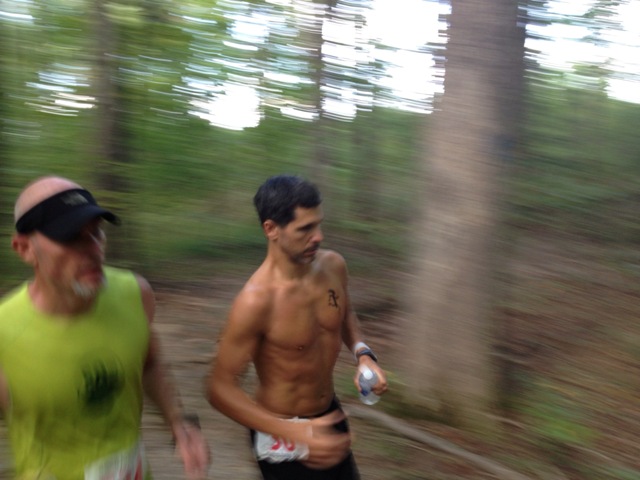
Thanks Fred Doss for getting me in under 7 hours!
If you want to safely participate in long-distance events then you have to put in the time and effort to build stellar aerobic endurance. The longer you train and race in a fat-burning mode the less likely you are to break down resulting in better performance. Once you build your aerobic fitness, (which can take years for most people), then you can add more and more distance, to a certain extent, to take your fitness to the next level without compromising health.
Don’t get sucked into racing such long distances so often, especially early on if you’re new to the sport. Ultras require a high level of fitness as well as mental stamina which takes significant time to develop. Personally, I think that one race a year over 50K is more than most can safely handle, yet we hear of so many doing multiple centuries. Ain’t nothing wrong with going shorter. Speed and strength are healthy attributes every human should have to some degree, let’s not forget that.
There’s more to this game than just being effective (covering the distance and finishing). You want to be an efficient human athlete which means you can cover the distance in a manner where you can still function the next day and next week and you’re better for it all around – mentally and physically.
Dr. Stephen Gangemi "Sock Doc"

I'm a board-certified chiropractic physician and clinical nutritionist with a passion for true natural health care. I implement dietary & nutritional therapies, exercise & movement practices, and lifestyle changes along with manual therapy techniques to help the body heal and prevent illness and injuries.
David W says
A great article again Dr G. I am glad you put in the part that building the aerobic engine can take years. I have been frustrated from seeing reports of folks who drop from a 9 min pace at MAF down to sub 7 min pace in 5 months. For some of us not gifted, me especially, this takes a very long time but improvement will happen IF you spend most of your time training aerobically. I like the fact that my heart and aerobic system acts as a natural regulator to tell me that I really shouldn’t be running this fast because I am not ready for it. And every single time I ignore it and get impatient, the injuries come right along to slow me down. Someday , and maybe it is in the book, I hope you will share with us more success stories of folks like my self who are slow gainers but make great progress over a long time in aerobic development.
Whether it is 100 miles or a 10k going too fast before the aerobic engine is built is a problem in the making for most of us!
Thanks Dr G.
André Cruz says
Uauuu,
I´m learning too much with you and Phil´s book.
Tks for sharing.
But, how would you train for a marathon or a ultra?
What would you do? How many miles por week?
During the race, would you use a HRM and run all of the race using the aerobic system?
Tks
Sock Doc says
Sorry, this isn’t the place to talk about a training program and I don’t subscribe to a “one size fits all” program anyway. Plus, mileage changes during the course of the training. I topped my miles out in the upper 50s training for the 50K.
David says
Ultra’s tend to take care of runners one way or another with regard to training, recovering, and diet… most of the topics you discuss. If you don’t practice proper nutrition combined with proper recovery, you won’t be healthy enough to mentally or physically handle multiple 50+ mile races, or even the tougher training between races. I just came off a year with 3 50 mile races and Leadville with the 50’s used as steps to get to Leadville. I’m running New York in a couple weeks and have enjoyed the 5ks, 10ks, and 1/2s the last 5-6 weeks getting ready for New York. It’s a nice change of pace to employ speed work again and run the shorter races hard. However, I had to be careful coming out of Leadville, making sure I was recovered before I could handle the stress of speed.
Bonking… there are so many issues involved with trying to adhere to a nutrition plan. I know I can recover in a race if I miss my nutrition plan, but absolutely cannot miss hydration and electrolytes.
Wolfgang says
Great article, as usual Doc !
Makes the day in the office so much better 🙂
I totally agree with all you´re saying in this article. So many great athletes I knew who had 2 or 3 good years winning a lot of races before burning out. Maybe quit the sport at all or never could return to the former heights. Me, I´m doing one big ultra per year and seems something must be fine with this formular, age 42 I´m still (since 11 years) member of the Austrian National Team (and began my competitive career with 12).
Not topic of this article but I hope you find the time to reply, the more experienced I become the less shoe I wear. Last year I was out with one of Inov-8´s minimal shoes, since a couple of weeks I use the Merrell Trail Glove exclusively. Now the Inov-8 seems to be quite heavy and “much shoe”, do you believe it´s possible to run (and be competitive) with such little shoe like the Merrell or a Vivo ?
Best wishes
Wolfgang
Sock Doc says
Thanks Wolfgang. And yes – the less shoe the better in my opinion as long as you’re able to handle it. I wear Inov-8s 150s on the trail and the 138s on the road – I don’t think you can get too much more minimal than those. And the lighter the shoe the less you have to carry; less weight = faster legs.
Dan W. says
How do you feel about the trade-off with foot protection? I run on some pretty sharp rocky trails (volcanic stuff) and even when picking my way gingerly in minimalist shoes, it’s a bit much – I found the Saucony Exodus to be a good shoe – aggressive tread and rock plate, but only a 4mm drop. I still run other softer trails (pine needle singletrack) in more minimal shoes with the same or less drop, so I don’t feel like I’m compromising my foot strength or standard gait too much..
Sock Doc says
This is the topic of an upcoming post but in brief, I think those Saucony shoes are shit and I would never wear them. They’re far from minimalist. We need to get out of this “but they’re only 4mm drop so they’re minimalist” crap. (Nothing personal! :))
Wolfgang says
Thank you Doc !
What´s good enough for you is certainly good for me, just ordered a pair of Inov-8´s 150s & 138s each 🙂
Sock Doc says
Get em’ before they’re gone. My next article will discuss the industry of minimalism going in the wrong direction.
Walls says
Great article. Very valuable thoughts. I have my first Ultra planned for June next year Mont Blanc! 80K! Gulp! Really looking forward to it and v nervous at the same time. Will make sure I take heed of the warning signs mentioned above and train aerobically all the way. Will do a few shorter training ultras before then to get ready. Big challenge! Wish me luck!
Dennis says
Thanks for this. Especially the last paragraph.
Dan W. says
So then, if someone has developed an aerobic base and consistently stays within that level of exertion, aren’t they like the persistence hunters who spend time at their long slow distance? My trail running involves mostly lower-level aerobic rates mixed with power-hiking and some bouts of high-intensity when there’s a steep hill. My body seems to be comfortable with 3+ hours once or twice a week as long as I’m getting good sleep and eating enough. I’m set to “run” a trail marathon in less than two weeks; but that run will be a mix of jogging and walking – and yes, it’s going to be a challenge, but I’m not planning to peg at my AT and try to stick there for 26.2 miles the way many casual road marathoners or competitive ultra-runners do…I’m out there to enjoy the scenery, camaraderie, etc. Doesn’t this seem like a reasonable distinction between doing chronic mid-to-high-intensity long-distance endurance and doing lower-intensity long-distance endurance? So maybe Ultra’s are more “healthy” than 13.1 and 26.2 road races when done “right”?
Side note: 5K and 10K are probably where it’s at for most as they seem to be a good pair with strength-training, moderate endurance volume (20-30 mpw), and relatively short (but intense) aerobic work…my only hesitation there is that some people probably do constant high-intensity 5Ks and 10Ks that are probably quite damaging if they aren’t building an aerobic base to support it.
Sock Doc says
Lots of good points here Dan. Yeah, I’m all in agreement for going out on an aerobic “hike” or easy run for hours and hours. That’s a great thing to do and people should be able to do this, (though most can’t at least w/o sugar or exhausting themselves). And it’s okay for most to run a hard race too at such a distance, just not too often. So if someone is really doing a chilled-out Ultra as compared to a hard 13.1 then yes you could say that is better, as long as they’re properly trained.
And yes, you can definitely push the 5Ks and especially the 10K races too much and create some injuries and health issues.
Sauerkraut says
I definitely find the ultras much less stressful than a marathon or a half. For the shorter distances, I always have a target time, and run them as fast as I can. For ultras – especially since they’re usually cross country – it’s just about enjoying it and finishing. So walk up the hills, run at an enjoyable pace, and take in the scenery. I can go much longer without food these days, too, since going fairly consistently LCHF in my diet.
Worst recovery in a recent race was a 5K – but I did push hard and considerably improved my PB.
Scotty Kummer says
Great article. I’m convinced I have raced enough this year and I need some time off!
Dave says
Great words Doc.Gangemi,thanks for this finally one voice of normaliity,,this world of racing became so demanding for “normal” runners with family and work obligations!
Sue D says
Thanks for this common sense reminder. I’ve been listening to your talks on trailrunnernation; I’m a barefoot runner who goes about 17 miles but not much longer. The long, slow approach to building aerobic base resonates with me, and it’s what I’ve been shifting my practice towards anyway, as high intensity runs tend to spark migraines for me. I also tried HiIT last winter and found it left me prone to injury and did nothing to relieve stress, as running long seems to do.
I don’t race much, but I am thinking of training to run a 50K next May. It is not a high-pressure race. I’ve hiked the Appalachians for long stretches at a time and have run a few trails there too. So I think it’s possible for me to do.
Since I know how diet can change one’s health (migraines reduced by over 90% simply following a whole foods approach, no gluten), I’m looking to eating healthier as a way to boost my aerobic base as well. I wasn’t sure if I was on the right track with all this until I started listening to you on the podcasts. Now I have a guide. Thanks!!
Trev says
Hi Soc Doc I have a quick question. I am a teen with gynocomastia and it sorta sucks. Any way I am really healthy and eat Paleo and do gymnastics and move a lot. I have heard of foods that lower estrogen which I presume is my problem. Do you know of any food that does this? Can you recommend anything else? thanks for the help!
Sock Doc says
I don’t know of specific foods but nutrients – and there are several that help detox estrogen, most common are B6 and folate. Now the herb rosemary does help detox extrahepatic estrogen (that’s the estrogen in your fat tissue); you could give that a shot. This is the company/product I give to my patients: http://supremenutritionproducts.com/RosemarySupreme/index.html
Brandon says
Very informative site! I’ve really learned a lot about running & training but I would like to know how to apply the information in this article to Basketball. I know this site has a lot of great tips on running marathons & long distances but I would love to know/read more on the benefits in regards to Basketball. I will be playing Basketball overseas or possibly in the NBA developmental league next year. Even though Basketball isn’t a distance running sport per se, we are constantly running & at different speeds. It can get very easy to overtrain trying to incorportate weights, plyometrics & conditioning in with becoming a better Basketball player skill-wise on the court. Looking forward to future posts!
Sock Doc says
Check out the Sock Doc Training Principles to start; it all applied to basketball as you need a high level of aerobic endurance in that sport.
Dan says
Thanks for the reply – my trail 26.2 went well enough, but with the 6,000ft altitude, I fell short on my aerobic capacity and definitely need to keep training it.. I didn’t overcook myself though, and two days later am ready to get back to training.
On shoes – my biggest problem is I need size 15 – and hardly anyone makes that size, so I’m a little stuck with what I can source.
I will be interested to read your next article – especially if you talk about foot protection for rocky/rooty trails…