 Consult with
 Sock Doc Workshops
Conditioning your body to burn fat involves more than just training properly. Fat metabolism relies on a low stress lifestyle as well as a diet that promotes fat-for-fuel. I won’t go into proper training here – that’s been done over at the Sock Doc Training Principles and other areas on this site. I could also talk in great lengths about how to lower stress so you’re not pumping out a lot of stress hormones (primarily cortisol) throughout the day and burning more glucose than what you should be, but I won’t – because it’s so individualized and in a way it’s common sense, though admittedly easier said than done.
If you are dealing with a lot of stress whether it’s your work, family, finances, or other, you’ve got to do what you can do to deal with these stresses before they wreck your health, if they haven’t already. As I say to my patients, “Fix what you can fix.” This means that if you can’t fix a lifestyle situation right now for whatever reason, then do your best to modify it as best as you can. But you can always change your exercise habits and you can always change your diet. There’s really no excuse unless you’re in prison; well maybe some of you have other scenarios too, but you get my point. Let’s learn how to eat properly to burn more fat rather than sugar. Note: This is sort of “Part II” of many parts in the Sock Doc discussion of “Carbohydrates: Evil or Essential?”. Check out Part I here.
Eat Fat to Burn Fat
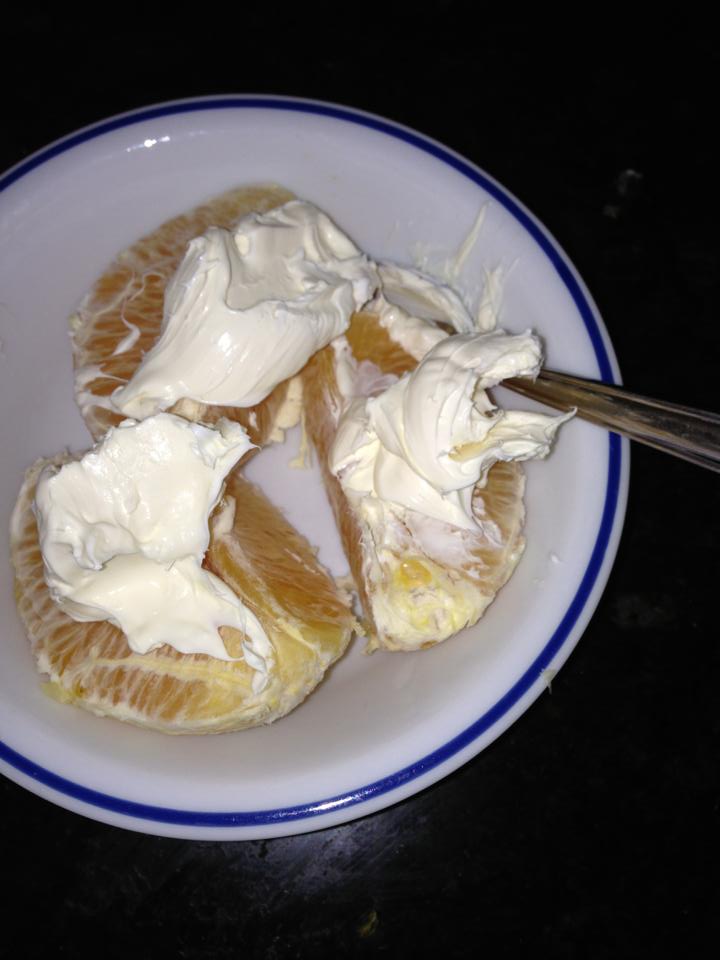
I put oranges on my clotted cream.
Diet is a huge factor when it comes to your body becoming aerobically efficient and burning fat for fuel. Even if you could care less about endurance training or racing you should still be concerned with aerobic metabolism – it makes you a mentally and physically efficient human being. So with all the information out there – what do you eat, when do you eat, and how much do you eat?
First, I’ll start by saying you ultimately have to see what works for you, but there are definite things you should be doing, and plenty of things you should not be doing. But next I’ll say that if you think your diet is working for you, don’t assume that it can’t be improved. You have to experiment and get out of your comfort zone some to see if you can feel better and perform better by tweaking your diet even more. In a way, your diet is always a work in progress, but that doesn’t mean you chase down what you think is the latest-and-greatest diet in the news this month.
A diet lower in carbs and higher in fats fuels a healthy aerobic metabolism and keeps your glycogen in your muscles for when you want to train hard, train long duration, lift heavy, or do all three. This type of diet also keeps your brain functioning well as the brain runs off of glucose, (ketones too which will be discussed later), and you should have plenty stored in your liver and circulating in your blood to provide adequate sugar. So how much fat should you be eating in your diet – 50%, 60% – 70% – or more (or less)? The answer depends on your body but I’ll say that you should shoot for the higher end and you should eventually, over time, be able to function on much more fat in your diet than carbohydrates.
I’ll use me as an example. I used to eat a diet consisting roughly 50% of fat, 20% protein, and 30% carbohydrates. When I would train over two hours, I had to eat something such as some gel packs, (like GU), or an energy drink. During a race over 90 minutes I’d always consume some carbs – I had to. Eventually I increased my fats to 60-70% of my diet, and now I can easily run three hours, (aerobically of course,) with no food and no fluid (including water unless it’s really hot out). In a race I won’t consume any carbs unless it’s over two hours. I don’t need them like I used to and not only am I a stronger athlete, but I’m healthier too. For example, my cholesterol is so much improved, which you can read about here.
Stop Snacking!
Another major change I made in my diet just over the past couple years is I have, for the most part, stopped snacking between meals unless I’m training hard. Like most physicians, I was taught one way and eventually learned that the way I was taught was wrong. Unfortunately this occurs all too often in the professional education system. Believe it or not, I’m humble enough to know when the advice I was giving to patients wasn’t the best advice, as now I think otherwise. So now I recommend that my patients do not snack, unless they are exercising to the point where it is advised, (that’s long duration or high intensity), and they only eat three or four meals a day. Snacking creates habitually high blood sugar levels; it never corrects the problem. This is why people with “low blood sugar” always have blood sugar issues – they will never resolve the problem. If you go around all day snacking on carrot sticks, fruit, crackers, and other carbohydrate foods, you’re giving yourself sugar all day long. So eat three to four meals a day with a lot of fat, and adequate protein.
If you focus on eating fat, (that’s grass fed meats, fish, eggs, butter, cheese, cream, nuts, seeds, olive oil, coconut milk & oil, chocolate, avocado), and take note of the protein then you’re left with carbohydrate foods. How much protein should an athlete consume? A good rule is to take in around 1.5 grams of protein per kilogram of bodyweight. So if you’re 150 pounds (roughly 70 kg) then you need around 100-105 grams of protein a day. That’s only 400 calories, so for an active person who might need a minimum of 2,000 calories a day, it’s only 25% of the total caloric intake.
Starting making some of these changes in your diet now. If your diet is roughly 50% fat, don’t just jump to 70% tomorrow. Gradually increase it and see how you feel. Switch your whole milk in your coffee to heavy cream. Dump olive oil on your salad. Use butter on everything and coconut milk more often. Eat more grass-fed beef rather than chicken. Enjoy!
Dr. Stephen Gangemi "Sock Doc"

I'm a board-certified chiropractic physician and clinical nutritionist with a passion for true natural health care. I implement dietary & nutritional therapies, exercise & movement practices, and lifestyle changes along with manual therapy techniques to help the body heal and prevent illness and injuries.
Wendy says
Hi Dr. Gangemi, Thanks for all the teaching you provide.
When you say “coconut milk,” are you talking about canned, or the kind that comes in a carton?
For awhile I was drinking the coconut and almond milks sold in the dairy section and enjoying them, but then I noticed that they have inorganic calcium added. I’ve seen recent information suggesting that might not be a good thing.
http://www.sciencebasedmedicine.org/index.php/calcium-supplements-and-heart-attacks-more-data-more-questions/
What are your thoughts on this issue?
Sock Doc says
I use THAI Kitchen organic coconut milk. It just has guar gum added to it.
Pau says
Hi Steve!
I have two questions:
Could you tell me some examples of high-fat breakfasts?
How do you eat the olive oil, avocado, butter… without bread? Or you eat it with bread?
Thanks! This is really interesting! where did you learned so? hehehe that’s the third question! Sorry!!
You are great
PD: Sorry for my english
Sock Doc says
Eggs, bacon. Fruit with heavy cream (or clotted cream). Smoothie with heavy cream and coconut milk.
I don’t eat bread – rarely, anyway.
Where do I learn these things? I little bit everywhere and then I see if it applies in practice with patients – that’s how I know what works and what doesn’t.
Ivan Bruno Hostil says
At last a clear text on Low-carb High-fat dieting.
Now that I’ve been eating out more than I’m used to and I’ll keep doing it for at least the next couple of months, I’ll try my best. I’m training hard, sessions varying from 5 to 10 miles, four times a week including shots, strength and, of course, weight lifting at the gym the days that are left. How much do you think should be the proportion Fat, Carbs and Protein in my meals a day?
Sock Doc says
That you have to figure out for yourself! (that’s the message of the article) 🙂
Christobel Ng says
A few curiosity questions :
1. How long does it take for you to transit to 60-70% fat ?
2. Just curious what is your daily meal like with training ?
3. Training for 3 hrs without gul or water… does it comes naturally as one increase fat intake ?
4. Recovery carbs.. do you take or no ? And what type of carbs would you take after a hard training or race
I have been trying to go low carb but gets hungry all the time and I know that I need to increase my fats in take.. still trying to figure this out. Hence interested to know your experience. I know that different people are different… but will be nice to hear
Christobel Ng says
And BTW.. great article.. been waiting for this
Sock Doc says
Hi Christobel – good questions and they will be answered either in a future article or in my upcoming book. The entire carb chapter already written is approx 19 pages long. I have posted 4 pages of this thus far. At most I will post half on here in the upcoming weeks.
Christobel Ng says
Thanks.. look forward to reading them !
Néstor says
Hi Dr. Steve, very interesting article!
when you say, for example, you eat 50% of fat, it refers to the total amount of grams or calories in your diet?
Sock Doc says
Yes.
jonnyt says
Great article, much appreciated.
Would this be dieting program influenced at all by the type of sport? Rowing aerobic sessions on the ergometers are rarely more than an hour and a half, and racing lasts only between 6 and 20 minutes. Is there a risk of not burning through all of the fat intake if the training isn’t suited? Sorry if this is a stupid question, but nutrition has never been a strong point of mine
Sock Doc says
It is not, just depends on how you train for it. Check out the Sock Doc Training Principles.
Coreyanne Armstrong says
Hahaha I like the “There’s really no excuse unless you’re in prison.” That gave me a chuckle – and of course, other random situations. Like being a midshipman at the Naval Academy or on a ship or…in boot camp…or particularly low income with very limited amounts of time. None of these apply to me (anymore – I was once a midshipman, and on a ship for many years), but I know there are SO MANY people out there with 1/10 of the money I have available for spending on groceries. I know you can’t do anything about it – but do you have any super-money-conscious advice to go along with this article? Thanks 🙂
Sock Doc says
I don’t sorry – other than grow your own food and get to know your local farmers (if you have them) very well.
Terri says
Would you recommend this same diet to someone who was, say, 100 pounds overweight?
Sock Doc says
Depends on the individual but I have a lot of times.
Kevin says
Is high cholesterol a concern, or do ealthy fats such as those you recommend not cause it?
Dr. Stephen Gangemi "Sock Doc" says
Healthy fats in your diet should not increase unhealthy cholesterol.
Jared Petrie says
Dear Dr. Sock Doc,
When it comes to dark chocolate, I enjoy a serving of Tazas 95 stone ground chocoate that has only four ingredients. I need to bulk up and wonder how much you would recommended that I have. I do the full serving, which is half a bar and has 250 calories. Also, I usually do my runs these day in a fat burning mode.
Dr. Stephen Gangemi "Sock Doc" says
I don’t think chocolate is something you should be eating every day, regardless of wanting to bulk up.
Anthon Petersen says
Some people with allergies also seems to have benefits like reduced symptoms when using a diet with low carb intake. But would this type of diet be possible if you are striving for a career in professional tennis or similar sports?
Dr. Stephen Gangemi "Sock Doc" says
It’s beneficial in all sports to various degrees – more for endurance/aerobic, less for speed/power/anaerobic.