 Consult with
 Sock Doc Workshops
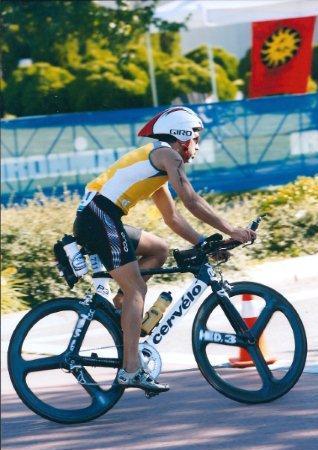 I often get asked, “How does the Sock Doc train?” – what heart rate, what duration, what intensity, etc… There’s so many different coaching ideas, perspectives, theories out there, sometimes it’s hard to sort through it all. Well, here’s the general run-down:
I do practice what I preach, but also realize that I have been training and racing competitively for 20 years now. I started racing duathlons (run-bike-run) when I was still in high school, then graduated to triathlon in my 20s mostly because the duathlons were phasing out and eventually became non-existent. I knew how to swim, but I had to learn how to swim faster so I could race. I’m now 37 years old and have completed 16 Ironman races, with a PR in Hawaii of 10:03. Click here for my 2011 racing calendar & results.
I bring up the very brief history because I have done the one thing that most people never do in their entire lifetime – I’ve built a really good aerobic base. I’ve put in the time where I’ve kept my heart rate in the “zone” to become very efficient at endurance racing. It didn’t take weeks or months, but years. That doesn’t mean I’ve only trained aerobically week after week, but I’ve taken periods of each year where training was entirely aerobic and other periods where it was less aerobic. I’ve overtrained enough in the past to learn when to change a heart rate program, or a training program for that matter. I’ve overtrained in the past by doing too much anaerobic activity > too much hard training and too much racing followed by not enough rest. But I’ve also overtrained by doing too much aerobic training, and this, as I’ve seen with treating people in the office, can mimic the same signs and symptoms as too much anaerobic work. Training is very individualized. It’s great to use a program or coach as a foundation, but it still needs to be adjusted for your ability, fitness level, health level, and lifestyle. Speaking of overtraining, I’m well aware that many use the term “over-reaching” now rather than overtraining – citing that most athletes over-reach but do not actually overtrain. Call it what you like – they’ve done too much and fitness and health are suffering. For now I’m stickin’ with the term overtraining.
Yes, I almost always wear a heart rate monitor. I’d say maybe a couple times a month I might not if I’m doing a very easy recovery workout, where I know my HR is going to be very low. Otherwise, whether I’m training by myself or with a group, I wear it, and I pay attention to it. I wear it often in races, but not all the time. I’d say almost always in Ironman and usually in Half IM races too or anything over a few hours. It’s the best way to know if I’m staying within my aerobic racing zone. Otherwise, I may be pushing too hard and will bonk before the end of the race, or maybe I’m not pushing it enough and need to pick up the pace. In any shorter race I don’t bother with the monitor because I’m going to be mostly anaerobic anyway.
The majority of my workouts are done within the 180-age formula. Since I am 37 and have been racing and training for some time now, I add 5. That puts me at 148, so my zone is essential in the 138-148 HR area. When I am in shape it is often very difficult for me to get my HR up to the higher 145+ level. I have to push myself. This is the one of the beautiful things about HR training and building your aerobic base, you become very efficient. I hear patients complain all the time that they can no longer run but have to walk because their heart rate is too high. Unfortunately, most don’t stick with the program. But when you do, you’ll eventually have to work at it to stay aerobic. So now when I go out for a run and I’m going along I often look at my watch and see I’m in the upper 130s or lower 140s and I have to pick up the pace a little bit to get my HR up into the upper aerobic zone.
When you are training for some time and looking to make the next leap in fitness gains, I feel you have to often stay in the upper end of the aerobic zone. This is one thing I don’t entirely agree with Dr. Phil Maffetone on. He notes that any activity in the aerobic zone or even below the zone will provide aerobic benefits. Although it will to some degree, you will reach a point of diminishing returns. You can’t go TOO easy TOO often. If my zone is 138-148 then I’m not going to keep building my aerobic development if I’m always hanging out in the 120s – that’s a recover heart rate – one to do after a race or hard workout. The other HR philosophy I tend to follow which Dr. Maffetone does not is the HR zone related to different activities. I follow the general rule of other coaches that if you’re on the bike, your zone is going to be 5-8 beats lower, and another 5-8 lower for swimming. Are you rowing, skiing, or horseback riding? That may even be specific to you too. The reason for my different view on this is because lactate levels are different with each activity – they’re higher in cycling and swimming than in running at the same heart rate. In other words, a 150 HR swimming is going to be a lot harder than running at 150.
So ideally, where is your zone? Or, better yet – where are your zones? First, let me say I truly believe the 180-age formula is the best all-around formula out there. I think many people, including myself, owe a lot to Dr. Maffetone for coming up with such an easy and essentially universal formula. Of course, like anything out there, it is not for everybody. But, in my experience, (and I have a lot personally and professionally), and as mentioned before, most people think they are the exception to the formula – “How can I possibly train this easily at such a low heart rate and accomplish anything?” But for most, the 180-age formula is all they need. That’s it. Let’s face it, most people want to do one thing – lose weight. And I’ll add they also don’t want to get injured and they want to be healthier too. Most only exercise a few times a week and some maybe up to five times a week. Most people are very inconsistent though. They may put in a week or two where they worked out 4-5 times then they have a couple weeks of 1-2 or zero workouts. So again, they never build their aerobic base. Consistency is so important. Even if you are one of these people and want to do a race, which I think is great, then you still need to stick with the 180-age formula until it doesn’t work for you anymore.
That brings up the next point – when does the 180-age formula no longer work for you? Well the answer is that it is really ALWAYS working to some degree, but sometimes you have to mix it up and do other things – such as train harder, or perhaps easier. If you use the Maximum Aerobic Fitness (MAF) test that Phil talks about, this is one way to know when it’s time to move on. You’re essentially charting your progress over some distance and if you’re improving, then you should be covering more distance (going faster) in the same time at the same heart rate (or the same distance at a faster time with the same HR). I use a hilly 8.6 mile loop from my house for my MAF test. Typically, I’m in the 145-146 average HR and running it in 1:02-1:03. When I’m stuck there for a while, I add in more shorter anaerobic workouts. In a real-life situation, you most likely will not progress week after week. Some will be better than others. But if you’ve gone a few weeks and there is no progress, and you’ve been consistent, and you’re feeling sluggish and tired of working out, it may be time to do one of two things – either push harder to ease-up. Wow, this just got complicated.
First, take note of two things I just mentioned. One was the consistency issue. If you’re not consistent in the workouts, then don’t expect any major improvements in your MAF. Second, you may be tired and burnt-out because you’re sick (or about to get sick) or you’re under too much anaerobic stress elsewhere. I talked about this in “My Perspective” in Maffetone’s The Big Book of Endurance Training and Racing. If your diet is bad – high in sugars, bad fats, caffeine, etc, and if you’re under a lot of stress, then essentially a lot of your life is anaerobic and that could be making it difficult to make any aerobic progress. Regardless of the heart rate, if you consume things like too much sugar and caffeine, you’ll be less aerobic (less fat burning) than if you did not consume those foods.
Ok, let’s say you’ve decided that you’re under a lot of stress and not feeling great, maybe getting sick or your body is aching and/or you feel an injury coming on. That would tell you to back off on the aerobic workouts some. So either less duration, less frequency, or maybe you just need some time off – a few days or a week. Stick to walking. But if you feel that the aerobic workouts have just gone stale and you’re no longer making gains in your MAF test (but you have in the past), and you’re feeling good and healthy, then it’s time to get moving on to some more anaerobic activity.
There are many different types of anaerobic activity. If you’re a runner you could do some hill workouts or some sprints. You could do a 5K or 10K race too. When you add in anaerobic workouts, you’re looking to get your HR up well over your 180-age max. For me, I’m shooting for the upper 160s low 170s if I’m doing some 60-90 second hill repeats, or the mid low to mid 160s if I’m out for a hard run, say for 30 minutes. Initially, if you’re new to this and just staring some anaerobic workouts, all you need to do is some quick 20-30 second sprints while you’re out running. Run as fast as you can for 3-4 of them. Your HR won’t respond as quickly so it’s tough to go by that. It’s great to do them on a slight decline too (going down-hill). A couple important notes to mention here. First, never do more than three anaerobic workouts in one week. Second, never more than 5-6 weeks of anaerobic activity in a “block”, then you take a rest – back to aerobic. I’ll add one more – the day after these anaerobic workouts you should be doing an easy aerobic workout, or taking the day off. So if you choose to do some sprints on Mon-Wed-Fri, then perhaps Tues and Thrs and Sat are very easy low HR workouts for 30-40 minutes, with Wed and Sunday off. Again, the specifics are different for everybody, this is just an example. Also check out my Paleo-plyometic workouts used to develop speed, power, and balance.
Okay, enough about you – back to me. Haha. As initially mentioned, I am mostly training in the 180-age zone but depending on the time of the year, I modify this somewhat. I like to use the zone training found over at Joe Friel’s site TrainingPeaks and I also discuss that here. To use the zone formula there you need to know your lactate threshold (LT). Yes, I know mine. It is around 173 for the run and 167 for the bike. I’ve had it tested with a lactate meter and gas analyzer too. (I tend to agree with Friel and others that your LT is going to be lower for cycling than running, and even lower for swimming. Maffetone does not agree with this.) Now, putting my LT in the formulas on that site, my Zone 2 (aerobic zone) comes out 147-157. Yes, that is a bit high for my aerobic training zone. I am typically lower than that, but as I get closer to my race season I will bump up my shorter (30-60 min) workouts to this zone, so essentially I am breaking the 180-age rule here. But my longer workouts are still in the upper 130s and the lower 140s. The formula breaks the HR training now into 5 zones:
1 – Recovery
2- Aerobic
3- High Aerobic
4- Tempo/anaerobic
5- High anaerobic above LT
However, I actually focus on 3 zones.
ZONE 1 – RECOVERY – heart rate under 140 for long runs and easy workouts- recovery days
ZONE 2 – AEROBIC – 140-155 HR, depending on the time of year and the workout. For example, I may go out for a 60 min run and keep it in the 145 HR range, or a 45 min run 150 area, or a 30 min run stay in the 140-150 but push 5minutes at 155 HR.
ZONE 3 – ANAEROBIC – this is my 160-175 range where I’m, well, very anaerobic. Short sprints, hill workouts, that sort of stuff done here.
Again, I’m doing different workouts at certain times of the year based off my racing schedule, my fitness level, and other factors too – how I feel, progress, stuff like that. It’s always good to note your PE – Perceived Exertion. If you’re aerobic and it feels hard – you can’t talk to your partner (or yourself) then you’re most likely anaerobic. If you’re in an anaerobic HR and it’s easy – well, you might need to go faster/harder. Pay attention to how you feel!
Every workout should have a plan. This is very important to remember. Whether it’s a recovery day, easy day, hard day, long day, you can’t just haphazardly workout. Your workouts should be tailored to your overall goal. If you’re training for an Ironman or marathon, then there is very little, if any, need to do anaerobic work. Sure you’ll most likely be anaerobic towards the latter end of the race, but that doesn’t mean you need to train at those high HR levels. Races like that require a strong aerobic base. I think the current Ironman and half-marathon craze is well, crazy. Back when I started racing IM races in 1996 I had a good 5 years of racing under my belt, consisting of many Half-IM distance races. Today many people enter an IM race before they’ve even done any triathlon. The mentality out there is that if you haven’t done an IM, then you’re “not a real triathlete.” So people don’t care about breaking 2 hours in an Olympic distance race anymore. It’s considered more honorable if they drag themselves through a full IM in 15-17 hours. I don’t quite understand that. The same thing is happening with the half-marathon craze. Those races are booming. I know people who have never raced and just started a running program yet already signed up for a half in just a few short months. Why? So you can get the 13.1 sticker on your car? The problem with doing this is that these individuals don’t spend the time to build their aerobic base. They train too hard – at heart rates I can’t conceive. Professional marathoners might race at a 5:30 min/mile but a lot of their training is much, much slower – often at 7:30 or 8 min/mile, if not even slower. Their heart rates are very low. It’s so aerobic. Yet, the average new runner out there wants to do their half marathon at an 8 or 9 min/mile yet they train at an 8 or 9 min/mile or even faster. And it’s all very anaerobic to them. Now if they trained aerobically, which for many means only walking, there would be no problem here. But few, if any, do. They are in a time crunch. So they train hard, eat wrong, can’t sleep, and are too stressed out – they’re a disaster. I get to fix the injuries they create and all the anaerobic (health) problems they’re dealing with.
Building your aerobic base takes time. And when you have it you’ll love it because you won’t get injured, you won’t lose your fitness when you take a week off for a vacation – and you’ll feel good because you’re always burning fat and not running off sugar. Use the 180-age Formula, until you plateau and then tweak it so it works better for you. That could mean going faster, or slower. It’s okay to mix it up – actually you need to eventually mix it up – but the 180-age formula should always be your general foundation.
-Sock Doc
Dr. Stephen Gangemi "Sock Doc"

I'm a board-certified chiropractic physician and clinical nutritionist with a passion for true natural health care. I implement dietary & nutritional therapies, exercise & movement practices, and lifestyle changes along with manual therapy techniques to help the body heal and prevent illness and injuries.
Kyle Roberts says
I agree with you wholeheartedly, Dr. Steve. I have been following the Maffetone Method for 3-4 months and have never felt better! I can run for longer periods of time with no injuries. It helps that I have been working on my running form and efficiency as one of my main focuses, too. I can’t wait for the Green Bay Marathon in May to see the result of all my hard work running at this easier pace. Hopefully it will result in a faster marathon.
Love the new website!
KR
Sock Doc says
Thanks Kyle! Let us know how the race goes.
Tom Scott says
Question for you — I’m 63, 222 lbs., 5’11”, and even though I’m at least 30 lbs. overweight, I’m in fairly good shape. I have a Garmin 500, and using that, I calculate my max heart rate to be around 172. On my training rides, I will typically have at least 3 segments 5 minutes long where I’m averaging 163 to 168 bpm, and occasionally reach 170.
Is there any danger in this? Other than getting totally exhausted, that is.
Even with this training I’m having a hard time keeping up with some of the younger guys on the club rides. Of course, I realize losing another 20 lbs. (I’ve lost 50 already) would help a lot, too.
Sock Doc says
Hi Tom, that’s a pretty demanding HR. The only way you can really tell what you max HR is is to actually go as hard as you can and see where it maxes out. May be a good idea to do it under a stress test/physician EKG criteria in case you have a problem with it. But really, there is no reason to know what you max is because for HR training formulas, as I discuss, you don’t need to know your max HR. Either use the 180-age formula (for someone over 65 years old, up to 10 beats may need to be added), or figure out your LT as I discuss here. If you’re training with the club rides and having a hard time keeping up, you aren’t building your aerobic base and endurance, rather you’re pushing your anaerobic system too hard which will result in injury, illness, poor performance, sugar burning (rather than fat burning), and overall poor health.
patrick says
Hi Doc, It’s unclear to me whether you encourage both aerobic and anaerobic at the same time. For example can I go for 2 aerobic workouts + 2 anaerobics in the the same week ? Or should I be splitting between the 2 in separate blocks every 5 weeks? Thanks in advance! Great site and thanks for putting my achilles problem to rest!
ps – My training goals are boxing/kickboxing specific
Patrick
Montreal/Canada
Sock Doc says
Hi Patrick, nice to see a boxer/kickboxer on this site! First, I always encourage aerobic. You can never just perform solely anaerobic workouts, you’ll burn out too quickly. That often won’t happen if you’re just doing aerobic workouts (it can though), but if you always stay aerobic for months and years, you’ll never develop speed, power, strength. And for someone in a sport like boxing, you need to develop your anaerobic system – both the strength aspect as well as the anaerobic endurance (cardio aspect).
So this is all very individualized whether you’re currently training aerobically, aerobically with strength added, or some anaerobic. In the recent MovNat post & video (here) I show a workout that is aerobic (for me) with strength/power aspects added in. For someone not very fit, this would be a very anaerobic routine though, especially as the minutes trickle by.
If you’ve developed a good aerobic base and it’s time for you to add in some anaerobic work (other than strength) via intervals, speed work, etc. then yes, 2X a week is definitely fine, even 3 is okay. The following day (recovery) should be very aerobic though. So you can do this routine for 3-6 weeks depending on one thing – YOU. That means if you’re continue to improve and feel good, keep going. If after say 4 weeks you’re tired and not progressing, then cut the anaerobic and go back to aerobic.
My training is much different than yours because as you know from reading this site, I’m much more of an endurance guy. Since my winter racing schedule kicks off in early Dec with a half-marathon trail race right now I’m building up my aerobic base. It’s already at a high level but I’m coming off summer racing so that means time for a break, recovery, and rebuilding. So all my runs are 100% aerobic heart rate and I’m doing MovNat-type strength (carrying stones, lifting logs, jumping) and some kettle bell workouts for strength and power too, but no anaerobic intervals/hill workouts/sprints right now. I’ll stay this way for 4-6 weeks until I feel the urge for speed, at which time I’ll add in that 2-3 times a week for the anaerobic block.
That was probably a longer response than you needed but hope it’s clear to you, and everybody else out there. It can be confusing though since some people say only do aerobic, and other people say always do some anaerobic. Ultimately it depends on your goals (such as when your primary competition is), your health, and fitness that determines what you should be doing, and when.
Patrick McKenna says
Thanks for all your help and Trail Runner Nation podcasts,
Can you comment on where your heart rate should be for ultramarathon racing? Is it the same zone as ultramarathon training (MAH to MAH-10)? or even lower?
Regards,
Patrick
Sock Doc says
Well that all depends on your health and how well you’ve built an anaerobic base – in other words, how much fat to sugar you’re burning during the race. The more efficient you are and the more fat you’re burning, then you can head up to a higher zone during the race. Zone 2-3 are the aerobic zones (as is MAF 180-age formula), and for races over 4-5 hours it’s the place to be, longer would be even in Zone 1-2 if you’re doing something like a 100miler. But if your aerobic base just sucks (you should actually not be racing if that’s the case), then you would definitely want it much lower – perhaps -10 like you mention.
Patrick McKenna says
Thanks SD. I think my aerobic base is pretty good. 41 years old, been running for more than 2 years with good progress and no issues. Completed several Ultras this year (50K/50M) and will be attempting my first 100M next month. I’ll aim for Zone 1-2 during that run. Might have to invest in a HRM with a longer battery life.
Thom says
Hello Sock Doc,
Thank you for putting the time and effort into thsi site…
I’ve been using a HR monitor for ever. I’ve had a couple of VO2 max test over the last year. My MHR was 163 a year ago and then 160 a month ago. I moved up from the 6:30 protocal 1 year ago to a 6 minute protocal. I’ve always used the 75 – 80% of my MHR to train my aerobic system with. This put me in the 120-128 range for running and then biking would be 115- 120. The MAF score would be 180-43-+5 = 142. The low end being 132 should I be trying to increase my HR up to 132 or since my MHR is low stay with the zones I’ve been training in?
Thank you,
Thom
Sock Doc says
If you feel like you’re making progress at your lower zones then I would not change them. Typically people train too hard (too high a HR), you may be training too easy too often however.
VO2 is no indication of performance and you do not use VO2 at all to set training zones.
Best way, if you’re confused by the formulas, is to test lactate levels.
Thom says
Thank you for the reply.
I understand VO2 isn’t an indication of performance. I was using that as a reference for how I came up with my MHR. I use the performance indictator that I increased my workload with a decrease in HR. This is an indication that my aerobic conditioning improved from one point in time to another. I’m just trying to determine if I need to increase my HR during my training to get even more improvement, or if this will start me down a path of overtraining. I’m three weeks out from a race and I will have to play with it afterwards.
Sock Doc says
Yeah – work with it after the race. You’re in taper mode now anyway, depending on the race distance.
Francois says
Hi,
Thanks for all those useful information. Sometimes though is too much for a new comer. I’m 56, I started to run 4 month ago after 30+ years of chain smoking. At first 100m non stop, 4 month later 10km non stop. I have improved 5k from 39′ to 30’….just to say that I push hard. Maybe too hard. So after reading your website, I decided to try aerobic training. Wow!!! From 6′ to 6’30 per km, I achieved 7’50 to 8′. Soooo slow but very comfortable. It feels that I am very slow compare to what I was used to. My MHR according to my age is 170 and RHR is 48. I have determined that my aerobic training zone is between 120 to 126. Am I right? It feels so painful to remove the competitiveness in my trainings. Also, I usually run every 2 days. Long run / tempo / easy run / fartlek / long run. Is the aerobic training compatible with my training plan?. (I’m training for a 1/2 marathon). Thank you in advance for your help, I’m so confused with all this.
Best regards
Francois
Sock Doc says
Yes, your zone is around the 120-125 range. Take your time developing the aerobic system. Be consistent. It will pay off. If you want to run faster and more efficiently when you’re 66 then start now.
I would ditch the tempo and fartleks and just run 100% aerobic at different durations for a good 8 weeks minimum. Test yourself every few weeks as I mention to monitor progress.
Ken says
Hi Doc, I just discovered your website and have to admit to being a fan. The Maffetone formula seems to be straight forward – I’m 58 with a resting heart rate of 55 and have been active for years. According to Maffetone my aerobic threshold is 122, and if I add 5 for being active it’s 127. Very slow…..but I hear you about keeping at it for at least 8 weeks so I will.
However there’s a calculator at http://runnersconnect.net/training/tools/heart-rate-calculator/ where if I plug in my numbers it indicates my aerobic zone is 134 to 144. Do you know anything about this? Thanks for being a great resource!
Ken
Sock Doc says
Lots of different formulas out there. Check out the Sock Doc Training Principles for more.