 Consult with
 Sock Doc Workshops
 Sock Doc Training Part III: Strength Training – Do It. But Make It Work For You
Training is not just working out – but working out PLUS rest. The harder you push your body, whether via distance training, intensity, or strength conditioning, the more you have to rest to recover. We all know about the benefits of quality recovery – sleep, active recovery, as well as a healthy diet and what I like to call the aerobic lifestyle. Essentially, the less stress you’re under in other aspects of your daily life, the harder and longer you can train. If you’re parenting some kids (or kid) during the day, eating poorly, and not sleeping well, then you’re living a less aerobic or more anaerobic lifestyle and that means your training will be compromised. To account for this, I’ve changed the way I look at the training equation; here’s the new Sock Doc formula:
Training = (Working Out + Daily Stress)/Rest & Recovery
You can see from this new formula that the more external daily stress, (work, family obligations, & poor diet, for example), you have in your life, the more it will affect your training, and the more rest and recovery you will need. Many athletes do not take into account their external stresses, so they get injured, sick, or underperform. You can handle longer workouts, be it a long run or a long power session, more often if you’re under less stress. You can obviously handle those more if you have more time to rest and recover. So the idea here is to try to reduce or eliminate as much external stress as you possibly can while also making sure you are recovering and resting efficiently.
I like to tell patients to “fix what you can fix.” This means there are some things you can change in your life, and some you cannot at this point in time. For example, everybody can change their diet. You can reduce or eliminate refined carbs, unhealthy vegetable oils, caffeine if you need to – things like that. Dietary changes have huge impacts on a person’s life – not just their daily activities but their workouts and their sleep too. So it’s a great place to start. No need to go into that more here; there’s plenty of info on this site to help you address your diet but just remember that diet is huge when it comes to training properly; it’s a significant factor in the recovery part of the equation. The healthier your diet, the faster you’ll recover, and the more your body can handle working out and daily stressors. If you need to know where to start – check out the Sock Doc view of the Paleo Diet.
Daily stressors such as work, family, and other daily obligations can perhaps be changed to some degree to lower your overall stress load. Many may like to tell their boss at work what they really think but it’s not often the best idea. So you fix what you can fix. Maybe you can adjust your commute to work or how efficiently you work, freeing up more time and thus lowering your stress. This in turn makes your life more aerobic so you can handle more of other types of stress – such as the stress of anaerobic workouts. And yes, the less rest your body will require.
Rest and recovery means actual rest such as sleep but also active recovery. Sometimes a very easy aerobic exercise such as an easy run or balance work is much better than just taking the day off and lounging around. I think we should all be moving every day – “exercising” every day. This is not plausible for everybody, and as addressed in Part II, various forms of exercise and intensity need to be taken into account. Even just walking can be considered active recovery. Do some bear crawls (MovNat training) to mix up the walk (depending on where you’re walking), or do some squats and one leg balancing while you’re brushing your teeth. One of the many reasons I like MovNat so much is because it can be scaled towards anyone’s training. Balancing and barefoot running (or walking) are great on easy days with lifting, throwing, climbing, and carrying heavy objects left for harder days.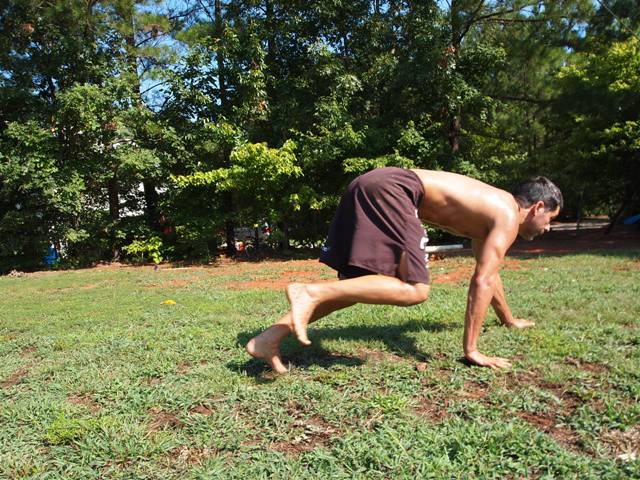
Sleep of course is a major factor in recovery and as the equation states, the more working out and the more stress you’re under, the more rest you will need. The obvious problem here is that often the opposite occurs. The more someone trains the less they sleep – or the less they’re able to sleep. This is especially true for those who are under a lot of stress – they sleep less and not as well most often due to spikes in cortisol throughout the night. My sleep article addresses several sleep conditions, but essentially dealing with daily stress, including dietary stress, will lead to better sleep. This, as you can see, has multidimensional ramifications because the less stress you’re under during the day and the more healthy your diet is, the better you sleep – all leading to more productive workouts.
Health First, Performance Second
Health and performance (fitness) are often closely associated with one another, though they shouldn’t be so closely intertwined. Health is not just the absence of some known disease, but your entire body functioning without any problems – that means your body is free of aches and pains, has abundant energy, and your mind is sharp and clear. A healthy individual isn’t injured, constantly sick, or sleeping poorly. Your impression of this may be that nobody is healthy. The fact is that a lot of people aren’t very healthy, but they may be very fit.
As you become more and more fit your health should also improve, and vice-versa. If you change your diet and lifestyle for the better you will see some positive changes in fitness. You will move more efficiently when you’re healthy and you’ll naturally be more fit. Unfortunately as many become more fit their health suffers, because they are stressing their bodies out too much (anaerobically) or not recovering properly. This excess anaerobic syndrome is the same one that many link with chronic, damaging “cardio” as discussed in Part I. Most train too much, too hard, and since the majority of us aren’t professional athletes, we don’t get to rest and recover as much as we’d like. Overtraining is easy.
Those who only do hard CrossFit workouts and the chronic anaerobic endurance athletes are not very healthy. When the vast majority of workouts are cortisol inducing activities the body will break down because there is not enough time in the day to recover. Although that professional athlete may last longer when they have someone training, feeding, and managing their schedule it eventually catches up with them.
So whatever training program you want to support, or bash, remember it all should come down to two things – what you’re trying to accomplish and how it affects your health. Too often these two parameters do not complement one another. I unfortunately see way too many injured and unhealthy “athletes” who are training for or have just competed in a half or full marathon. The general public conception is a misconception that these athletes are healthy. Far from the truth. (More on this in Part V.) A similar situation of being fit but not healthy occurs with those who only do some hard weights and sprints a few times a week as their only workouts.
Overtrained, Under Conditioned, or Under Rested?
“Overtraining is not possible, you’re just under conditioned.” I remember first hearing a statement like this during the 2006 Tour de France by Floyd Landis, who of course was later disqualified for doping. It’s the “glass half empty, glass half full” idea. Whether you think overtraining is a possibility or not, is up to you. I understand some now use the term “overreaching” which is when one is pushing themselves too much and performance is starting to plateau or suffer but they’re not in the full blown stage of overtraining. Call it what you like – overtrained, overreached, under conditioned, or under rested – if you’re in any of these categories you’re doing something wrong.
Injuries typically don’t come out of nowhere. Sure, there are exceptions – traumatic accidents for example. You may step in a hole while running and sprain your ankle. You may slip while performing a lift. If you’re playing a contact sport you’re obviously at risk. But the majority of injuries that occur do so because of muscle imbalances as a result of some stress to the nervous system. This is the forte of Sock Doc, and how I am able to address injuries and health problems faster than most could ever expect. Dietary stress, hormonal stress, emotional stress, and physical stress (past unresolved injuries, improper footwear, orthotics, and yes, even harmful [static] stretching habits) all impact the nervous system causing imbalances in the sympathetic and parasympathetic system which in turn results in patterns of muscle imbalances. It’s these muscle imbalances that cause injures, either locally or elsewhere in your body – especially if they affect how you move (your gait).
So yes, you could be under conditioned to perform a certain activity and end up with an injury. This happens if you’re training at too high of a heart rate too often and for too long and never developed your aerobic base. It’ll also happen if you’re lifting too much weight too often without sufficient recovery. It could happen if you’re not incorporating any, or very little, aerobic activity into your daily routine. And it can happen if you’re doing too much aerobic and not incorporating sufficient anaerobic endurance or strength into your training.
When you’re injured (or ill), you’re forced to rest. So it’s important to realize some of the warning signs of overtraining – or under conditioning. Read up on them so you can back off and adjust before it’s too late.
John C says
hey sock sock doc since as a college basketball player the majority of what I do and the majority of the game is anaerobic even throughout my week playing pick up games or lifting weights is mostly anaerobic. However I have been incorporating about 20 to 30 minute aerobic conditioning workouts like some biking or running about 2 days a week and staying away from anaerobic workouts fully on those 2 days so far I feel pretty good and to any basketball players reading this no I am not losing my vertical. would you say I am on the right track as having the right ratio for my sport? Do you think I will see benefits in this or I need to do more aerobic.
Sock Doc says
It depends on how well developed your aerobic conditioning is. Basically, the more the better. The better your aerobic then the more you can keep accuracy and intensity in a basketball game. Two days a week for 20-30 minutes is not much. Personally, I’d be advising much more, especially on the “off-season.” Up to 1hr easy runs and a couple other days per week of 30-45 mins.
John C says
very interesting I will definitely add some more in than because I haven’t really spent alot of time doing aerobic conditioning or specific conditioning in general it was always just playing basketball or doing intense skill work which almost always had my heart rate way up over my LT that had me in shape. Is it ok for me to do my aerobic conditioning after I do my strength traiining ussually I finish with anaerobic circuits or something like that but I want to balance it out. It’s not counter productive to do a strength workout that’s mostly anaerobic and then do aerobic conditioning to finish is it?
Sock Doc says
Of course that’s not counter productive; that’s crazy talk.
John Calarco says
Sock doc, my aerobic runs have been going great I even do them on the court running back and forth while handling the ball and shooting making sure i stay in the right heart range (im 21 so 159 just coming off an ankle injury so 154 is my LT please correct me if im off). My question now is should I be doing my aerobic work on days where im not in an anaerobic state? My biggest goal here is to be stay healthy and prevent overtraining so should my aerobic runs be done on days where i am not doing any type of anaerobic conditioning? Because honestly im going to be anaerobic probably five days a week when the season comes and i know in the aerobic vs anaerobic article you reccomend only 3 days a week anaerobic and never back to back but with me some times we have 2 a days and im anaerobic 2 times a day. this is my dilemma.
Sock Doc says
Sounds like you’re on the right track. HR Number looks good. Yes I’d keep up with the aerobic runs as much as you can – per the time, and energy, you have. Good work!
John Calarco says
Great thanks so much for all the help, no exageration you have changed my life im no longer overtrained and no more nagging overuse injuries. I truly appreciate and admire what you do doc god bless and keep it coming!
Christian says
Hi, sorry to ask such an obvious question, but I am not sure about how to proceed with incorporating aerobic runs into my marathon training. I’ll be doing my second marathon in April 2013. I want to enjoy my race without messing myself up in the process but still would like to knock 13 mins off my last time to get under four hours. I’ve calculated my aerobic training pace to be no more than 138 (180-42) and have done one very slow 10km at this heart rate in 1hr 08mins. I would normally do the same route in 51mins (49 mins racing). My schedule has me doing long, recovery, interval and tempo runs. My question is how many of these should I do as aerobic runs? All of them for a while? Just the long run and carry on with faster stuff as well? Thanks for your advice. I am also looking to drop one of the runs (not the long run) for a general strength workout.
Sock Doc says
You have five months or so before your race. Plenty of time. Based off your recent 68 min 10K that you were doing before in 51 minutes and racing only 2 minutes faster (that’s not good – you should not be training 2 minutes slower than your race pace) – you have a very poor aerobic base. I’d be doing 100% aerobic runs at least 5 days a week. No tempo. No intervals. Just 45-90 min runs all aerobic for at least 8 weeks. Throw in a couple strength workouts in there if you like.
Christian says
Thanks for this. I really had stopped getting faster which was a bit frustrating. I think all these slower runs should also help me work on my form and finish my transition into minimalist shoes at the same time. I’ll let you know how I go.
Ashley says
Hi, I am currently on your waiting list and can not wait to meet you! The information on your website has changed my life. I have already starting implementing some of the changes into my diet and exercise routine. I use to strength train ( crossfit style training ) 5-6 x per week. After reading your site I realized I have been overtraining my anaerobic system. Currently, I train 3x per week with weights and the other days I walk for 20-60 minutees at a leisurely pace. I have a lot of hormonal ( HA- according to my doctors diagnoses ) and other signs of training to hard. I already am starting to feel better with the small changes I’ve implemented. . Do you think 3x per week of anaerobic exercise is still to much? What about walking daily? Thanks for your advice and I cannot wait to meet you!
Thanks so much!
Sock Doc says
Yeah 3X a week of anaerobic week after week after week with no rest is too much for anyone. If you have any health problems, especially hormonal, then you’re doing something not right.
Ashley says
I am so confused about this! For so many years I have been told ( I’m a trainer ) and read that you should do anaerobic exercise for healthy, fitness, and body fat management. After reading your post about chronic anaerobic exercise it made me wonder if that’s part of my problem . It’s a challenge to know what and how much to do for a healthy body. I’m starting to realize there is a difference between health and fitness.
John Calarco says
Hey sock doc! haven’t commented in a while hope all is well, i had a quick question about doing aerobic conditioning on a rower, in the past ive done it on the bike or running but my feet have been feeling stressed lately due to some recent competitions (got some plantar fasciitis creeping in) I definitely fell into a state of over-reaching or whatever you want to call it so im hesitant to run barefoot for 30-40 mins like I did before the pf started creeping in to BOTH feet. I also have tight hips so i try to stay away from the bike when possible. Id love to hear what you think man, Thanks!
Sock Doc says
Hey John – really can’t advise you beyond what’s already here on the site.
Bernard says
Dear SocDoc. Love the website and am slowly taking on heaps of advice. Always more to learn. Since October last year I’ve been following the 5:2 diet, ie intermittent fasting. I’m interested in your take on this, simply because I’m interested in and have a lot of respect for your opinions!
Sock Doc says
That’s a long response but in a nutshell I’m cool with IF if the person is healthy and fit. Most people fast because they are not hungry in the morning and their metabolism is so slow – so these types of people need to eat. But if you’re healthy and fit then by fasting and eating just after exercise you can benefit with an improved metabolism and fat loss.
Hugh says
Dear Soc Doc.
I have a question for you regarding the difference between Maffetone and Friel training zones. I’m 55 and for 2 years have been doing all of my easy runs (6 hours a week) conscientiously using the Maffetone calculation – ie: for me currently <125bpm. I also eat a v low carb / hi fat diet with a conservative amount of quality protein. However these slow easy runs have failed to improve. I also note that my resting heart rate has 'increased' markedly from 46 2 years ago to 52bpm currently. Would I be correct in assuming that my workouts are not taxing enough and that I've lost stroke volume? Am I one of the people for whom the Maffetone figure doesn't quite work?
If I look at the Friel calculations you've published: my tempo runs are done at an average of 160bpm, which would suggest an easy aerobic heart rate would be 136. Perhaps this is a better figure for me? I'd love to know what you think. Thanks for all the great information
Sock Doc says
Correct, the MAF may just be too low for you at this time. See how you do on the higher Friel calculation or consider adding in some harder workouts as I write here: https://sock-doc.com/2014/02/anaerobic_training-hiit/
Hugh says
Thanks Doc, your reply is very reassuring. The higher rate feels more natural and still very relaxed, very ‘Lydiard’, which seems right too. I’m looking forward to seeing how it goes
Hugh says
Hi Doc
To follow up, I went out and did another tempo run so that I could calculate the Friel zones with fresh data. This time I ran the last 4 miles of 6 at an improved 167 bpm, making my crossover point about 142bpm. This surprised me, it seemed very high, so a couple of weeks later I booked myself into a sports science lab at a university where they are familiar with the test. The tecnicians there observed my crossover point at hr 162 or 95% of my hr max! This is very pleasing of course, I’m not complaining, but it raises some questions. Firstly what HR should I train at now? I’m certainly not strong enough to do long runs at 162bpm several times a week.
Also the technicians at the gym suggested that my fasted state (overnight) and my diet may have contributed to the high figure and that raises my curiosity. If the crossover point occurs at a higher point in a fasted state, is it then advantageous to do base training in that condition? One could do a workout of higher intensity before crossover?
As before I’ll look forward to your reply
Sock Doc says
I don’t see how you’d get a 20 bpm difference regardless of diet. And what do you mean by your run crossover point of 142? Sounds like your LT based off the Friel test was 167?
Hugh says
Sorry – I shouldn’t have used ‘crossover point’ when specifically referring to Friel calculations. I’m looking for a training level. As I understand it with the Friel calculations lower aerobic training would be 85% of LT which gives me the 142. I would expect that to be somewhere around my crossover point, but when tested in a lab it appeared to be around 162
Or do I have this all wrong?
Sock Doc says
I’m thinking your 162 is your LT and therefore around 85% of that is your 142 training “aerobic” zone?
Joel Pelley says
This is so phenomenal and exactly what I was looking for. I run Spartan Races and though I have seen great improvement over the past year, I believe I have been training far too much anaerobic and too little aerobic. My question is, how to put together an actual day for day plan that would help me build a true aerobic base (for the distance running of 4-14 miles) while preserving my current level of strength (just right now for all obstacles)?
Dr. Stephen Gangemi "Sock Doc" says
Glad you are learning from the series. I cannot give more specific advice without a consult though.