 Consult with
 Sock Doc Workshops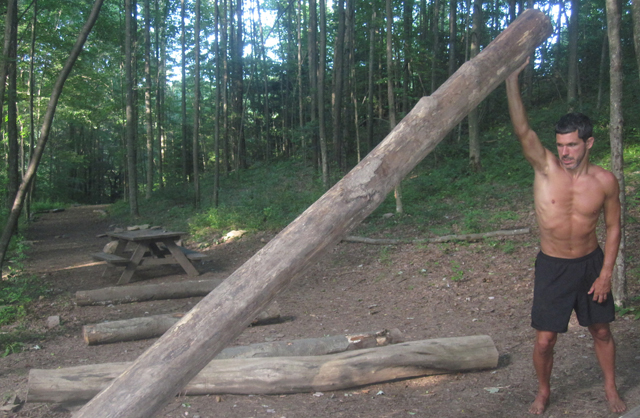
Log Lift
Sock Doc Training Part II: Build Your Aerobic System – (Move Your Ass Often, But Not Too Quickly)
We all can agree (hopefully) that strength is important. There is some disagreement as to when one should add in, or begin strength training. Some say to develop the aerobic system first and shun weights initially one hundred percent as it will impair proper aerobic development. Others say the opposite – start with weights because you’ll burn more calories and see results quicker than when training your aerobic system alone.
I feel it’s very individualized but I don’t see strength training to be harmful as anaerobic endurance workouts can be when there is an insufficient aerobic base. For example, if I saw a person who was doing absolutely zero daily exercise I would first encourage him to start walking. That’s going to be aerobic. Moving – it’s fairly important. I also want to know what he’d like to do so he’d hopefully stick with an exercise routine. So although I’d love it if he were walking and doing some dynamic, natural movements every day and eventually also some strength work too; but that may not happen for some time for some folks.
If the person is already under a tremendous amount of stress and eating poorly he’s living an anaerobic lifestyle already, so no way do I want him training too hard either via anaerobic endurance or heavy strength training. Deep squats, balance work, and maybe some carrying of weighted objects would be a good way to get this individual integrated into more strength training. Now if the person just doesn’t know where to start and he is eating well and under very little stress then I’m all for some weight training to start.
So the point here – take a look at the whole picture and don’t just do what everybody else is doing; do what works for you, do what you like to do, and make sure your body is able to handle the workout. Unfortunately, if you’re often involved in group training sessions, this may be difficult to do as you will be pressured to train with the group versus doing what is ideal for you. Therefore, the group setting is often not best at least for the majority of your training program, especially if you start in a class that is above your current fitness level.
People often go from one extreme to another. It’s somewhat like diets, going from the high carb, low fat diet to a low carb, high fat diet. Endurance athletes fear strength work and too much anaerobic while sprinters, lifters, and power athletes fear workouts that are overly aerobic. The marathoner wants to steer clear of the weight room. The powerlifter avoids the treadmill, track, or trail.
Strength training is very important for every athlete, even a long distance endurance athlete. That doesn’t mean the runner needs to be squatting massive weight just as a shot putter shouldn’t be running several miles every day. How much weight and how many miles respectively? That depends on the individual – what he’s trying to accomplish and what their goals are. Clearly a long distance runner doesn’t want the over-development of Type II muscle fibers or use a lot of energy trying to develop such; and a strength athlete doesn’t want to expend too much energy into his aerobic system. But for the runner, power developed by carrying a heavy load up a hill can be very beneficial at various times in one’s training just as a strength athlete can achieve some benefits by running for a prolonged period of time – even 30 minutes – to develop one’s aerobic capacity. That brings us to the next point:
Train Your Weaknesses – Focus on Your Goal
“Train your weakness” is stressed as a MovNat principle, one of the many I learned last summer while attending MovNat with Erwan, Vic, Clif, and a dozen other participants. (Sock Doc’s MovNat Guest Post.) Training your weakness is important in becoming a well rounded athlete. This can mean training your body more on the weaker side (the less dominant side) so you become more balanced, but it also means you should train what you’re not very good at so you can become a more fit and healthy individual. So if you’re more into lifting weights, work on some easy long runs to develop your aerobic system. You’re not going to lose your strength and develop skinny legs! I’m talking some 30 minute runs, maybe even up to 60 minutes every so often. Keep it slow; walk if you need to. Carry a kettle bell or a log if it makes you feel better (or cooler), or benefits your training. If you’re more of an endurance athlete as I am, work on strength – carry heavy objects, lift, throw, and jump – things that help develop power. Find the fine balance between what your goals are, what you like to do – making yourself a well-rounded athlete.
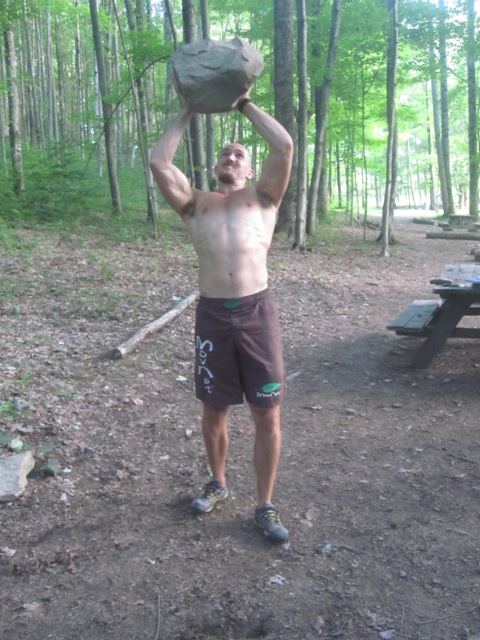
That’s a Foam Rock
Aerobic conditioning may not benefit the strength-only athlete as much as the endurance athlete can benefit from strength, but they can both can help (or hinder) to various degrees. The strength-only athlete will lack many of the health benefits of true aerobic training, such as reduced stress hormone levels, increased immunity, and resistance to fatigue. Those incorporating aerobic activity are thought to live longer too (see Part V). On the other hand, the endurance athlete shunning anaerobic will lack power and speed, impaired glucose metabolism, and might not live as long if they have to climb a tree to escape a tiger chasing them. (!)
I’m not going to lift heavy everyday even if I was able to keep my running up. That would impair my ability to run a one to three hour race as fast and as efficiently as I possibly can. But I do want to develop power and anaerobic endurance, so I incorporate strength training at different times in my training cycles during the year. Strength training is fine but the more you do, the less time and energy will go into your endurance training (which will hopefully be primarily aerobic) and the greater chance you’ll develop an aerobic/anaerobic imbalance. These aerobic/anaerobic imbalances lead to muscle imbalances resulting in pain, injury, illness, and lackluster performance. Lackluster is an old word; thought I’d bring it back.
Likewise, if you want to lift a whole lot of weight, integrate some aerobic activity into your workouts but not so much that it impairs your strength. The more developed your aerobic system the longer you’ll be able to sustain certain workouts and the faster you’ll recover. Even in a very anaerobic sport, such as ice hockey, soccer, boxing, or MMA fighting, the athlete who is going to still be strong physically and sharp mentally til’ the end is the one with superior aerobic and anaerobic conditioning.
John Brosseau says
I have been doing CrossFit-type exercises for the past several months and would like to hear your thoughts on this type of exercise as it pertain to aerobic/anaerobic balance and what to do about it. It has really helped me get back into shape and I have lost 33 pounds (and kept it off). I am now at a good weight but am feeling some nagging injuries that I think may be over use type injuries and/or muscle imbalance types of injuries. I would appreciate any thoughts. Thanks.
Sock Doc says
Well Crossfit tends to be very [mostly] anaerobic and I discuss it more in this podcast: https://sock-doc.com/2012/07/sock-doc-podcast-3-strength-endurance/
Crossfitters think aerobic is bad and it will deter their muscular/HIIT/anaerobic gains. Of course none of this is true. It’s great that you lost so much weight but you’re injured, and this is common.
I’m a MovNat supporter (and a certified trainer) and I like MovNat so much because it’s more natural “real life” movements and it can be scaled to any level, any age, and aerobic or anaerobic.
Greg says
I am a 45 year old man who started running/training 5 years ago to loose some weight. I ran on a treadmill and worked my bowflex shedding 50 lbs. I did my first triathlon and got hooked as well as road races. In 2010 i did 27 races 4 triathlons (1 of them a half iron) and 23 running races. My best 5k was 21:22, 10k 7:23 pace. Here is my question, I have always had a high hr now knowing I was not aerobically fit. I have had a few injuries, as of 2 days ago sciatica! I have been training for my first marathon in February and even now my hr at a 9:30 to 10:00 minute pace is in the 160’s. Not immediately but within a few miles. I hear what your saying about training aerobically, but how do I go about it now?
Sock Doc says
Nice work shedding all that weight and taking care of your own health. That’s a lot of racing in one year – 27 – wow.
So how do you go about it now? Simple. You do it. That’s it, just as I lay out in these Training Principles – especially Parts I and II. If you don’t, then you’re the guy who could very well end up like the statistics I discuss in Part V and the many other heart injury articles I have written (https://sock-doc.com/2012/12/aerobic_endurace_bashing/ (for example)).
I say this because without knowing much about you I do know:
1) You used to be very overweight
2) You race a lot
3) You train anaerobically
4) You’ve been injured
5) Based off your 5K and 10K times your marathon time should be approx an 8min/mile pace – in the 140s HR. You’re nowhere near this.
Those are health risk factors right there without knowing your dietary and lifestyle stress load.
Greg says
So it’s been almost a year without any injuries and currently no races scheduled. This I feel is the right time to address my LT aerobically. So I started running keeping my HR around 140 to 145 and when it rises I slow down. Been trying to be consistent so I run for exactly 50 minutes (it’s all I have time for to get the wife & 2yr old out the door on time). I must admit it’s a bit of a bummer to see that I start out at 6mph 10 min/mi and by the time I get between 3 & 4 miles I am backing the speed down do to cardiac drift. The 50 minutes has been a good base because I can see the mileage going up a little for that time allotment. 1 am 45 now and this past year ran only 2 half marathons a few 10ks and maybe half dozen 5ks all at slower speeds due to being not as fit as previous years. Some questions for you?
1) To maximize this process, what is the highest my hr can go?
2) My hr rises slower on the bike and optical and takes a lot to get it to say 140, will these activities help with what I am trying to achieve or do I stick with just running?
3) Will 50 minutes in the am and another 50 in the afternoon speed this process us? How many days a week if it’s ok should I double up?
4) Being realistic, what time frame am I looking at to get to an 8 min/mile pace at hr in 140’s best guess?
Thank you for all your insight and I enjoy your website and advise! It is vey hard to go from the past 5 years of training/racing anaerobically to aerobically, it’s like having 2 devils on your shoulders one saying keep it slow this will pay off and the other saying this is boring-run like hell!
Thanks so much
Greg
Sock Doc says
Hey Greg – a little bit too much personal attention would be needed for this one; sorry I can’t do that via comments.
George W says
Hey Doc, I need further clarification on my previous question about Spinning and PF: If I figure out my aeorbic/anaeorbic limit numbers and operate within those aeorbic limits with my heart monitor, wouldn’t that work, assuming I mixed in other aeorbic training? And also, my question lingers: will spinning cause PF even with hard sole clip-on bike shoes?
Sock Doc says
Yeah that should work. Shoes should not be a factor here unless they’re the wrong size or they are compressing your foot too much.
margaret sciberras says
Dear Doc,
I am a long distance runner, aged 51 and was obliged to stop due to lower foot problems. To be more
specific, shin pain and upper foot. Followed your treatment to release the shin pain and stopped running not to aggravate injury further. Decided to try acupuncture treatment after attempts with podologist doctor, therapist which seemed to be all in vain. The treatment has changed the direction of the pain in the ankle , as the chinese doctor believed that pain was originating from ankle. Seemed to be confused as the ankle always had a clicking sound to movement. right side always has been a problem staring off from the hip downwards. Have been running a lifetime.
Appreciate you feedback as I follow your website.
Susan
Sock Doc says
I’m not sure what you’re asking. The Shin Splint post/video I have did not help but and the acupuncture changed the pain?
Nuri Shakir says
Dear Doc, I am an MMA fighter and looking for a path of fitness that suits me. I am more of an exlposion fighter. So at one moment i am doing going slow like jumping rope to standing still but the next i am going a hundred miles per-hour which is (punching, kicking,throwing, moving). In the past i have done a lot of anaerobic work sort of. Which got me down in weight fast and then I would eventually I would stop and do it again getting ready for a fight.
But I then did crossfit for about a year and I was very good at lifting part of the workouts but poor at the running. I would alway go out hard then crawl back in to do lifting part and i did well with lifting, jumping, throwing. But in my fight i felt like i lost some pop and then i started to do short faster workouts and got it back rather quickly.
while in shape resting heart rate is low. But for instance i was running at 4.3 for about an hour trying to keep my heart rate down to 150-155 and my heart kept jumping to 160 then back down to the right range. But this kept happening all workout. I felt i could have ran faster but my heart would be out of the target range. So my first question is since i am about 34 years old and have seen my best results doing crosfit style workouts. But on a stop and go bases. How much aerobic work should i add in? Have i set myself up for destruction?
And yes i have had the heart thing for a while and had a stress test done and they said i was fine.
Sock Doc says
It’s individualized but ideally you add in as much as you can handle to the point that it doesn’t impair your strength & power – but only enhances & sustains those attributes.
Craig says
Hi,
I am 52 and have been using the Maffetone Method for about 8 months. What should my heart rate be when competing in 95km (bike-run-kayak) race. I was thinking that it should not be more than 152bpm.
Thanking you,
Craig
Sock Doc says
Seems high – unless you have a high LT.
Paul says
Hey guys,
I’ve been running for a while and recently I’ve started to suffer from sciatica and my piriformis is strained.
I could do with some advice (I watched the soc doc vid – which has eased the issue)
A little bit about me, I run in sandals and minimalist shoes, I’ve been trained in POSE technique and no longer have knee or foot pain. I do MOVNAT strength training and I also do Yoga.
I’ve never had piriformis trouble before, but it keeps flaring up. I started yoga six months ago, and the pain started 3 months ago… could it be this?
I also sit all day at work, I go for a long walk at lunch and try to stay mobile.
Essentially I feel really fit and healthy I eat a LCHF diet.
On paper I’m doing everything right….
Anythoughts? It’s got to be a muscle imbalance somewhere…
Sock Doc says
Really can’t advise you more without seeing you or a consult.
Paul says
no worries Dr Steve,
I live in london so it could be a commute. I looking around london for a good physio, perhaps one that is trained in the function movement screen.
I think knowing what the issue is often the most important discovery!
Adam says
This is a great article doc! I really love reading your stuff! But I have a question for you. I’m in the process of developing an aerobic base. But, I really feel like I would like to do a little bit of strength training. Would doing exercises like pull ups, push ups, dips, short sprints and other body weight exercises hinder my aerobic base? And what about incorporating some of your Movnat type training too? Like some of the crawls and other exercises. Thanks doc and great articles, keep em coming!
Sock Doc says
I think strength is fine to do while you’re building the aerobic base as long as you’re not doing crazy high-intensity type anaerobic such as CrossFit-style workouts.
Adam says
Oh ok! So it would be ok to be doing exercises such as pull ups, push ups, plank holds and etc everyday? I should just avoid higher intensity workouts such as plyometrics and free weight workouts?
Sock Doc says
It all depends on what you’re trying to accomplish and your intensity of doing various exercises. I don’t give cook-book recommendations.
Adam says
The race I’m training for is the 5k. I’m doing a lot of aerobic base training, but I felt like some functional strength training would help out. So do you think doing these exercises would be ok to do? It isn’t really too intense, just a couple sets of pushups, pullups, dips and some plank holds. I also like your movnat training, is that ok to be doing while building an aerobic base?
Lawrence says
Hopefully your still answering/replying here. So I’ve been consistently training for about 6 years now. Originally it was weights with moderate “aerobic” activities (5 days weights, 3 days 30-60 minute runs). The past couple years I’ve gotten into endurance running, with a 50k under my belt along with several halfs, 5ks, etc.. My training regimen essentially flipped with 4-5 runs and 2-3 weight sessions, with the past year primarily body weight exercises. A couple months ago I added the heart rate monitor to my training program and quickly realized that the “aerobic” running I thought I was doing is clearly not (I implemented the HRM specifically because I was tired of getting sick). So, after some research, the TRN podcast with you, I find myself here interested in this MAF/zone training stuff. My questions are simple:
1) Weights, good idea? I’m back at the gym and love it.
2) Is there an intensity level I need to worry about with the weights as I attempt to build my aerobic base running?
I feel I have the “base” with weights, that is I’m not new to it, but I certainly don’t monitor my heart rate while squatting, pressing, etc.. And it’s obvious that heart rates spike with higher intensity lifting. I’m just curious if that would adversely affect the aerobic base I will be attempting to build outside of the gym running. I did read the article by the way, I just feel this was not directly answered, at least for me. And since you mention goals several times, I should mention my goals are continued endurance runs (50k, 50 miler, 100 miler in 2015-2017 respectively) but also improved core strength (my core sucks, no doubt there) and some of the strength I feel I lost over this year where running was the main focus. I’m not trying to be Arnold and Kilian at the same time, but would like a better balance than I feel I have right now. Thanks in advance.
Sock Doc says
Would have to do a consult due to the in-dept nature of this comment/questions.
Lawrence says
Understood. Figured I’d give it a shot. Reading your 14-page, 5-part series right now and finding it quite informative. Thanks for the resources.
Cindy says
I suffered a Heart Attack a few weeks ago due to emotional stress, my cardiologist said that the bottom of my heart is dead, that I have to start building up my cardio slowly to get back into my elite status. My cardiologist don’t know nothing about heart rate, I asked them many questions and they avoided me. I’m desperate to know for how long can I do cardio and at what intensity.
Cin