 Consult with
 Sock Doc Workshops
Training twice a day, also known as two a day workouts, can make dramatic improvements in your fitness if done correctly. Unfortunately for many, two-a-day workouts add just another factor in the injury equation as many athletes are not ready for such physical demand. Should you, regardless of your current fitness level, work out more than once a day? In this article I’ll discuss why I think more can be better if you do it the right way.
Should You Train Two a Day Workouts If You’ve Been Training Less?
The idea behind two a day workouts is to try to get in shape (or back in shape) as quickly as possible in time for some competition. As most collegiate sports teams have an event in late August, their mission is to get their athletes ready to perform. This “get fit quick” fitness program can work well if approached one way, or backfire if various training intensities and durations are implemented faster than the athlete can adapt to the demand. After all, as you may know from many other Sock Doc articles, it’s all about adaptation to demand which improves performance.
Over any athletic downtime period, (such as school break for students or end of competition season for various sports), most athletes, once they are no longer around a structured team training environment, quickly lose motivation and fitness. Adults lose a lot of fitness when they go on vacation and don’t train for a week or more. It only takes a matter of weeks away from training to lose substantial amounts of strength, power, and endurance. Specifically, it’s said that after just three weeks of practically no training, aerobic enzymes drop by almost 30%, lactate threshold drops 7%, and heart stroke volume drops 10%.
You can only develop fitness so fast. Forcing fitness is a great way to become injured. A deconditioned, unfit individual or an athlete who has just come off the sidelines from injury or simply not consistent with training just can’t hop into high intensity two-a-day workouts and expect to excel. Yeah, the ones who do might appear to be making gains in various fitness attributes but, aside from those few who are genetically gifted, these athletes are the ones whose season is often cut short early due to injury.
More Time Training, More Time Recovering
Since training is as dependent on rest and recovery as it is actually working out, training too often and too intensely is a great way to become injured, or at best quickly plateau with respect to fitness gains. Simply put, a hard workout in the morning session followed by another in the afternoon for several days in a row is often asking for trouble. Can it work? Sure, but as long as there is some recovery time factored in after such a crash course in training. The problem is, most athletes are going from high intensity two-a-day workouts right into high intensity daily workouts and/or competition, (which is always intense – or at least should be). Ideally, for this to work and work well, there needs to be some recovery period after so many two a day high intensity or long duration workout days.
A better approach to this time constraint fitness catch-up program is to alternate the high intensity workouts with lower intensity training and/or skill and drills. An athlete already in rather decent shape can often handle a high intensity workout approximately every 36 hours. So an intense training program perhaps consisting of some HIIT or intense plyometric exercises on Monday morning could be followed with a skill/technique training session that evening, an aerobic endurance conditioning session Tuesday morning and then another HIIT or power-type session Tuesday evening. Again, this can really work well for an athlete who has maintained some fitness base or even better, they’re trying to take their fitness to the next level. For someone who is unfit or just getting back into the swing of things then reducing the time and intensity of the two-a-day workouts can still work, as long as these workouts are within the confines of their present fitness level.
An endurance athlete with a well established aerobic base can experience some dramatic gains by implementing a two-a-day program. This doesn’t mean that you simply double-up on your workouts. Though that can work if you’re trying to increase mileage and overall aerobic capacity, there’s a whole lot more to fitness than just duration. But if you’re short on time and can’t run more than 30 minutes in the morning then doing just that and running another 30 minutes at night can be a great thing. Actually, running 30 minutes twice a day may improve your fitness and health more than just one run of 60 minutes. Often any activity that is even moderately intense (including a truly aerobic run) will bump up some cortisol levels as that one hour mark approaches. If you’re already dealing with potentially high cortisol levels due to excess stress elsewhere in your life, then breaking up that workout into two shorter ones might not just be the ideal way to improve your fitness but also your health as the aerobic activity can help reduce your stress hormones. And of course, exercise is often a great way to lower mental and emotional stress. So the more you’re active, the better off you’ll be.
Improve Fitness by Mixing Up Your Training
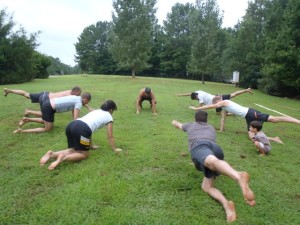 Remember as with any training program, you never want to increase duration, intensity, and complexity at the same time. So if you’re trying to get in some added miles or distance this is not the time to also increase interval training or strength training, and vice-versa. If your training is involving more complexity, for example various jumping skills or even moving towards more minimalist shoes, (or going barefoot more often), this is not the time to increase volume or intensity. Be smart about your training.
Mixing up the two a day workouts can be very effective. As noted above, if you’re already rather fit and you want to take your training to the next level, some higher intense training every 36 (or even a shorter period for a few days in a row) can work well. Give it a try a few times a week for a good three weeks as long as you’re seeing progress. It’s a time commitment and you’ll have to make sure you’re resting well and eating well for it to work in your favor. But you don’t have to always be training high intensity or volume when it comes to an effective two-a-day.
Consider the benefits of movement skills. Running in the morning and taking an evening movement class such as yoga or a class focusing on body awareness is a great idea too. If you’re not focused on one sport and looking for overall fitness improvements then aerobic conditioning one time of the day and strength later in the day may be the way to go rather than try to do them back-to-back. For a well conditioned athlete, two-a-day workouts can be a great way to get off a fitness plateau and make some fast gains, provided the plateau isn’t because of overtraining. Moving more is almost always a good idea, as long as you’re moving well. If you’re injured or your form (economy) is poor or compromised then the more you’re moving in such a manner the worse off you’ll be; it’s rather obvious.
Move More For Improved Health & Fitness
So give the two a day workouts a shot when you’re ready. Actually, you can say that you’re ready now as long as you’re not suffering from an injury which is limiting your movement. Walking in the morning and working on some balancing exercises in the evening is something that most anyone can do provided they have the time. If you do, these two a day workouts can be huge for your overall physical and mental well-being. Once fitness develops, tossing in some two a day workouts, even once a week, either to improve a certain skill, aerobic endurance, or strength can really bring your fitness to a level you thought not possible. Our bodies are meant to move, and move a lot. Maybe it’s time to ditch this idea that we got our daily workout in now it’s okay to sit around the rest of the day or we should only train more when we’re preparing for a race.
Dr. Stephen Gangemi "Sock Doc"

I'm a board-certified chiropractic physician and clinical nutritionist with a passion for true natural health care. I implement dietary & nutritional therapies, exercise & movement practices, and lifestyle changes along with manual therapy techniques to help the body heal and prevent illness and injuries.
Vlad says
Great post Doc. Similar to the high low approach used by Olympic sprinters and what Joel Jamieson uses with his MMA fighters.