 Consult with
 Sock Doc Workshops
I recently wrote an article called “Healthy People = Barefoot People” which discusses why barefoot people tend to be healthier than often-shod people and how/why being barefoot can improve your health. It’s a good read – but hey, I wrote it, so of course I’m going to say that. Part of the reason for the article was also to discuss three important topics/questions that I get a lot. One – “If I’m not injured should I still get out of my over-supportive shoes?” (Answer = yes.) Two & Three – “How do I properly transition out of my current shoes without getting injured?” & “I started running barefoot and now I have pain, why?” (Answer = you’re doing it wrong.) Since I posted that article about one month ago I’m still getting these questions so I think that I should have broken up that article and put the last two sections separately. So here it is along with some additional info regarding my shoe suggestions. If you’ve read “Healthy People = Barefoot People” and are doing well, then most of this is deja-vu, and you can skip to the end where I discuss those recommendations. If you’re reading this first, great – but read “Healthy People = Barefoot People” next to really understand the concept behind why I think everybody should strive more the most minimal footwear.
Should You Venture Into Minimalism if You’re Not Injured or Having Any Problems?
If you’re not injured and could care less about performance should you get out of your traditional footwear or running shoes? Though many advise just to keep doing what you’re doing I don’t support that position. You will only truly be sure if your feet and other areas of your body are strong and healthy if you venture out of your footwear. If you have trouble doing so it’s an indication that there is a problem you’ve been supporting just as if you were not having elbow pain every time you played tennis because you wore a brace, for example. Just because you don’t have pain, weakness, or discomfort doesn’t mean a pr oblem is not there. Ask yourself WHY you can’t be without your supportive shoes or supportive foot braces. This doesn’t mean you go barefoot right away, but you should enter the realm of minimalism just to get an idea of where you’re at. Stronger feet and lower legs and more body awareness are definitely possible the more you are barefoot.
A healthy individual can be barefoot, (baring some injury to the foot), and they can further improve their health, fitness and overall well-being. If you have a health problem or an injury, investigating the minimalist and barefoot approach may be an essential step in your recovery, and further prevention of that or another problem. Barefoot isn’t going to cure a disease you may have – but it most likely will have a noticeable effect on your health and well-being. If you don’t think it can have such a powerful effect, how do you really know unless you’ve tried it?
Ready to Make the Change? Transition to Minimalism and Barefoot Correctly
Yes, too many people are getting injured by switching from their current footwear to minimalist footwear or even barefoot. This gives the traditional medical doctor, podiatrist, or therapist reason to believe that humans today are not meant to be barefoot and we need to protect our feet with more supportive shoes. I get a fair share of hate mail from these people who think that because we don’t live in wild jungles we need support on our feet to get through the day on our “unnatural” surfaces. Though of course I don’t agree with this, the typical unhealthy person and/or person who has always worn supportive footwear or orthotics can’t just make the shift so drastically. Many of them do, and they get injured, so these doctors and therapists see them in their office and rather than educate the patient on overall health (diet, lifestyle, and foot care), they convince them that barefoot is evil and humans need shoes all the time. This is pretty sad in my opinion, but it’s the standard of our health care system.
You must transition to barefoot slowly and carefully, so you do not become injured. There is no rush! Start just by walking barefoot inside your house as much as you comfortably can. If that’s painful then you can start with a minimalist-type “transitional” shoe and eventually work out of those to barefoot. It’s okay and often advised to alternate between your current traditional shoes and a minimalis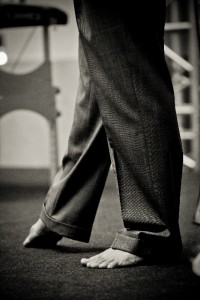 t shoe/barefoot if you have pain or discomfort. It’s very common actually to feel tightness and some discomfort in the Achilles Tendon as it has shortened from years of wearing shoes with a high heel. So if you feel an ache in your Achilles then just be sure to rest it well and even go back to your current shoes as needed and not barefoot or in low-drop shoes until the discomfort subsides. If you’re wearing orthotics, talk to your prescribing doctor about getting out of them so you can walk naturally again and not support your dysfunction. If that doctor doesn’t think that’s possible for you to rehab your feet in such a way then personally I’d find another doc, unless your situation truly warrants a supportive device (very rare). If you’ve been wearing supportive shoes with orthotics for years the transition is going to take time.
Once you can comfortably walk barefoot then work on balancing (one leg at a time) barefoot too for several seconds and then a minute or so at a time. Hard surfaces (tile, hardwood) are okay and advised!
Once you’re walking barefoot and balancing well inside comfortably then venture outside onto hard, smooth surfaces such as your driveway. Slowly build up time as you comfortably can. Eventually make your way to other surfaces such as grass and gavel. Of course make sure these areas are safe to walk on. If barefoot is bothersome to you outside then use a minimalist shoe at first.* Remember that different shoes work for different people!
Once you’re walking barefoot outside comfortably then try a bit of barefoot running on a flat, hard surface – not too much at first or you’re likely to develop sore feet and calves very quickly! If you’re not a runner then a minimalist shoe will be more appropriate at first or you should just stick to walking. If you don’t want to or don’t like to run outside barefoot then that is perfectly fine. But do your best to get into a minimalist shoe or “barefoot style” shoe. Continuing to walk barefoot outside, and especially inside, as much as you can, is advised.
Watch the Sock Doc Video on how to properly strengthen your feet and lower legs.
Proper Shoes For A Healthy, Fit Body
If you’re a runner or avid walker then while introducing this barefoot program into your daily routine you should also be transitioning out of your current “necessary” footwear into minimalist-type shoes. Think flat, firm, flexible, and wide. This means that the shoe should not have a significant, or any, heel to toe drop, (if you’re coming from a thick heel you will not want to go to a zero-drop shoe immediately), there should be little to no cushion or padding in the sole, and the shoe should not be rigid anywhere – it should bend throughout the shoe and in any direction. The shoe should also be wide at the toe box allowing the toes to naturally splay apart.
Finally, don’t go back to your old shoes! The only unfortunate nuisance of being barefoot and wearing minimalist/barefoot-style shoes over time is that the typical shoes you were wearing will soon be very uncomfortable on your feet and you’ll need new footwear. Even a 4mm drop may be uncomfortable to an often-barefoot individual. It is for me.
Some Transitional and Barefoot-Style Shoe Suggestions
As of Spring 2013, these are the most common recommendations I give to patients for footwear, and where I see the most success.
“Transitional Shoes”
- New Balance Minimus Trail MT10 (not the Trail MT00). This is a 4mm drop (15-11). Great for the road and most trails. This is the most common shoe I recommend even if you never go on a trail.
- Nike Free 3.0 v4. More cushion than the NB Min Trail. Same drop but more stack (21-17). The v4 (version) is not as comfortable as the v1 – but thanks to Nike that’s all you can get right now; hopefully v5 will improve? The Run+ 3 is even more cushion/stack if you need it, and an 8mm drop (23-15).
- Saucony Kinvara. I personally don’t like these shoes; I think they’re too stiff and shouldn’t be called minimalist. But several patients I’ve seen have had success with them. So if you’re going to use them, work your way out of them as quick as you can. Only a 4mm drop, but big stack (23-19).
“Minimalist and Barefoot-Style Shoes”
- New Balance Minimus MR00 (WR00 for the ladies). This is NB’s newest road shoe that is zero-drop and a stack height across the bottom of 12mm. Though I wish it was a little less material, it is what I run in on the roads currently unless I’m barefoot.
- Merrell Road (and Trail) Glove. With an 11mm and 10mm stack respectively (zero-drop), the Merrells are a popular barefoot-style shoe. A lot of people, including myself, feel they are too narrow and unstable; but many like them. Worth a try.
- Vivobarefoot Shoes. Can’t get much more minimalist than Vivobarefoot. See some of my reviews here. I run in the Breathos on the trail, but haven’t run in their road shoes too much anymore as they are very “floppy”. I like (love) the Evo for walking and the Ra and Oak dress shoes for work. My kids wear their boots and shoes too when they’re not barefoot.
- Vibram Five Fingers. These are the toe shoes everyone knows about. I personally don’t recommend them to my patients as there are so many other zero-drop “barefoot” type shoes now available and I see no need to separate the toes via footwear (but practicing toe splaying on your own is a good thing to develop).
- Inov-8. I’ve recently began running in the Trailroc 235 and like them a lot. Very similar to the Vivobarefoot Breatho but more a more solid base (the lugs aren’t as narrow) and the shoe fits more snug at the heel; 13mm stack. I also just began wearing the road 138 model; what a great shoe. At only 7mm stack height (zero drop), they’re much more minimalist than the NB zeros. Currently the 138s are my favorite road shoe.
Other Shoes/Sandals
- Altra: Roomy and comfy zero-drop shoes good for a wide foot.
- Lemming (formerly Stem): Zero-drop trendy casual walking and everyday shoes.
- Sandals: Hey, you don’t always need a covered foot. Luna Sandals and Invisible Shoes are what we wear and I recommend.
Dr. Stephen Gangemi "Sock Doc"

I'm a board-certified chiropractic physician and clinical nutritionist with a passion for true natural health care. I implement dietary & nutritional therapies, exercise & movement practices, and lifestyle changes along with manual therapy techniques to help the body heal and prevent illness and injuries.
Jan says
First off: huge thanks for your articles… insightful, and nicely written!
– As far as I know, I’m relatively (I became weary after reading some of your articles 😉 ) healthy and fit, with an active lifestyle (running, MTB etc.)
– I can easily balance on 1 foot, barefoot, for a minute or more. Eyes closed needs more focus, but I can still manage 1 minute without wobbling.
– start with walking: check! I have no problem walking around barefoot, inside (I never wear shoes inside, but quite often regular socks) or outside, for up to an hour (outside) or more.
– start with running, progress slowly: small check. I’ve started 3 weeks ago as mentioned in another reply. I reduced my progression speed as I noticed the strain on my calfs.
But: indeed, a small burning pain (nothing serious, I can still run barefoot following my schedule, though it might not be wise to do so) on the top/inside/middle of my right foot.
I have the feeling I’ve ticked all the usual boxes. But maybe my starting point is wrong. How can I check if I am really healthy enough (in your “broad sense of the word”!) or who can help me with this assessment?
Sock Doc says
Thanks Jan, glad you like the articles. The calf muscles are the most common area a person will feel converting to barefoot. Those muscles have tightened up and shortened over the years of wearing shoes and is more proof that stretching does nothing to help lengthen them.
If you’re having pain and you’re going about it the right way (which it sure looks like you are), then you most likely have some local muscle imbalances in the foot that need to be addressed. Easier said than done, because not a lot of docs do this type of assessment, but for the pain you’re feeling is probably from an imbalance in your tibialis posterior muscle and your peroneus longus – these are the major muscles for pronation and supination. The tib post I show how to check in the Plantar Fasciitis Video and the per longus I show in the new Knee Video – which is so new it won’t even be up until next week, but you can look for trigger points under the foot there around the arch and were the big toe joint goes into the main arch of the foot too.
Clara says
hello, thanx for the article on walking barefoot.. I have a fallen left arch..(they said i was born with flat feet..didn’t bother me till i was 51 & had to stand & walk..all day on the concrete at work..can i use these minimal shoes with a fallen arch..? & can i use these at work on a concrete floor? thanx
Dr. Stephen Gangemi "Sock Doc" says
If your feet are strong enough!
SteveL says
I’ve been making the switch as well. I am running in shoes with a 4mm drop and minimal cushion. I love that. The heal no longer gets in the way of a mid-foot to forefoot strike. I do have one issue. When I walk it feels like I have a lump on the bottom of the ball of my foot. When I massage it out there doesn’t feel like there is any lump there. It is worse first thing in the morning and the more I walk during the day the less it’s there. Any thoughts as to what this is? It doesn’t actually hurt just annoying. Oh and that lump only started once I made the slow move to my transition style shoes.
Sock Doc says
Could be some normal structural changes as your foot is changing from being in traditional shoes too long. Could be a weakening of your arch – in which case check your tib post muscle. Could be that you need to move out of the 4mm to a 0 drop.
SteveL says
Okay will do. Thanks!
lumpy says
Developed the same lumpy thing on both feet. First on the right after an injury by running barefoot on trail and stomping the remains of a young tree which poked out of the ground with the ball of my foot. Painful midfoot as result, didn’t take care of that as well as I should’ve and now it feels as if the bruise under my mid three toes stiffened up into a lump. Same thing with more pain in the morning etc. Its holding me from going out and running decently since a month or 2. Got the second in the left foot after beating it on the ground a couple of times with starting handstands and coming down badly, its less painfull yet it remains hurtful still after a couple of weeks. No clue of what to do with it.
Sock Doc says
Please read this; thanks!
https://sock-doc.com/sock-doc-questions-comments/
Becka says
It’s been a long and slow process, but I have been transitioning over 2 years to barefoot. I started off by going barefoot inside as much as possible, and removing the orthotics from my shoes. I remember I had a surprising amount of pain in my calves and arches for several weeks! I swapped in and out of the orthotics for a bit due to that, but eventually was able to toss them entirely. I purchased a pair of thinner shoes – not minimalist or zero-drop by any means, but much thinner than my cushioned running shoes – and starting wearing those preferentially outside. As before, I had an adjustment period where my feet and calves hurt if I walked too long. During this period, my knee pain resolved.
Each successive pair of shoes I’ve purchased has been thinner and flatter than the ones before, and I just bought my first true minimalist shoe last week – the Merrell Wonder Glove. My feet have never been healthier and I no longer have to worry about injuring my knees when I run or squat.
It’s true that as you adjust to barefoot shoes, your old shoes no longer seem comfortable. I had a pair of boots that I only wore occasionally in the winter, and after a year of wearing thinner-soled shoes outside and socks/barefoot indoors, the short stacked heel felt like it was jolting my entire body when I walked. I had to give them away.
Sock Doc says
Awesome Becka, thanks for sharing the experience. I need to start an “Orthotics Trash Can”.
FB says
I have a question about the lifespan of minimalist footwear. With conventional running shoes, everyone says replace them every 350-500 miles. I generally push it to about 600, but there are definitely noticeable differences at that point – portions of the soles get smoothed out (in my case, it’s the toes), and they feel “dead”.
It seems to me that following the minimalist ethic, shoes should remain useable until they literally come apart at the seams (and even then you could sew them back together). Is this true? If so, I’m kind of excited about all the future money I should be able to save.
Sock Doc says
Yes, FB, and a good point. I do think that if you’re in a minimalist or barefoot type shoe they’re good until they fall apart.
SteveL says
I have a really good minimalist shoe store in the Seattle area called Born to Run. They say many of the shoes last 1000 miles since there isn’t any cushioning to break down.
Matthew from Brno says
Hi,
As you know, I follow a lot of your posts and support your ideas on barefoot running and managed to get myself running fit again much quicker by following your advice than that of my traditional doctor.
Now my wife and I are discussing the issue for our son. He is starting to walk and my wife wants to put him in shoes. What is your opinion on this issue for young and developing children, who are learning to walk?
She is looking for explicit, professional advice specifically for children!
Many thanks
Sock Doc says
Keep your kid out of shoes! Most important thing you can do along with breastfeeding him.
Here are 2 article from my DRG site:
http://www.drgangemi.com/kids/childs-shoe/
http://www.drgangemi.com/kids/healthy-active-barefoot-kids/
todd says
Hi Doc,
I’ve been literally transitioning from a traditional shoe (NB 993) to minimalist shoes (Merrell RG, evo, etc.,) for almost 2 years. I have had some limited success off and on while going through many injuries (tenditinitis, soreness). When I run minimalist, my back, hip, knee issues all disappear but the trade off is foot issues. I can never seem to get past uncomfortable soreness/pain when I try to stay more in minimalist footwear. I have recently tried “altra” which have some cushioning but don’t like them full time. Is it normal to take such an extraordinary long period of time to transition? While I do believe 100% minimalist is better, I must admit it is sometimes a huge relief to put on traditional sneakers. My goal is to run marathon distances eventually but currently 6 miles is the longest I am able to go in my merrell RG and 12 miles in my altra’s. I’m 43, strict vegan, 5’8” – 155lbs. I’m always careful to give my self proper recovery time between runs yet I’m still unable to make a full transition. Help!
Sock Doc says
Hey Todd – that’s interesting and although not uncommon, it’s also not too common >> the minimalist shoes help your knee, hip, and back but make your feet worse. So basically what you’ve got going on here is a foot problem that, when you’re not supporting them with “traditional” shoes, make your feet hurt because there are muscle imbalances in your lower legs and feet that are revealed when you demand they work harder (or correctly), in the min-type shoes. So look for trigger points in some of those muscles as I show in my videos, that may help. But also note that the feet and lower legs have a lot to do with adrenal gland function (stress) so look there. Although I respect your desire to be vegan, I don’t agree with it. I’ve never seen a healthy vegan (or a vegetarian either). Vegans consume too many carbohydrates which results in inflammation and hormonal problems. Yeah, it may “work” for some, but clearly something is not working for you, or you’d have no pain/problems. In this case – don’t just look to your feet or shoes, look to your diet. I would love to see a follow-up from you in a few weeks or so if you decide to change your diet.
Todd says
I should probably give a little more detail. Basically, when I run in zero drop shoes, I don’t experience the impact that I do in beefier high heeled running shoes because I’m able to land more forefoot and lighter. Because of this my back, hips, and knees don’t experience the jarring caused by heel striking. I find my self wishing I had some cushioning for comfort. If I walk around all day in a shoe like the merrell road glove (no cushion) I’m very sore by the end of the day and that has not improved much. In your opinion, is it that important to have a zero drop shoe? If not, I can use a cushioned shoe without as much structure but with a little bit of a heel (racing flat). As far as my diet, I do agree that a lot of vegans eat too much of the wrong types of carbs. I’m careful to avoid any processed/refined foods, sugar, and have also cut out dairy and gluten. Literally just fruits, veggies, yams, brown rice, beans, seeds, some “pseudo-grains” (B12 supplement as well). It’s seems to be having a positive effect for me as I’ve lost almost 20lbs since I started almost a year ago and blood work shows a definite improvement. My last injury (according to the MRI) was diagnosed as peroneous longus tenosynovitis. The pain was directly under my foot towards the lateral side. I really believe this pain was mostly from lack of cushioning because when I went back to my regular cushioned shoes it eventually went away. I guess what I’m saying is I’m frustrated that I’ve been unable to “lose” the cushioning and go to a shoe like vivo barefoot or something similar.
Sock Doc says
My previous response doesn’t change based off your additional info here. The reason (well, one reason) I wrote “Healthy People = Barefoot People” is because yes, I do think that it is important to be able to walk and run barefoot – or at least in very minimalist shoes, for all the reasons I mention in that article. Since you can’t – there’s something wrong. And also remember that any “itis” like your tenosynovitis is inflammation.
Jeff Haynes says
Thanks for the response and here is the link for the page on vivobarefoot’s website which demonstrates the squat http://www.vivobarefoot.com/uk/squatting/ pretty basic stuff really but I actually don’t get into this position very often – I find it difficult to get my feet flat on the floor doing this squat. Guess I just need to train into it.
Sock Doc says
Yeah those are great exercises. I remember seeing those a while back but forgot about them; it’s great you posted that here because they’re a very good thing to learn – along with the barefoot balancing as I mention.
It’s interesting that “you don’t get into this position very often.” You should; I do almost daily – it’s not “stretching” – it’s a normal, natural, healthy movement and one I have all my patients learn. (Some will unfortunately never get to a full squat due to their health.) Some work in a full squat position in some countries. If your core is strong you should be able to basically sit on your behind (off the ground of course) and have your feet flat as the video shows. A couple tricks here – one is to stick your butt out like you’re trying to touch a wall behind you and two is to widen your stance and point the toes out a bit.
The full squat is also one of the skills I learned well last year while at a 5-day MovNat workshop. I’ll be at the 4-day certification later this month and another 5-day in early July. Great stuff. Check out a course when they come to your city. (http://movnat.com)
https://sock-doc.com/2011/09/endurance-orientated-movnat-training/
Jake Blaser says
Great article. I injured myself transitioning to minimalist shoes because of overuse (too much too soon) about a year ago. This caused really bad plantar fasciitis. My reasoning for the transition was to run more naturally and efficiently, not because of injury. During my recovery process I educated myself on how to properly transition and ultimately decided to go completely barefoot. I have been running solely barefoot now for 8 months.
The transition requires patience as it is truly a rehabilitation process for the lower extremities, especially the feet, ankles, plantar fascia, achilles tendon, etc. Running barefoot is awesome. Your feet become real-time coaches that will help you totally transform your running gait to a natural, balanced, and efficient bio mechanical movement.
I cured my plantar fasciitis within 2 weeks of running barefoot. The transition required me to throw out any goals and to listen to my body completely, which is the hardest thing for any athlete who has the old-school “no pain no gain” philosophy. Over time (amount varies by person) I got really strong and am much faster and efficient than my previous shod days. I’ve revitalized my passion for running and am now in the best shape of my life because of barefoot running.
My next run will be a 1/2 Marathon. Happy running, everyone.
Mark says
Hi,
What’s your opinion on Birkenstock sandals? I wear them a lot – hard footbed models. Guess they’re zero drop.
Sock Doc says
Yeah but I believe they’re thick and not very flexible.
Mya says
Hi
You forgot to warn people that their feet might stretch or grow.
After building the muscles in my feet I found none of my old shoes fit me anymore and I’m actually taking 3 sizes larger in a wide!
I’m much healthier so I don’t mind the size change, but this change took less than a year and I have a feeling it’s going to keep going for at least one more size yet.
I managed to correct my posture, weak lower back, shoulder pain, knee pain, high and weak arches, and oddly enough less cramping in the reproductive organs (I haven’t figured out that one yet).
I don’t go completely barefoot all the time but I do recommend the vibram five finger minamlist shoes.
Sock Doc says
Yes – not only might, but they will. Thanks.
Jason Shapiro says
Fascinating. I have been going barefoot as much as possible for a few weeks and most of my shoes feel small. I wasn’t sure it if was because I was not used to wearing them or if they actually spread out somehow.
jake says
About five years ago I the balls of my feet began to go numb in hard soled shoes. Eventually, they would go numb and hurt in any shoes and when barefoot. My toes curl in a relaxed position, and a podiatrist diagnosed the problem as collapsed metatarsal arches. I have been able to eliminate the symptoms by using insoles I’ve made with thick metatarsal pads and thick Poron padding under the balls of the feet. But my feet haven’t gotten any better. Do you have any advice on how to make my feet more healthy? Thanks.
Sock Doc says
Aside from the article Healthy People = Barefoot People, I don’t have any individual specific advice I can give you. Sometimes if there is so much damage done the a type of metatarsal may always be needed to some degree.
Ellen says
P.S. Would soft soled moccasins with or without padding work? Thanks!
Sock Doc says
Sure would.
Eph says
I have been using several kinds of Vibram Five Fingers shoes over the past two years. I don’t just wear them for running or walking; I wear them all of the time. Since there are no socks, they require washing every week or so. Even the kangaroo leather model can be washed. I find that the separated toes give me more stability when walking or even standing, and this is an essential feature of these shoes. When I am barefoot I also separate my toes. Many yoga practices recommend separating the toes. One of my many yoga classes is the Iyengar practice. This requires separating the toes for a better foundation while keeping the spine straight and well balanced. The other minimalist copycats do not have this feature, except for the Nike, which has only four toes.
Sock Doc says
You are right about the need to be able to splay your toes. I wasn’t clear on saying that as part of the VFF mention. I have corrected that statement; thanks.
Terri says
My problems began 25 years ago. When I experienced a bulging disk in my back (very painful) in my mid 30’s, I thought it was a back problem. I gave up my high heels that I wore to work every day, and took the conservative route to avoid surgery. A year later, the swelling had subsided. I still wore heels occasionally, but soon developed heel spurs. I wore heel pads in my flat shoes and again, got through it without surgery. Not long afterward, I developed plantar fasciiaitis…worked through that. All during this time, I was seeing a chiropractor for back maintenance. Probably about 10 years ago, I went to a podiatrist where he recommended rigid orthotic for over pronation. Wore them for two weeks and threw them in the trash. They made my feet and back worse. My chiro then had me try the foot levelers. Way more comfortable, but still didn’t fix anything. I gained weight due to very high stress during that time, and my hips, knees & all my joints begain bothering me. Got through all of that, went to another podiatrist, got two cortisone shots in my toe area (top). That was about 2 years ago. I have every otc orthotic known to mankind…use different ones in different shoes (finding shoes have been a nightmare…ugly). I had/have metarsalgia, neuroma, and of course the over pronation. I lost 25 lbs….greatly improved the pain. Still suffering though. Was all set to go back to the last podiatrist to see what she would suggest I do next when I found your website. Over pronation is worse on my left foot, and my toes have begun to turn toward my big toe because of the way I walk. My second toes are longer than big toes. I was flat footed as a child, and wore saddle shoes (dating myself) for several years (age 5-8). My arches developed normally…until I ruined them with high heels. So, now that the damage is done, where to begin? I haven’t worn anything with more than a 3/4 inch heel in 6 or 7 years. (I’m 60).
Thanks.
Sock Doc says
Hi Terri, As I often say to people – “Sometimes you just gotta be treated by a doc or therapist who looks at the entire body from a structural, nutritional, and emotional perspective and understands how everything is interrelated and attributing to a health issue or injury.” Although there’s not a lot of “us” out there, that’s your best bet. A good doc will be able to get you back in a very short period of time and if not, at least explain why it may take longer. But you have a lot of compensations over the years and that all needs to be worked through.
John Cook says
Hi Sock-Doc –
I want to transition slowly to more minimalist shoes. For a time I was wearing prescrip orthotics in “motion control plus” shoes (for me, Asics 6 and in the past Brooks Beast ). I’ve ditched the orthotics, but do use soft metatarsal insert pads on both feet – I’ve had morton’s neuroma issues on both.
I’m wary of transitioning too quickly to a shoe like the ones you recommend. My thought was to buy a slightly less supportive shoe (weaning down to “motion control” or “stability plus” to use terms I’ve seen at various stores) and mix that in with my current shoe …eventually buying two pairs of the less-supportive shoe, and then integrating a less supportive shoe, and successfully less until I can tolerate truly minimal shoes.
My question is what if any recommendations do you have as a gentle first step down from motion control plus shoes?
I’m a 42 year old male trail runner, about 5’10, 162 lbs; I run about 25-30 miles a week and periodically compete in local trail running events. Thanks!
Sock Doc says
Well from my experience going to the thicker Nike Free + is plenty thick and cushioned. I’ve never had someone go from a motion control plus to just a motion control. Remember those are just selling terms shoe companies use to sell shoes. So stability plus might not be more stability than another company’s stability – it could even be less.
Other than that head over to your local shoe store and try some different shoes on. (Weight means nothing BTW.)
Jeff Haynes says
I have a question about off road running. I am still transitioning towards a zero level minimalist shoe. I run in some inov8 road shoes most of the time and they are just 3mm drop, very light and flexible. They are great for the road, but what is best when racing off road?
In the UK at cross country events with mainly various depths of mud to run through, everyone wears spikes which give good grip. Barefoot is not really an option, it is just too cold here, and your feet would get ripped to shreds. So some sort of footwear is necessary. I am just about to get some Vivo Barefoot Neo Trail which seem good but I think even these will struggle in some of the muddy conditions here. Would you ever wear spikes Sock Doc?
Ran a race in spikes last saturday and my feet are very sore, I guess it could be the shoes they are a bit of a close fit and not too flexible at the front of the shoe, the plate under the forepart of spikes can be very stiff aswell.
Anyway I’m woffling a bit but would like to hear your comments about this subject.
Regards Jeff
Sock Doc says
Sure I would wear spikes if the conditions called for it. But yeah, they’re stiff.
Remember – you wear whatever shoes you need to for the terrain, environment, etc. to protect your feet but also to not dampen/hinder performance.
Jason Shapiro says
What kind of shoes would you recommend for tennis? I have morton’s neuroma and am feeling better wearing nothing around the house. Most tennis shoes seems to have a large drop but I am concerned that too little cushioning while playing may not work that well. Thanks for all the great articles.
Sincerely,
Jason
Sock Doc says
As with any activity, find a shoe that works for you in regards to drop, stability, etc right now. The only extra consideration with tennis/court shoes is you’ll want the outsoles to be durable enough to hold up to the start/stop action.
Jason Shapiro says
Thank you.
janzi says
Hi,
I was an exercise teacher but in 2006 I tore the cartilage in my knee whilst dancing in a (new) pair of Capezio toggle sneakers. I had previously worn regular trainers (ones without the raised instep).
I had an arthroscopy in 2007 and started to wear prescribed orthotics (I was diagnosed as having hyper mobility and pronation).
I saw immediate benefit in the problems in my feet. However I have continued to experience problems with my knees since and have been unable to rely on them, or return to dancing or teaching.
I have recently (Dec 2012) had another arthroscopy to repair torn cartilage on the same knee, following years of pain and limping.
I have had my feet cast for new orthotics but I’m reluctant as I am experiencing the painful symptoms of torn cartilage again (six weeks after surgery!). I am starting to wonder if my knee pain is exacerbated by the orthotics and why the feet we are born with should be better off inside controlled structures as opposed to in their natural state.
I have a chronic allergic condition (Multiple Chemical Sensitivity) but I am otherwise slim and follow a healthy sugar-free diet. I do however have lots of aches and pains.
I feel so confused about which way to go as I feel like my life and career have been on hold as I wait for my knees to go back to normal (I’m now 46).
I should point out that I live in the UK where health care is free and no surgeon or bio-mechanics expert has benefited financially from my treatment.
Help?
Janzi
Sock Doc says
Check out the SD Knee Video to get some ideas on the knee assessment. And yes orthotics are great at moving pain around and altering normal function especially when they are made to support a problem/injury.
Roya says
Interesting. Thanks again Doc! What about for Zumba/dancing? Is there any transitional or minimalist/barefoot shoe you would recommend?
Thanks!
Sock Doc says
Nothing particular there.
Jan says
Doc is quite right, nothing specific when it comes to shoes. At least, nothing different from selecting normal shoes. They should fit well and you don’t need off-road profile ofcourse, that’s the same for minimalist shoes.
When it comes to transitioning there seems to be 2 ways: just loose the shoes and ease (slooooow) into it, or use transitional shoes, meaning they don’t have a 0 drop, but say 4-6 mm. There’s more brands, but Inov-8 is one that comes to mind.
But… what about loosing your shoes at, say, 3/4 of your Zumba workout? Impact is rather low with Zumba, it’s mostly the friction you’re gonna feel…
Hawked says
Hi Sock doc,
I went to get the minimus trail M10 and realised the shoe itself was verywide at the toe box, is this a problem?
Hawked says
Would you recommend the Inov-8 f-lite 195 with a 3-mm drop as a transitional shoe?
Sock Doc says
Yes, I like those a lot.
Sock Doc says
Typically the wider the better.
Hawked says
Thank you for your replies sock doc, especially since it’s out of your own free-time, I highly appreciate the responses however short or long they may be
frankie rodriguez says
I’m a letter carrier.I have developed heel spurs ,flat feet,knee pain over time.I just purchased a pair of z-coils.Now I’m thinking of returning them.Can you please suggest a good walking/running shoe for me?Also do you think that correct toes along with a barefoot type of shoe will help my condition?Also what is the best way to address my heel,foot and knee pain?
Sock Doc says
Please read this; thanks!
https://sock-doc.com/sock-doc-questions-comments/
janzi says
Hi Sock Doc,
Do you think that YogaToes are advisable in conjunction with wearing transitional footwear during the transitional phase?
Janzi
Sock Doc says
I like Correct Toes better because you can walk/run in them.
janzi says
Thank you for your expertise. It’s greatly appreciated 🙂
Ilene says
Hey, Sock Doc
The info I have found on this website has been so, so helpful to me.
I really believe that going barefoot is essential for good health. However, in my own experience, the transition hasn’t been very smooth… It’s been about 4 months and I feel like I’ve experienced way too many injuries, so I have slowed it down while trying different ways to improve my running posture. I’m suspecting something is very imbalanced in my body, but having a hard time find the root of the problem. In the past few months I’ve had PF, pain in the ball of foot, achilles, pelvic cramps, knee pain, but the thing that worries me most is the aching hip/lower back pain. I was mostly doing running 4ish days a week with Insanity mixed in here and there. Most things have subsided but when the hip/lower back pain and PF came, I just had to throw in the towel.
I’ve stopped everything, even yoga, for the last couple weeks. My instinct is telling me I have really injured my hip, but I’m not sure where to take it from here…(and plus the fact that I’m in Central America for the next month and a half). I sure could use some words from the wise.
Thanks, Ilene
Sock Doc says
Please read this; thanks!
https://sock-doc.com/sock-doc-questions-comments/
Jesse says
I love the advice. I’ve definetly been misguided in the past. I’ve got FFF, planters facitis, and i over pronate bad, especially my right foot.
I will be buying a pair of Nike Free 5.0 since I’ve tried them in the past, they were very compfortable but i dismissed them because of having misguided advice.
My major problem is that the shoe listed are all sneakers (more or less) and i am a commercial electrician so i am walking and standing on concrete 8 hrs a day, and i am required to wear work boots (not safety toe) just regular work boots. Im looking for a write up on some “transition” style boots and eventually “barefoot” style boots.
I have started walking barefoot around the house (i just found this website last night) as much as possibld.
Thank you,
Jesse from Florida
Sock Doc says
Check out VivoBarefoot’s site for some good work boots.
Jennifer says
I am addicted to your website, thank you for truth! I am transitioning to the mt10 and have run in some j-41’s I have. Trying to start with one mile in min shoe but I am still running in my motion control (don’t want to give up my 6-10 mile runs with friends) I am working on all of the transition excercises you have. Do I wean myself off of the motion control while increasing mileage slowly
In the mt10’s again I have been doing these runs separately.
Sock Doc says
Yeah you got to slowly wean out of them.
Susan says
Dear Dr. Steve,
I am a 60 y.o. lady, and have been experiencing some numbness in my toes and feet in the past several months after a rough fall onto my left knee on hard kitchen surface last October. The knee seems okay now finally, but I am left with mild numbness. Could this be caused by shoes?
What is your opinion about the shoes I have lived in for a really long time: typical Walmart flip flops and old fashioned white, canvas Keds that have been around for many decades? Now have Plantar Fac. in right heel. I have hardwood floors and hard stone floors through the house. Could this have caused the injury?
Thanks so much.
Sock Doc says
Please read this; thanks!
https://sock-doc.com/sock-doc-questions-comments/
Jennifer says
I have transitioned to the Kinvara in the last week. I have some calf tightness but rubbing out the trigger points in the tibia to help. I ordered some New Balance mt10’s and got them after the Kinvara’s. Should I transition to the mt10’s or go to the mr00 since the Kinvara and the mt10’s both have a 4mm drop, the kivara has a high stack and lots of cushion.
Sock Doc says
That all depends on what one works better for you right now.
pramod says
HI , very interesting blog . I started playing tennis and i have pain in my shin splints . Can i use your suggestion to play tennis with barefoot shoes ?
Sock Doc says
Sure – if you’ve developed the foot strength.
John K says
Hi Doc, I seem to have an injury in my big toe’s metatarsal or maybe sesamoid due to an incident of landing on some uneven pavement while running in VFFs. I went to a physical therapist and he gave me some exercises to do which I think are aimed at strengthening my arches which are pretty collapsed. Should I be trying to wear as minimal of shoes as possible or does this injury need some cushioning to recover? The pain/discomfort comes back particularly when I exercise and bend the big toe, like when I do pushups barefoot.
I’m doing plenty of research on your site and others to try to address my gait (overpronation probably) and overall health, but this more acute injury has me worried–I don’t want it to be a chronic thing…
Sock Doc says
Sometimes you need some cushion as you heal up. Check out the overpronation video I just posted too – under VIDEO Tab.
Laurie says
Hi Sock Doc,
You just answered my BHRT question I posted in response to the estrogen video, and I want to thank you so much. I will study your other site as well. Even considering your excellent state of health, I don’t know how you accomplish so much…
I have been virtually completely barefoot for 6 years. Since I am more of a cyclist than a runner, my barefoot runs have been off and on during this time. I worked into it very slowly, and LOVE it! Such freedom! I have also been doing difficult single standing leg postures in yoga for 15 years, so the strength is there. Recently I’ve increased running frequency, and yesterday did 1 hour (using the Maffetone heart rate formula of course, thanks to you), on a little bit rougher pavement than I’m used to and noticeably lost skin for the first time. It of surprised me because I didn’t feel it until afterwards. It must indicate friction, but I’ve been working so hard on form and thought I was there. When I run again in a few days, it will be in Xero Shoes, and will stay in them until my soles are healed. Now I’m scared to run barefoot. Is this common? any suggestions? Could it just be that I need to stay on smoother pavement?
Thanks again,
Laurie
Sock Doc says
It’s not uncommon and happens to all of us. Your skin will get tougher and eventually that won’t happen. Heal them up first and then build back up from smooth to rough.
bhavana says
Hi sock doc
I’m having flat foot, I used orthotics (insoles) now and then may be few for years but not persistently. From 2 years I discontinued the arch supports as I read many articles about importance of barefoot. I bought newbalance shoes 2months back, using it caused me foot pain. I thought it was shoe bite as the pain was more near nail bed. I discontinued for some time and started to reuse it from past 2-3weeks as I started to brisk walk every day for half an hour in the morning and in the evening. But I have quite a bit of pain in my whole legs especially near calf and in and d
Dr. Stephen Gangemi "Sock Doc" says
Please see the foot articles on this site as well as the various shoe reviews.
jeren goldstein says
I play tennis singles, pretty rigorous with plenty of torquing and other stresses. I’d like to begin transitioning to minimalist footwear, but I’m unsure of what to try. Is vivo motus the only or best option?
Thanks, I’m finding much illumination on your site.
Dr. Stephen Gangemi "Sock Doc" says
Check out the shoes reviews on this site for other suggestions, though the Motus is a good option – though it is not a transitional shoe, so proceed cautiously.
Nicole says
Question soc doc. I have plantar fascitis and have for five months. My theory is I got it when my back got injured and I had spasms which caused me to push down on my feet and calves to get through the pain while laying down or trying to get up. They say to stretch before getting out of bed so you don’t reinjure the plantar. Is this true? Also should we experience any pain while barefoot do we just push through it and keep going?
Dr. Stephen Gangemi "Sock Doc" says
Please see my series on stretching to understand why that theory is not true and no you should not have pain while barefoot.