 Consult with
 Sock Doc Workshops
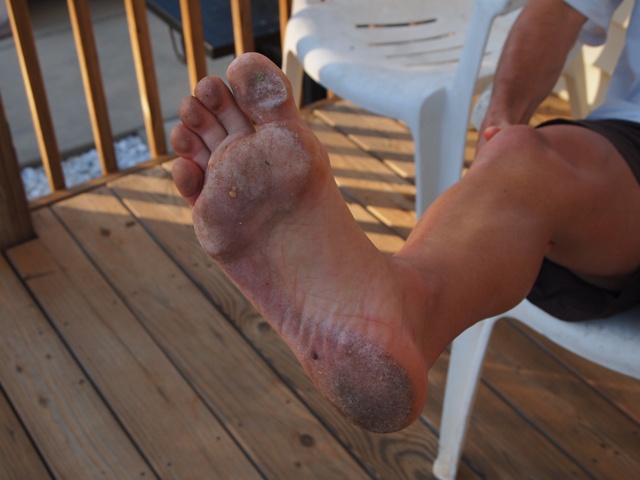 Sock Doc readers know that I only wear socks on my feet while in the office treating patients, hence the name. I have yet to ditch the socks in the office setting as I don’t feel they’ll look great with dress pants and a white lab coat. I advise every patient to go barefoot as much as possible since the feet are loaded with nerve endings that sense contact with the ground. Those nerve endings communicate with the brain and affect one’s entire nervous system. Your nervous system runs your entire body, therefore going barefoot can not only improve lower leg function and balance, but your entire health. I never wear shoes at home and I rarely wear them in the yard, (I typically wear sandals), unless it’s cold outside.
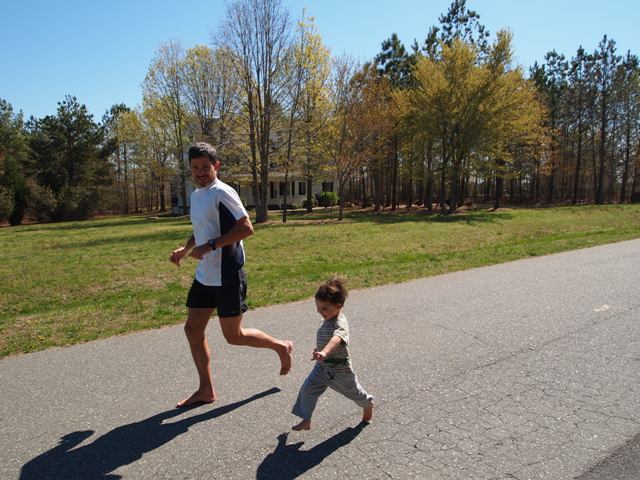
This past weekend and with warm weather here in the Chapel Hill area of North Carolina, I decided to shed my last line of defense and leave the running shoes at home. Typically I run in Nike Free 3.0, sometimes my Vibram FiveFingers. I’ve run in minimalist-type shoes for many years now and I’ve run several times at the beach barefoot, but the most on the road was a one-time stint of just a few minutes. You can’t get any more minimalist than being barefoot; it is truly zero-drop, the heel and ball of the foot are on the same level.
So off I go and I’m feeling pretty good. The soles of my feet were tender, especially on parts of the pavement that weren’t entirely smooth. I had to “dance” around areas at the ends of some roads where gravel tends to accumulate; out here on country roads there tends to be lots of them. But I kept running. Originally I was planning on running maybe 10-15 minutes. But I felt good so I kept going. My heart rate was very aerobic, in the 130-140 range, but there was one thing that really struck me by surprise and excited me – my running cadence.
I think it’s important to check cadence. It’s something I’ve done in the past on the bike and more recently while running. It’s a valuable number to be aware of and easy to check – just count how many times one foot, (either your right or left), hits the ground in one minute. An efficient cyclist will have a cadence rpm above 90, some closer to 100. Inefficient cyclists tend to be in the low 80s or upper 70s, and instead of spinning, they are working too hard, and usually anaeorobically. Running cadence is very similar. Kenyans are running at a cadence of 94 to 98 even in the later stages of the marathon. Other elite runners are running in the 90-94 range. Slower, inefficient runners tend to be in the range of 76-86 and even less when they’re not racing. Elite runners tend to keep their cadence about the same even when running slowly.
Biomechanically, there are only two things you can do to run faster. You can run with a faster cadence or you can run with a longer stride. If you lengthen your stride, you lose efficiency because it produces more vertical oscillation. In other words, you bounce too much. But running with a higher cadence means the foot spends less time in contact with the ground and that means running faster. If you land on your heel it will take a few more milliseconds for the foot to be lowered to the pavement and then roll forward and finally push off the ground at the toes. Ground time of his type of foot strike will add up over the miles than if you landed with a more flat or midsole strike. Plus, a heavy heel strike produces more impact and that stress adds up too and will cause fatigue sooner than if you stayed off the heel.
So back to my running cadence – even in my Nike Free 3.0 I ran at a 91-92 cadence. That means my right, or left, foot was striking the ground 91-92 times every minute. Not too bad. But going barefoot – for the first time on pavement – my cadence was at 98-99, and I checked it three separate times throughout the run. Wow. I wasn’t even running very hard, yet my feet were hitting the ground a total of 15 times more every minute. That’s amazing. Even adding a few steps per minute is tough to do and typically takes a lot of training. So I kept running barefoot. I ran 10K in 50 minutes with an average HR at a nice aerobic 136. I was smooth, fast, and efficient.
One other thing I noticed was that other than some slight tenderness on the bottom of my feet, (which was gone by the next day), running barefoot was better for me than running in my FiveFingers. My current thinking on this is that in the Vibrams, my feet are fooled into thinking they’re barefoot, but they’re really not, and that tricks my nervous system and makes my feet less responsive to the terrain. Small pebbles and rocks actually hurt more in the Vibrams. Going barefoot, my feet can self regulate as I run. I don’t feel that way nearly as much in the Vibrams. Plus, the Vibrams didn’t give me that Kenyan cadence.
One thing I do now know: I will spend more time running barefoot as part of training. Will I ditch my shoes for good? Highly unlikely.
UPDATE (May 29, 2011): I am no longer running in the FiveFingers. They were causing some sharp pain on the outside of my right foot, right around my 5th metatarsal, after running in them for approximately 30 minutes. Half my runs are now barefoot (on the road – pavement), and the other half in New Balance Minimus Life. I am using the Nike Free 3.0 for yardwork. I really like the NB and I don’t perceive the Minimus Life to be a walking/recovery shoe as they’ve designed it. It’s only a 4mm (10mm-6mm) drop and fits like a slipper. I plan on wearing their newer version of a zero-drop model when that comes out, and hopefully running more and more barefoot everyday. For trails I wear the New Balance Minimus Trail.
This article originally was written for Zero-Drop.
Dr. Stephen Gangemi "Sock Doc"

I'm a board-certified chiropractic physician and clinical nutritionist with a passion for true natural health care. I implement dietary & nutritional therapies, exercise & movement practices, and lifestyle changes along with manual therapy techniques to help the body heal and prevent illness and injuries.
Jen says
I think you probably meant 198-199 on your cadence. I notice the same thing too that in my Vibrams or other minimal shoes that I just don’t adjust for the rocks like I do barefoot. Great post!
Sock Doc says
Thanks! Actually cadence is measured by one full revolution – so every time one foot (the same one) hits the ground in running, or one full pedal revolution in cycling. But you can count every one if you want you just get 2X the number and it’s more counting!
Rob Sturm says
Interesting read. I just purchased a pair of vivo barefoot shoes to wear to work. Out of the box they are the most comfortable shoes I’ve put on but I can tell from my initial walk around in them I’ve learned some bad habits in my traditional shoes — for instance my heel was hitting quite hard.
On their site, they have this video with some drills to help switch– it’s more geared towards runners but I was curious to get your take.
http://www.youtube.com/watch?v=Jio7DK15Q1E&feature=player_embedded
Sock Doc says
Yes. Any Saxby running info is good stuff. Remember heel striking is ok walking but not running. Your body won’t want to heel strike running barefoot.
Abby says
Hi Dr. Gangemi,
My name is Abby and I subscribe to your newsletter (thank you) and I also helped you plan your trip to Kona a few years back for the Ironman.
Anyway, I run about 30 miles a week and I really want to get the Vibram five finger shoes, but my feet are extremely flat and overpronate. I heard from some people that these shoes or barefoot running may not be the best for people like me. What do you think?
Thank you so much for your time!
Abby
Sock Doc says
Hi Abby, thanks! I’m going to write a post on overpronation soon. It is not the cause, but a symptom. And it’s not from your flat feet. You will overpronate when you have weak feet/calves and/or fatigued adrenal glands. So the more you wear non-minimalist shoes and don’t go barefoot the weaker your feet will become & the more you will overpronate. So yes – get the Vibrams or Merrills or Altras or Nike Free 3.0. Whatever you like. And if you’re overtraining or under too much stress you will overpronate too because those lower leg muscles are closely tied in with the adrenal glands.
Now the flat feet – people have flat feet either because they’re born that way or they lose their arches sometime later in life. If you have an arch non-weight bearing (seated) but then they’re flat standing then you lost the arch because the supporting muscles are fatigued. More reason to go barefoot or zero-drop and check your overall stress levels. If they’ve always been flat – not nearly as common – then no need to worry; that’s how you’re made!
Elizabeth Dunn says
Hi, I live in a basement apt. there is no carpet, just vinyl flooring. And I work in a grocery store with hard floors, and a thin mat. What do you recommend for shoes, I wear new balance tennis shoes 608 and orthotics made for me after an adjustment. thank you , liz
>
Sock Doc says
The recommendation is the same on any surface – your feet can adapt if they are strong and you are healthy. Don’t think you need more cushion just because you’re on concrete. So go with a minimalist type shoe you feel comfortable in whether that is Merrill, Altra, Nike Free 3.0, etc.
Also, although it is nice that your orthotics were made after your foot was balanced and put in what is referred in the industry as “subtalar neutral”, I still recommend you work your way out of them. Just as you would not walk around with a back support brace or other supporting device all day long, foot orthotics will keep you from strengthening your feet naturally. And they will have a negative affect your balance, agility, and health, even if they were “made for you.” Don’t buy into the hype; I’m all too familiar with it as I used to wear them all the time & make them for patients. Unfortunately there are still too many podiatrists, chiropractors, and physical therapists prescribing orthotics.
Cindy says
Hi,
I’m a long-time soccer player that has made the transition to triathlon. I was diagnosed with plantar fasciitis about ten years ago which can get pretty bad by the end of the day (I’m a soccer coach so I’m on my feet all day and wear running shoes to work) and I was wondering if buying a minimalist type shoe is a good idea for a person like me. I’ve worn soccer cleats for the last 25 years of my life (which were pretty minimalist by shoe standards except for the cleats on the bottom of the shoe) so is it possible for me to make the transition for running and training or should I stick with my Asics gel running shoes with cushioning? Thanks for your help, Cindy.
Sock Doc says
Well you’ll definitely be better for it if you can get out of those gel shoes. You’re saying you still have PF after 10 years? The longer you wear thick supportive shoes the more you’ll weaken your feet. Check out the PF video and the post https://sock-doc.com/2012/03/healthy-people-barefoot-people/.
Denise says
Hi Dr. Gangemi,
I prefer to dance (zumba for example) than to run for aerobic exercise. I still have plantar fasciitis but I am getting a little stronger thanks to your videos. I am still transitioning though and not yet minimalist. How should I approach my workout for right now, get a minimalist shoe or barefoot?
Sock Doc says
You can’t jump to barefoot if you’re still in the transition phase!
https://sock-doc.com/2012/04/lose-your-shoes/
Tre says
Hello, I enjoyed your article. Last November I started walking and running barefoot as much as I could even down to below freezing.
I started by walking on uneven terrain (plowed fields) and running on concrete. I found that it takes several weeks to build up the skin and over 6 months to build up the strength to walk on uneven terrain. If I wear shoes for a week or two my skin becomes fragile again but the strengthing stays. This makes it hard to run on fine gravel but larger rocks are ok.