 Consult with
 Sock Doc Workshops
 See the attached PDF for my recent article in Paleo Magazine, August/September 2014 edition – “Barefoot“. Check out Paleo Magazine for more great articles.
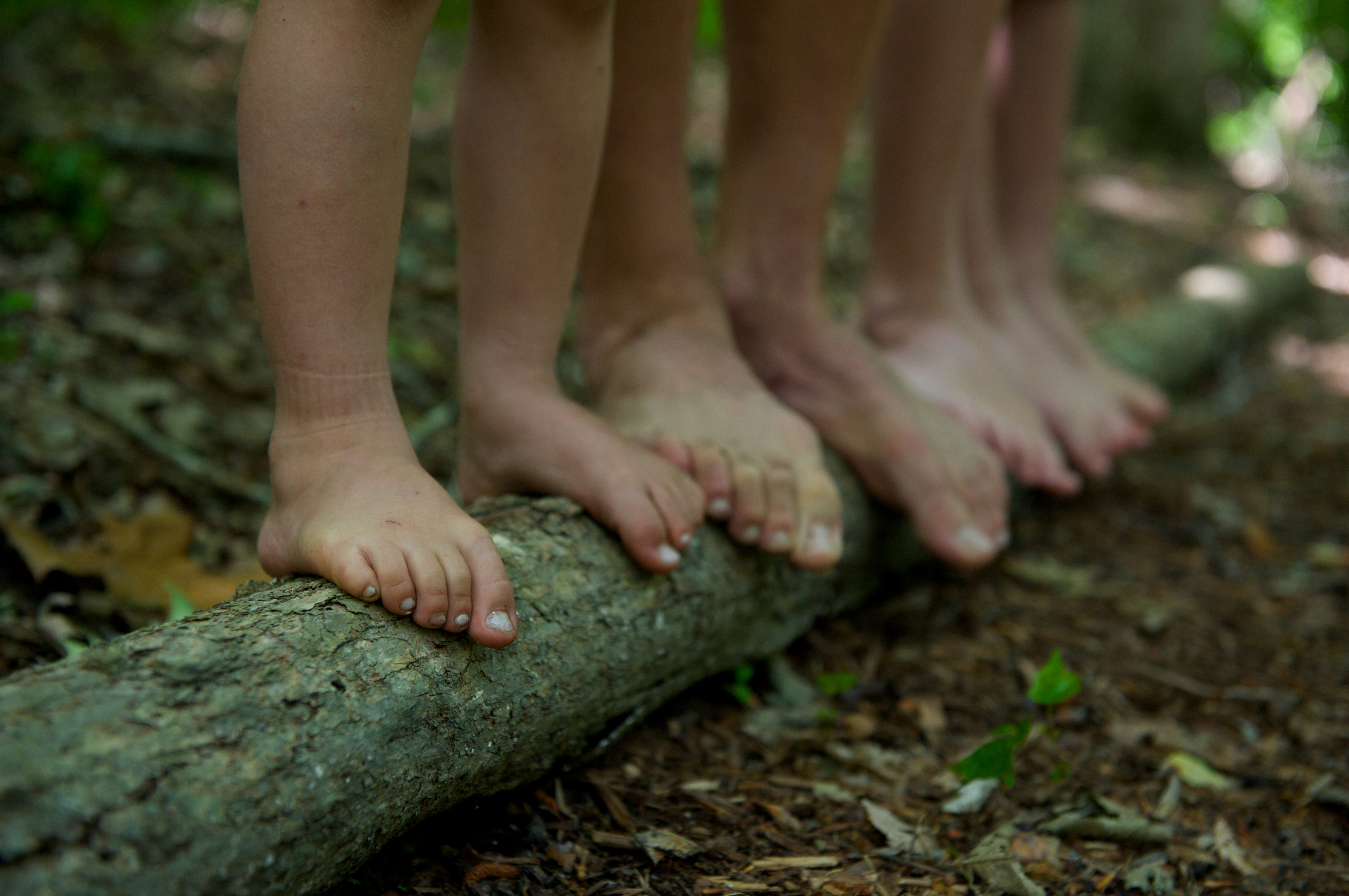
Humans, with rare exception, should be able to function well while barefoot from birth until death. Although sadly many people are unable to walk, run, or stand barefoot even for a few minutes without feeling discomfort, pain, or general uneasiness. Many people have essentially lost their ability to support themselves without secondary support, either because of poorly developed biomechanics or underlying health problems. What I’m referring to is a true barefoot individual – one aspect that should be, but often is not part of, a Paleo lifestyle. If you’re one of those people with a closet full of minimalist shoes for every occasion and you put yourself in that special barefoot club, I’m suggesting you actually literally step out of that false sense of reality that you’re giving yourself and your feet, and truly go bare.
Is Barefoot for Everyone?
I don’t think there is a debate on how we were meant to run, or even walk for that matter. Humans are not meant to over-stride and land on their heels when running, which today’s typical running shoe forces. Even while walking, conventional footwear will elicit more of a heel strike, extended stride, and an unnatural, inefficient push-off with the foot. A barefoot walker will land softly with a shorter stride and efficiently roll off the foot. Yes, even if you wear the thinnest of something under your feet you will change your gait and how your foot lands. But you also need to be healthy to be able to move barefoot.
Health is not merely the absence of some pathological disease. Many people think they are healthy but often they are not as healthy as they could be. Do you sleep well throughout the night without awakening and wake up feeling refreshed, without aches and pains? If not, I’d define that as poor health. Do you take any medication – whether it’s an anti-inflammatory, hormone replacement, or a drug to wake up, to go to sleep, or to have sex? Taking any medication is a sign of some health problem, (yes they are sometimes truly necessary). Do you lack physical and/or mental energy during the day? How about your digestion? Are you one of the many men and women I see as patients who think it’s normal to have a bowel movement just a couple of times a week? That’s definitely not healthy. Do you need some form of traditional footwear with support and extra “cushion” so you can walk, stand, or even exercise? Or even worse, do you need to wear an orthotic in order to walk without pain? If you do then you’re definitely lacking in the health department of conditioning.
You may not wish to go barefoot, but you should be able to. Sure, if you’ve been wearing traditional shoes for some time you will need to gradually transition into barefoot and/or any minimalistic footwear, but a healthy person can achieve this feat. You have to work your way towards barefoot just as you do health – they are both processes. Health and barefeet complement each other.
For those of you who may think that going barefoot does not have a significant impact on how you move and feel during the day, I would ask how many of you are actually barefoot for a prolonged period of time each and every day? I have yet to meet a person who is often barefoot, rarely wearing the typical shoes found today, who has not told me that they feel more vibrant, agile, and have overall more body awareness than when they were shod. Again – I’m referring to being 100% barefoot for most of the day.
Barefoot Beyond the Feet
Each foot is home to thousands of nerve endings and the information they receive and pass on to the rest of the body is anything less than extraordinary. When your foot feels the ground, (or whatever is below it, including any footwear), the thousands of touch receptors in the nerve endings feed back to your entire nervous system. Since your nervous system runs your entire body, any foot impairment, dysfunction, injury, pain, or improper footwear can not only hinder you directly, (such as lower leg function and balance), but it also has the possibility to affect certain aspects of your health.
Walking or running barefoot is an ideal way to improve your proprioception (sense of position) and kinesthetic sense (the feedback your nervous system receives from your feet). Natural, unaltered motions of the human body provide optimal neurological input and increase blood flow to the brain, improving the health of the nervous system. This increased blood flow provides more nutrients and oxygen to the brain and essentially the entire body thereby improving the health of the un-shod person. This is especially important in a developing child and is why a child should be barefoot as much as possible, inside and outside.
Use It or Lose It
If you’re not injured and truly healthy should you get out of your traditional footwear? Though many advise just to keep doing what you’re doing, I don’t support that position. You will only truly be sure if your feet and other areas of your body are strong and healthy if you venture out of your footwear. If you have trouble doing so, it’s an indication that there is a problem you’ve been supporting just as if you were not having elbow pain every time you played tennis because you wore a brace. Just because you don’t have pain, weakness, or discomfort doesn’t mean a problem is not there. Ask yourself WHY you can’t be without your supportive shoes or supportive foot braces (orthotics). This doesn’t mean you go barefoot right away, but you should enter the realm of minimalism just to get an idea of where you’re at.
We’ve all heard the saying “use it or lose it”, and the feet are no exception. If you don’t place certain demands on your tissues, there’s no reason for them to adapt and stay developed. Eventually, the muscles, tendons, and ligaments you don’t use you will lose their function. If you wear shoes too often then you’re risking losing motion, stability, and proprioception as you age and this can not only result in the obvious balance problems but may also affect other areas of your health.
Transitioning Towards Barefoot
Yes, too many people are getting injured by switching from their current footwear to minimalist footwear or even barefoot. This gives the traditional medical doctor, podiatrist, or therapist reason to believe that humans today are not meant to be barefoot and we need to protect our feet with more supportive shoes. I get a fair share of hate mail from these people who think that because we don’t live in wild jungles we need support on our feet to get through the day on our “unnatural” surfaces. Though of course I don’t agree with this, the typical unhealthy person and/or person who has always worn supportive footwear or orthotics can’t just make the shift in a drastic manner. Many of them do, and they get injured. When the doctors and therapists see them in their office, rather than educating the patient on overall health, (diet, lifestyle, and foot care), they convince them that barefoot is evil and humans need shoes all the time. This is pretty sad in my opinion, but it is the standard of our health care system.
You must transition to barefoot slowly and carefully so you do not become injured. Start just by walking barefoot inside your house as much as you comfortably can. If that’s painful, then you can start with a minimalist-type (transitional) shoe and eventually work out of those towards being barefoot. It’s okay and often advised to alternate between your current traditional shoes and a minimalist shoe/barefoot if you have pain. If you’re wearing orthotics, talk to your prescribing doctor about weaning out of them so you can walk naturally again and not support your dysfunction – that’s essentially what orthotics do. If your doctor doesn’t think that it’s possible for you to rehab your feet in such a way, then personally I’d find another doc, unless your situation truly warrants a supportive device (which is very rare). If you’ve been wearing supportive shoes with orthotics for years the transition might take some time.
Once you can comfortably walk barefoot, then work on balancing (one leg at a time) while barefoot for several seconds to a minute at a time. Hard surfaces (tile, hardwood) are okay and advised! Next, venture outside onto hard, smooth surfaces such as your driveway. Slowly build up time as comfortably as you can. Eventually make your way onto other surfaces such as grass and gravel. Of course, make sure these areas are safe to walk on. If barefoot is bothersome to you outside then use a minimalist shoe at first.
After you’re walking barefoot outside comfortably then try a bit of barefoot running on a flat, hard surface – not too much at first or you’re likely to develop sore feet and calves very quickly! If you don’t want to or don’t like to run that is perfectly fine – continue to walk barefoot outside, and especially inside, as much as you can.
Going barefoot isn’t about following some trend. Many people are trending barefoot just as they are Paleo – it’s the latest fad. Yet, the minimalist/barefoot trend is already going backwards after just a few short years. If you follow this trend you will soon be wearing a thicker, softer shoe next year than you were last and you’ll miss the health and fitness benefits of wearing less without even knowing it because fewer and fewer people will be talking about it. Minimalist shoes are only getting thicker and softer, much like the average human being. The Paleo lifestyle is the complete package. It’s a way of life. It’s not eating gluten-free while you sit at a desk all day and walk in thick shoes. Lose your shoes entirely and take yourself to an entirely new level of well-being.
Dr. Stephen Gangemi "Sock Doc"

I'm a board-certified chiropractic physician and clinical nutritionist with a passion for true natural health care. I implement dietary & nutritional therapies, exercise & movement practices, and lifestyle changes along with manual therapy techniques to help the body heal and prevent illness and injuries.
Mike Harold says
Have you any experience (or findings) about alpine hiking in bare-foot style shoes? Ie with very thin and flat soles rather than the clunky 2 kg boots that seem to be standard?
Mike Harold
Sock Doc says
I haven’t, not even zero-drop. I wish a company like La Sportiva would come out with a zero-drop mountain shoe.
David E Soto Jr. says
Well said.
I recently couldn’t figure out what was going wrong with my running. Crippling calf pain was limiting me to short, under two mile, runs. I realized that it seemed to coincide with my switch to Merrell “barefoot” shoes from VFFs. I ditched them both and went back to barefoot and experience a pain free run immediately. I ran barefoot exclusively a couple years ago but slowly, as you described in the article, reverted to thicker and thicker minimalist shoes. It resulted in my not liking to run anymore and basically, for the most part, stop running. But I’m back… working on it anyway.
I’m also real curious about hiking and backpacking. I have done day hikes in VFFs but not sure what to do about overnights. Any thoughts?
Dave
Sock Doc says
Yeah your experience is not uncommon. Some people find it very difficult to find shoes (if any).
I’d think VFF’s would work on long hikes? La Sportiva makes some “great” shoes but unfortunately none are less than 4mm drop and they’re all stacked up.
Nico Wellinger says
Hi Mike,
my family and friends are using nothing but Luna Sandals when hiking and climbing in the bavarian, austrian and swiss alps. You have a Vibram Sole working on all even wet rocky terrain and don’t have to complain about aching toes hiking down the hill for hours:-) But this is only our solution for rocky terrain above 6000 Feet, below we try to move barefoot.
Check out lunasandals.com
Cheers from Munich
Nico
Karen Johnson says
I’ve been transitioning to barefoot over the last 4 months. Currently I hike about 5 miles a day wearing patagonia rovers. Inside I’m barefoot. At other times I wear zero sandals or VFFs or moccasins. For the past month I’ve been experiencing tingling or pins & needles in my feet for about the first 5 minutes after I get out of bed, or after I’ve been sitting for a long time. The rest of the time my feet feel fine. I’m in good health (no diabetes), paleo diet, 53 years old. I’ve tried searching google for this symptom but have found nothing. Any thoughts?
Karen
Sock Doc says
Typically that’s a soleus issue. Lots of info here on the SD site – particularly videos on the feet.
Anita says
Hi
I notice a lump on the back of my heel on the achilles tendon. Could it be a mass.
I am scared.
Thanks
Sock Doc says
Have it checked out by your doc.
Jill says
I came across your website last year after having trouble with insoles and really liked your barefoot philosophy so I tried it out. I was trying to ease into it slowly, but one day while standing in my office barefoot I felt a subtle shift in the ball of my foot. This was last November and my foot has been numb ever since radiating up past my knee. I’ve done chiro, physio, acupuncture, osteopathy. Nothing helps and it seems to be getting worse. Have you ever seen this before?
Sock Doc says
Well I’ve seen a lot of foot problems; I suggest you look for another therapist who can address this for you. Barefoot doesn’t cause this problem, but if your shoes were supporting a weakness/imbalance then that would have been revealed once you took that support (shoe) away.
Kathy Poling says
What are your thoughts re: cross friction therapy? Specifically on an achilles pump bump.
Would you know of any physicians like yourself in Southern California?? Your web page has completely changed my thoughts on running gear (now running in Altra shoes) and I now go barefoot more than ever before at home.
Thank you!
Sock Doc says
I would stay off the Achilles as I would any injured area. Look to the soleus for an Achilles issue.
Sally says
Hi Doc. Two years ago I was virtually crippled with Plantar Fasciitis and had spent over $1,000 trying to address it. I read your blog and healed it by following your advice. You changed my life. Thank you. I’d love your opinion on the following:
My pediatrician noted at my son’s recent (12 yrs old) well check that he has flat feet. She said that should always wear shoes with arch support. I have been buying him barefoot style shoes and encouraging him to go barefoot when possible since discovering your site. Would you recommend anything specific for a child with flat feet?
Many thanks for what you do! Sally
Sock Doc says
Your pediatrician won’t be able to back up her claims regarding the arch support. That is ridiculous. If you want to weaken your child’s feet as he grows, then use arch supports and orthotics. So disappointing to hear that so many docs are recommending this based off misconceptions and bad science.
Corey says
Only barefoot is barefoot, I wish that people would not put minimalist shoes in the same conversation with going barefoot. Only barefoot is the bare foot and it’s 200,000 nerve endings in direct contact with the environment!