 Consult with
 Sock Doc Workshops
 The typical kid today isn’t outside much, and most aren’t moving as they should be even while they are indoors. They’ve developed awkward, uncoordinated movements as a result of being immobile, wearing modern footwear, and eating a highly processed and nutrient devoid diet. It’s said that one in six kids today will either be born with or eventually be diagnosed with a development disorder. The developmental disorders range from sensory disorders such as dyslexia, ADD, and autism, to motor skills disorders such as dyspraxia. These diagnoses are not only more prevalent today but many “typical” kids have balance problems, weight issues, and generalized body weakness. Many kids never exercise at all while others specialize in one sport their entire childhood years.
Dysfunctional Problems in Kids Increasing
In my practice I see a wide variety of people with a wide variety of problems. From a professional athlete with a knee injury one hour, to a kid with an ear infection or a woman with hot flashes the next. It’s not uncommon for me to see at least one kid a week with some type of movement disorder. Some of these kids are diagnosed with dyspraxia already, some are not. But the diagnosis never matters much as it doesn’t address the problem, it just gives the problem a name; what’s for certain is that a lot of kids move very poorly and a lot don’t move much at all.
The average child today, whom I will define as between the stages of walking and driving a car, is uncoordinated and simply inefficient at movement. Some of this is because they never developed properly maybe because they were forced to walk too early to impress the grandparents at Christmas or perhaps they were wearing shoes from their first few steps onward.
Then there are the kids who are really good at sports, but these kids are different today than when most of us grew up. Today a kid finds a sport and sticks with it – often all twelve months out of the year. They quickly become specialists in one sport whether it be running, swimming, golf, baseball, or a host of others. At a time in their life when their body doesn’t just want but requires the development of various movement patterns they isolate single (or several) movements depending on their one sport. 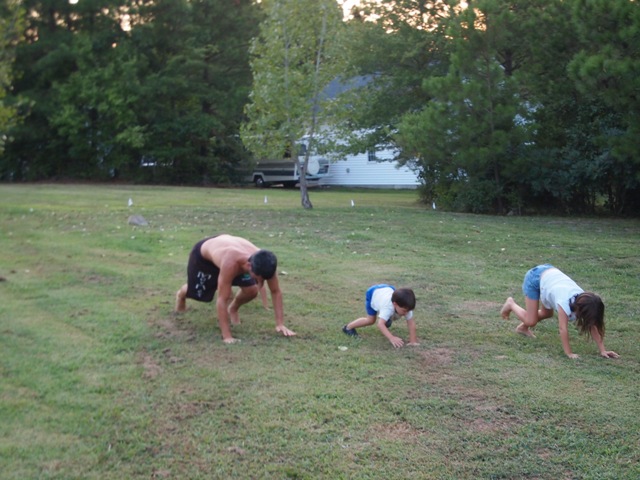
Specialization and Isolation = Modern Day Rehabilitation
The kid who grows up playing just that one sport is going to increase his or her chances of an injury as complex neurological and musculoskeletal patterns are never properly developed. But even worse are the kids who are exercising because they have to due to some developmental disorder such as dyspraxia or hypotonia (low muscle tone). Most often the therapist treating these kids recommends isolated, unnatural movements in an artificial environment rather than nervous system stimulating outdoor exercises in a natural setting. Even worse, most of the kids are fitted for unnecessary foot orthotics which further dampens their sensory system resulting in diminished motor response.
As Erwan LeCorre notes in the second MovNat Principle, Instinctual – moving naturally is an innate behavior. If kids have never developed normal, natural innate movement patterns such as crawling, walking, jumping, climbing, etc, then their brain has yet to develop to its full potential at the current time in their life. Asking a child to take a therapy band and move it to strengthen their shoulder muscles or wear more supportive shoes while trying to balance is desensitization of the nervous system, even if insurance pays for it.
MovNat Skills for Every Kid
So what’s a parent to do? My suggestion is to think basic health and fitness principles. This is where MovNat skills, outdoor exercises and principles fit beautifully.
First, have your child un-shod as much as possible. Inside or out, unless foot protection is needed, lose the shoes. Where shoes are needed think flat, firm, flexible, and wide. This means there is little to no heel (level footwear), there is no cushion or thick sole, the shoe is flexible throughout and in every direction, and there is a wide toe box for the toes to naturally splay apart. Proper body awareness and position (proprioception) and sensory feedback into the nervous system (kinesthetic sense) cannot be achieved wearing modern footwear. Shoes distort important neurological patterns from being developed by the brain. Neurological input from body movements increase blood flow to the brain which promote growth and development of speech, learning, and memory. These processes are impaired in the child wearing shoes. Shoes also disrupt gait which isn’t good for any kid especially one with a health problem.
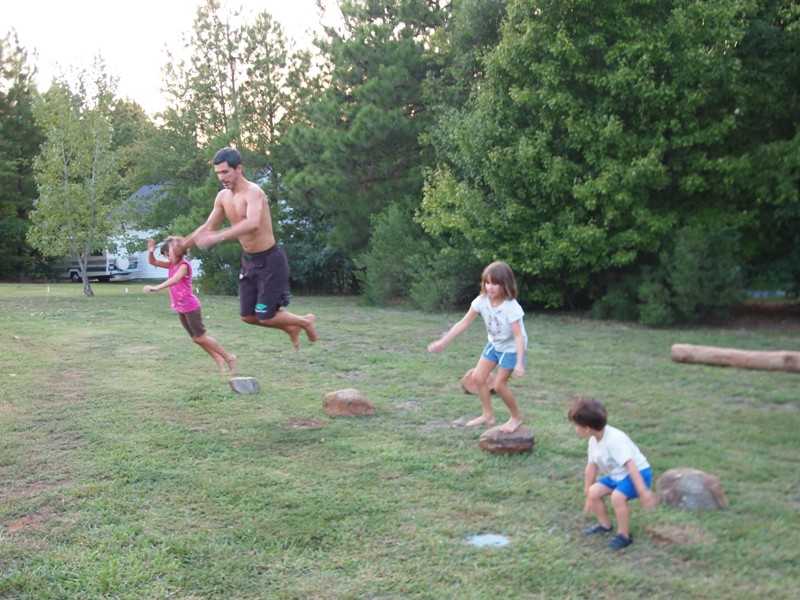
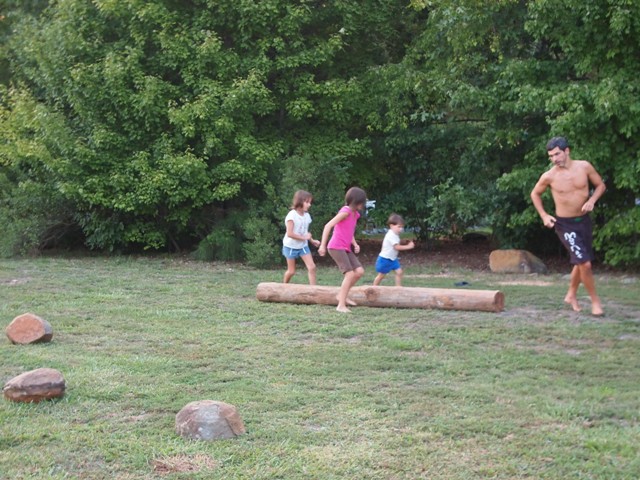
Second, let your kid play. Hopefully you don’t have to make them play, but at later stages in life unfortunately many kids don’t want to play or have lost the ability to play naturally (outside). If they’re just not sure how to run, climb, crawl, throw, lift, etc., then some instruction may be needed. If your child has any movement disorder consider what can be gained by having them walk barefoot outside, crawl around (forwards and backwards), balance, and lift a manageable object and carry it a distance. I think that’s ideal rehab for the entire body and the entire nervous system. This isn’t to imply that you take your child’s rehab therapy into your own hands, but to accentuate that process, or perhaps prevent a problem before it starts.
Finally, (although a healthy diet is essential I will not discuss here), reduce or eliminate artificial sensory stimulation in your child’s environment. The easiest and most effective way to do this is to limit TV and computer time. Not only are kids less active the more they watch TV and use a computer, but it excites their nervous system which in turn affects their focus and ultimately their motor system. (This is why a child with sensory issues has a ‘ism’ such as jumping or hand flapping when they are over-stimulated.) I’ve seen some pretty amazing results in kids when the parents cut TV down to one-half hour a day or in some cases, altogether. Especially remove a TV or computer that is in your child’s bedroom as it’s well known that they can negatively impact sleep, even if not actually ‘on’.
The overall idea here is that kids need to practice or re-learn MovNat skills, as at one point in their life most had the necessary locomotive and manipulative skills. Many of them have lost these basic principles at a young age, some due to health disorders, others because of modern day life, and others due to sport specialization. You’ll see some pretty amazing changes in your barefoot-moving kid regardless of their current health or fitness level.
This article was originally written for MovNat.
See also Endurance Orientated MovNat Training and also my full run-down of my 5-day West Virginia workshop, 2011, here.
Dr. Stephen Gangemi "Sock Doc"

I'm a board-certified chiropractic physician and clinical nutritionist with a passion for true natural health care. I implement dietary & nutritional therapies, exercise & movement practices, and lifestyle changes along with manual therapy techniques to help the body heal and prevent illness and injuries.
Greg Slatner says
Right on Doc!
ray mcclanahan says
Thanks for another great article Dr. Gangemi! This information is so practical for parents. Especially parents like my wife and I who have our daughters in a school system that is cutting physical education.
Very helpful! Thank you!
Angus says
Hi Doc, Great info here. I’m looking for info on baby/toddler development MovNat style. As you mention in this article, learning to walk too early can be detrimental. Which “developmental” toys should I chuck out? And what should my 6 month old be playing with to help develop naturally?
Thanks
Sock Doc says
I’d say anything that helps with head/neck control, crawling, and rolling around that age is great. (The ground is a great area to be rather that in devices, such as walkers or jumpers.)
Sunny says
Can you make some more recommendations specifically for parents of kids with hypotonia? Would be so grateful. Found this trying to get a Movnat perspective on hypotonia because my son might have it to some degree.
Dr. Stephen Gangemi "Sock Doc" says
That can be pretty in-depth so not something for comment sections. I think going barefoot as much as possible and getting your child outside in nature is vital though!