This winter I’ve treated more patients who have been injured, some rather seriously, due to slipping on ice. Sure, anyone can have bad luck and slip on a sleek surface, but you can increase your odds of staying upright if your brain and your body are communicating well with one another. If you do fall, how you land will greatly determine if you get injured or not. I recently saw a guy who slipped on ice and landed on the back of his head. That was his first point of contact, and obviously not a good one. He’s suffering symptoms of a concussion, which for many can last a year if not longer. Some people die from similar falls. So to lessen your chance of sustaining an injury, I want to first discuss how to walk on any surface (particularly on ice), and then what to do if you happen to fall.
Walk over Your Feet
You may have heard to “walk like a penguin” on ice, as this puts your center of gravity over the foot/leg that your weight is being transferred to (often your front leg). This is good advice because it stabilizes you more, and your leg is not way out in front with your body left behind. Or else, your leg will go more forward on a slippery surface, and you’ll go behind, perhaps on your behind.
However, think about how you should always walk if you move naturally in an unaltered fashion. Your feet should contact the ground closer to your center of mass rather than extending forward. Many people have poor gait mechanics, which is either due to or exacerbated by poor footwear, so their leading leg extends out too far, and they strike the ground with the back end of their heel. There is very little support when doing this, and if the surface is slippery, then you can quickly lose your footing.
As you may imagine, the footwear of choice in the winter is something warm like a boot, and these often have a very thick heel. A thick heel is going to essentially make it so your gait is extended—your stride will be longer than it normally should be. Many people walk like this all the time because they’ve always worn such footwear. Take your shoes off and see how far you extend your leg out to walk. It won’t be nearly as far as if you have some thick-heeled shoes on.
If you’ve read anything about barefoot running or minimalism, you’ve heard that when you run, you should land more mid- or forefoot rather than on your heel. When you walk, it’s rather normal to touch your heel, but striking hard with an overextended leg is not a good thing, especially if you’re on ice. You should softly land toward the center or front (toe side) of your heel, and then nicely roll forward and push off on your toes. That’s a healthier gait than striking hard on the heel and flopping your foot down, and then using more energy to push off on the toes. Actually, many people don’t even push off correctly; they sort of pick up their foot and carry it forward again.
So yes, walk more forward over your feet when on ice. But when not on ice, don’t walk so far back!
Move Naturally on Every Surface
Being barefoot is really an essential first step if you want to move well. If your foot is moving as intended, then the message it is sending to your brain will be accurate—it will tell you where you are at all times. This is because the mechanoreceptors on your feet are firing properly as you move. Mechanoreceptors are sensory nerve receptors that respond to mechanical stimuli, such as pressure, touch, and movement. You want as much healthy sensory stimuli getting to your nervous system, which includes your brain, as possible. Put on a shoe that alters these mechanoreceptors, and your brain will get confused. If your brain gets confused, then your proprioception will be altered. Proprioception is a sense of where your body is, as determined by the conscious feedback it receives from muscular, tendon, and articular sources and the unconscious feedback from the cerebellum of your brain. Your cerebellum plays a key role in your motor control, so it’s rather important if you choose to move well. If you get car sick, for example, you most likely have some cerebellum issues. If you get dizzy while doing some rolling on the ground, and it takes a while to get your bearings, then your cerebellum is compromised. So basically, if your foot moves poorly, then your brain gets confused and your position is compromised. This might not affect you too much until you’re on an unstable surface like uneven ground, or, of course, ice.
Fall the Correct Way
If your brain and foot/ankle are in precise connection with one another, then you’ll definitely increase your odds of getting down your icy steps and across your frozen driveway. But hey, sometimes sh*t happens, and you just aren’t paying attention and you slip. When I think of this and talk to patients about falling, one of my favorite movies, Joe Dirt, comes to mind as he recalls, “my neck broke my fall.” Don’t be like Joe Dirt and land on your head or neck.
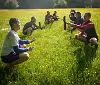
In MovNat, we teach how to fall properly. This may sound silly at first, but it’s a great thing to learn. The more you practice, the more likely it will become second nature to you if you fall, forward or back or to the side. So practice falling—it’s also some great eccentric conditioning.
When you fall forward (not as likely on ice, but it does happen), you want to land with your hands close together in front of your face, palms down. The harder you fall, the quicker this movement needs to happen. If you get to the point where your face might become part of the impact, then you should turn your face to one side. The way to practice this is on some nice soft grass while facing uphill. The steeper the hill, the better to start—you won’t have far to fall. You can even start while on your knees.
If you feel like you’re falling more to the side and not as straightforward, then definitely do not reach out with an extended arm. This is how people break their clavicle (collarbone) all the time. It’s a good way to break your wrist, too. Ideally, you lightly touch with your hand and then quickly tuck that arm under you—way under your body—and roll to the back of your shoulder. So you’ll either roll some or land on your back.
If you fall backward, which is most common on ice, the first thing to do is TUCK YOUR CHIN AND KEEP YOUR HEAD UP. This requires some neck strength. Strengthen your neck by lying on the ground and lifting your head up and holding it there for 20–30 seconds at a time. Also, as you fall backward, you want to slap both your hands and forearms to the ground to help dissipate the shock of the impact, palms down and forearms flat. Your shoulders stay off the ground, along with your neck and head.