Using Manual Therapy to Restore Essential Gait Mechanics

Manual therapy for gait mechanics

Moving and Beyond: Essential Gait Mechanics

Gait—it’s the movement of our limbs during locomotion. Our gait changes as we move faster or slower, and when we change terrain. Many people have poor gait mechanics, which limit their ability to perform to their fullest potential. Sometimes this limitation results in pain, and other times, there may be no pain but perhaps diminished power, speed, or strength. 

Gait is really how we move in any environment, hopefully in a natural movement. Obviously, there will always be times when movement isn’t quite “natural,” such as skiing or rowing. By adapting to our environment, we can move efficiently and effectively. Loss of proper gait often comes from injury patterns (both past and present), poor movement habits developed over time (or simply never learned), and your overall health. Believe it or not, your health, and particularly your diet and nutrition, can actually influence your gait. 

Neurologically Disorganized

Natural gait movements are essential, not just for proper joint mechanics, but also for a healthy nervous system. Take, for example, a quadrapedal motion (QM), such as the MovNat foot-hand crawl.  This cross-crawl pattern is something we’ve all done probably once in our lives, but most likely not for a long time. So when you try to do it as an adult, you’ve got to focus on it to redevelop the pattern. Perform the movement of going backward, and you really have to concentrate until your nervous system picks up the pattern and takes over.  If your body is stressed out for whatever reason, it will be more difficult to perform the motion, if not impossible.

Who hasn’t looked right when someone asked them to look left, or been asked to step forward with their left leg, yet stepped with the right? Many docs, including myself, would call this neurological disorganization, and it’s a sign that something is taxing the health of the nervous system. Performing a cross-crawl pattern like a foot-hand crawl forward, and especially backward, is not only a great exercise for your muscular and cardiovascular systems, but it’s also a great way to improve the health of your nervous system. 

Sometimes these patterns just don’t work right, and no matter what coaching cues you receive, you just can’t get it. Maybe it’s because you’re in pain. Or maybe it’s because your nervous system is too stressed—it’s essentially disorganized—and natural movements are a long forgotten pattern. Often, this problem is because of injuries or dietary/nutritional issues causing muscle imbalances.

Muscle Imbalances and Gait Imbalances

Muscle imbalances, often due to past and present injuries, are a major reason for gait disturbances; it’s a sign that your body is just not working right. These muscle imbalances will almost always have some trigger point associated with them, either in the muscle itself or perhaps distant from that muscle, making it sometimes rather difficult to figure out a treatment point. Trigger points are termed as hyper-irritable points in the muscle and fascial matrix, which alter nervous system function and can therefore alter gait. They are described as hard nodules, tight bands of fiber, or “knots” in the muscle or fascia.

Where there is a gait disturbance, muscles are (ab)normally working against one another, say a hamstring and a quadriceps. But also, opposite limb joints can be out of sync, say a left hip and a right shoulder. Stretching will not change a muscle that is neurologically facilitated (in spasm), and exercise of any type will not benefit a muscle that is neurologically inhibited (weak) more than temporarily. Many hold on to this belief that either type of therapy provides healing benefits, yet the balance of muscle function, and therefore the balance of gait, comes after muscle function is restored via manual therapy techniques like trigger point therapy.  

Trigger Points 

A trigger point is more often in the inhibited muscle—that’s the one that feels weaker to you. Many want to treat the muscle that feels tight and perhaps in spasm, so they stretch and do some deep pressure therapy in the muscle, but it often does nothing except perhaps relieve temporary pain. Mechanical sensory receptors, after all, are larger than pain receptors, so typically any direct therapy to an area will provide some pain relief, even if it’s temporary. 

Look for the trigger point in the muscle that you feel isn’t functioning very well or in an area that, when you hold a specific point (the trigger point), you experience more range of motion. For example, if you are having trouble raising your arm over your head, and your deltoid is just killing you, press with the fingers of your other hand into various areas of that delt and the surrounding muscles, and find one that helps you raise your arm higher. That’s the treatment point. 

Ideally, when you treat a trigger point, you’re pressing on it just hard enough but not too hard—you have to get a feel for it. This can sometimes be difficult to do on yourself. You can hold a trigger point, or rub it in a circular motion (either direction), or work the trigger point in a back-and-forth direction. One method may provide a better result than another on a case-by-case basis. Apply pressure or rub out the trigger point for at least 10–30 seconds. If the pain is improving as you treat the point, then continue until there is no further relief. Sometimes you can actually feel the trigger point “wash away” beneath your fingers and disappear.

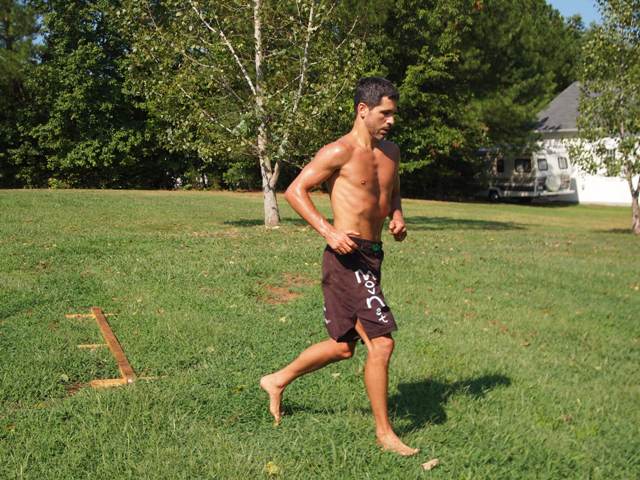
Trying to push through and alter the gait to make it look better when you have muscle imbalances is like painting over rust. The rust prevails. This is not at all to say that you shouldn’t work on form; it is necessary to some degree. It is to say that your gait is a significant reflection of your overall health and fitness more than anything else, except for perhaps improper equipment, as is often the case with poor footwear. This is why I always advise training barefoot. The wonderful thing about gait is that when it’s all working correctly, performance really takes off, and you’ll feel better overall. 

So work on correcting muscle imbalances with the method I described and see how it affects your overall gait. Then practice various gait skills often—not just walking but crawling, running, swimming, and climbing, pretty much everything that moves your body!