 Consult with
 Sock Doc Workshops
Oh, you caught me stretching my calves. This wall stretch that a lot of people do, a lot of runners like to do to warm up, is actually a pretty silly stretch. There’s lots of better ways that you can actually create normal flexibility and stability in your lower leg without having to actually stretch a muscle, to only weaken it and actually hinder performance, and even decrease injury recovery time. So let’s look at a couple of other ways that you can strengthen your calf muscles especially your soleus and your Achilles tendon to prevent and treat injuries.So one great way to increase the natural flexibility of your lower legs, your hips, your knees, and your ankles is actually to work on your deep squat, which I talked about on one of my other videos. So let’s just go over it really quickly. Feet about shoulder width apart, and you’re actually going to go straight down as far as you can while hopefully keeping your heels on the grounds. This is a stress position in many parts of the world. So at first it’s going to be a more difficult position for many people to get into. And actually, you’ll feel where you might have some mobility issues, maybe in the anterior tips of your ankles, maybe you’ll feel a little bit of a stretch or tightening in your Achilles, or maybe even in your thighs. So eventually, you should be able to get in this nice, relaxed position. If you have problems doing this, then what you can do is get up on a two by four, like this, so your heels are a little bit elevated, and then it’ll be much easier for you to come down like this. And another thing that I’ve shown in one of my other videos is that you can actually grab a pole or something in front of you to help with the counterbalance, or even hold a kettle bell like this so the weight will keep you more forward so you’re not falling back onto your heels. So that’s one great exercise or a drill to work on.
The second drill I want you to work on to help increase mobility and flexibility of your lower legs is actually to do a backwards run. This is a great eccentric loading exercise so your heel is sort of dropping down after the ball of your foot touches. A lot of people like to do eccentric heel drops. I think these are even better because you’re getting more of a loading into your Achilles and into your soleus, that lower part of your calf, and you’re going to help with a lot of strength in the foot and ankle. So, really simply, you’re going to run backwards really easy and lightly touch the heels after the ball of the foot lands just like so.
So the last drill I want you to try is a little bit more advanced, maybe a lot more advanced, for many people. And this one is going to really hone in on any little weaknesses that you may have in your ankles and your feet and any little ligament strain that you might have down there too. So it’s going to help a whole lot with strength and the stability of your lower leg and especially your balance too. So you’re going to need a two by four, and what you’re going to do is, as simple as it may sound, you’re going to stand on the board like this with the balls of your feet on the board and your big toe just hanging off a little bit. So not the arch and definitely not the heel. Just stand on the board like so without your heels dropping down, okay?
So get nice and comfortable, like that, and, once you do, traverse the board. Walk across, and it’s a lot harder than what it looks. You’ll really feel any little imbalance you might have in there. Once you get to one end, or get a little ways, then come back and go the other way, keeping those heels off the ground like I am right now. What you can also do is stop at a certain point and squat down, and I’m staying nice and relaxed here like this, staying on the balls of my feet, and then, to make it even more advanced, if you can, come up on the balls of your feet, like this. Get right up on your toes as much as you can and then back down, and do a couple of those almost like little calf raises but in the squatted position on the two by four. It’s pretty difficult, just like that, and back down, and come back up. I’m keeping my balance. I’m keeping my position, nice and tall. I’m keeping my heels off the ground, and I’m going to go and traverse the board again, just like that, never touching, or hopefully not touching. And if you do, just get right back on.
So let me just show you from the back now so you can see my heels. Put them on like so, traverse and across. Okay! And that’s how it’s done.
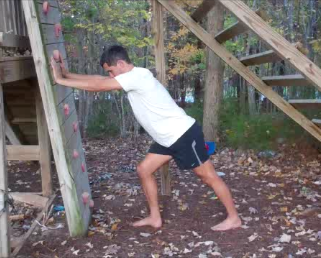 A common warm-up or cool-down ritual, particularly in the running community, is the straight-leg calf stretch. Of the many ways you can warm-up your calves, runners tend to like to push against a wall or other vertical object to get a good stretch and give them a feeling of security, as false as it may be. After all, most runners have tight calves, and most think it’s completely normal and comes with the total package of being a runner. Some feel the need to stretch in order to temporarily “loosen” the calves and be able to run while many more mistakenly think that the more they stretch the calves the less their chance of injury. Yet, stretching the calves in such a static “hold and stretch” manner is not associated with any reduction in injury and definitely not any faster healing time of injured tissue. Calf wall stretches, however, are a great isometric upper body exercise if you’re training to push something or someone over.
The Calf Stretch: Stretch More, Stabilize Less
Stretch and hold all you want but as a runner you’ll not effectively lengthen the muscles and improve stability at the same time to the point where you become a better athlete. Actually, the more you choose to do this calf stretch while leaning against the wall the weaker those tendons and muscles will become resulting in increased injury rates. Some runners are even taught to perform this and many other silly stretches after they run to “retain the flexibility” which they hopefully gained during the run. Are you kidding me? So if you hold a stretch for 8-20+ seconds then all of a sudden your body magically locks in the increased flexibility you got from your run. This is assuming you’re running efficiently in the first place, (which most people are not doing), and are actually creating some increased and healthy range of motion. It’s also assuming that you ran in the Land of Magic where post-exercise stretching for some short predetermined time now all of a suddenly prolongs gains just by adding in this little extra movement gimmick.
Functional Movement
Movement should be functional which means it should benefit your activity/lifestyle in a positive way. This is why deep bodyweight squats, for example, help with most all activities as the increased range of motion you develop in your hips, knees, and ankles will improve your flexibility and mobility despite not actually needing to squat while you run. Nor is your body in such an elongated position as the straight-leg wall stretch position while running yet at the same time you’re isolating the calves to make them temporarily more flexible, weaker, and unstable. What are you trying to develop – a longer stride where you’re pushing off at the point where your glutes (the power muscles of running) are no longer engaged and you’re relying on your Achilles tendon for power? It’s a very compromised position and if you’re really feeling a “good stretch” while doing this movement then you’ve got other issues that need to be addressed far beyond stretching.
More is Not Always Better
Longer, in regards to muscles, is not necessarily better unless the muscles and connective tissue (primarily fascia) has shortened due to some muscular imbalances. Stretching will never correct muscular imbalances anyway. Simply stretching a muscle and holding it to try to make it longer and “looser” actually decreases stability while compromising function. When you lack stability you’ll increase your chances of injury and decrease performance. Flexibility is a reflection of health and fitness and is also accomplished in part by performing activities that develop normal range of motion relative to the level which you currently function at. In other words, stretching to the point of a traditional “deep stretch” beyond your means is a bad idea. Let me explain more.
Flexibility can be increased in a healthy manner if you develop it within the confines of your current fitness. So if you’re unable to touch your toes yet you force yourself to do it, (or have someone push your back down or legs up to accomplish the task), then you’re going beyond your current functional ability. Nothing good can come from doing this type of stretch; it’s too much for your body at your current health and fitness level. (Yeah there are exceptions for some athletes but we’re not talking about those specific sports here.) The same thing goes for if you feel the need to stretch your calves in such a straight-leg wall stretch manner. If you feel like getting your leg out to a certain length and pushing your foot down is going to improve anything, you’re mistaken. You should be able to perform such a “stretch”, or movement, as I’ll call it now, without it being too difficult if your calves are naturally flexible. Said another way – if you feel the need to do the wall stretch and you get a “good stretch” then I say that’s a great indicator NOT to do the stretch because you’re only going to cause problems by doing it. If you don’t feel the need to do the movement then why do it because you’re already beyond such a ridiculous drill anyway.
Eccentric Heel Drops? Let’s Make It Better
If you want to naturally elongate your calves and create strength and stability at the same time some recommend eccentric heel drops. Though these are definitely better than the wall calf stretch as now you’re elongating in a (hopefully) controlled manner under an eccentric (lengthening) load, I feel there are better methods. Plus, if you’re dropping your heel off a step and holding the calf stretch at the bottom for a prolonged period then you’re right back to the disadvantages of stretching as you’re simply trying to make something longer that either does not need to or does not want to be lengthened. Running in zero-drop shoes or of course barefoot is going to elongate (stretch) your calf muscles and Achilles tendon while improving strength. This means better mobility!
Create Flexibility, Stability, and Strength in Your Calves
Simply wearing a shoe with less heel height will start to “stretch” your calves and Achilles tendon and naturally elongate this area. This is why if you transition too quickly to a lower drop shoe or barefoot walking/running then you’ll often have sore calves the next day. Even worse, if you progress faster than what you’re capable of you’ll actually injure yourself in this transition period. Check out “Lose Your Shoes” for more on this.
Many people are doing wall calf stretch to try to lengthen the calves yet they cannot even walk barefoot or in a zero-drop type shoe without issues. If your body can’t handle this normal (or what should be normal) stress to the calf under load then why do you want to put it in a compromised position by doing a wall stretch? This is like trying to run before you can crawl. Pushing on a wall in traditional shoes with heels is just plain silly; you’ve shortened your calf while you’re trying to lengthen it.
Once you can handle some barefoot and zero-drop shoes, the next step to help with foot and lower leg mobility and stability is to work on your deep squat. I won’t get too much into that here as you can watch the video. Full body squats are a great functional exercise to help you move better overall, especially if you’re a runner.
Another great way to develop strength, stability, and flexibility in your calves is to run backwards. Again, this eccentric loading training is like a weighted stretch but of course your heel can never go past the plane of the ball of your foot. But by landing on your toes and lowering your heel down in a controlled fashion, yes, you’re getting a good “stretch” without the many disadvantages of stretching. Do a few sets of these for 50-75’ and see how your calves feel the next day.
Finally, and this is the most advanced though it may look simple – walk on a 2X4 board as I show in the video. This will further improve your strength, stability and flexibility in your calves. Add in a deep squat on the board too – it’s much harder than if you are on the ground.
Can you do all these drills? If you can, then there’s no reason to ever push on a wall to do a calf stretch because your body is so far advanced you would achieve absolutely nothing beneficial from such as stretch. Now of course if you’re bored and don’t want to chit-chat before a race yet want to blend in, then find a tree, stick your back leg out really far, and lean. Enjoy!
Dr. Stephen Gangemi "Sock Doc"

I'm a board-certified chiropractic physician and clinical nutritionist with a passion for true natural health care. I implement dietary & nutritional therapies, exercise & movement practices, and lifestyle changes along with manual therapy techniques to help the body heal and prevent illness and injuries.
Craig says
Thanks Doc, another great video with helpful tips. I ran backwards for the first time last weekend. Felt great and loosened up a lot of areas from hips down. Only problem was I rolled my ankle trying to see how fast I could run. Silly! With the squat, I find that I turn my feet outwards about 45 degrees to get low, whereas you look comfy with your feet almost straight on. Do feet turned way out in the squat position indicate tightness in a particular area?
Sock Doc says
Feet turned out probably a piriformis muscular imbalance.
Melinda says
I turn my feet out as well – although I can’t get anywhere near a full deep squat yet. What exercises would you recommend to strengthen the piriformis and to help keep our feet forward while doing this?
I’m assuming that having feet turned out and practicing deep squats is going to strengthen the wrong muscles and cause issues?
Sock Doc says
You can’t strengthen “the wrong muscles”. Check out the Low Back Piriformis Video on this site.
Krzysztof says
Hi Doc,
Another great article. Would you recommend deep squats for pregnant women in 3rd trimester? Is it safe?
Thanks
Sock Doc says
I don’t see why not unless you don’t have very good mobility. Hopefully you do and have the ability to deliver in a squat position!
Laurel says
Hi Sock Doc,
I’ve been doing functional full squats for a few years. I first learned about them from Dr. Jolie Bookspan’s work. Are you familiar with it? If not, here’s a link: http://www.drbookspan.com/FitnessLifestyle.html If you scroll down a ways you’ll see photos of people in full squat in Thailand, a posture of everyday living there (as you mention in your video is the case in many other countries).
Since I don’t have a 2×4 yet, I haven’t tried the traverse, but I’m wondering what you are doing with your arms during that — are they hanging at your sides, or do you have them out horizontally from the shoulders? Also, if you don’t have the 2×4, would you recommend doing the mini-calf raises while in the squatting position just on the floor?
Thank you so much for all your interesting and informative articles and videos!
Sock Doc says
I have not heard of him but will check it out.
Your arms just hang relaxed by your side unless you need them for counterbalance as you’re learning. And yes you can definitely do the calf/toe raises on the floor. If you don’t have a 2X4 use the curb of a sidewalk or the edge of your stair (bottom stair not top!).
Tom says
If my only interest was running, not stretching makes sense. But what if I’m also into other sports like rock climbing where being very limber is a great benefit?
Sock Doc says
Check out the stretching articles. I don’t see why rock climbing would be any exception, especially since traditional stretching decreases stability – something you don’t want when you climb.
Beth Howard says
Thank you for this article. I happened upon it after searching for more stretches for my calves after a run. I’m a new runner (8 mos) and I have suffered twice with some sort of pulled calf strain. I assume it’s from bad running form or increasing my mileage more than I should. I religiously stretch after runs to help avoid injury, since I am almost 40 and have never been athletic prior to starting running.
My question is, have I been doing more damage by stretching (calf stretching by standing against a wall) then not stretching at all? I do dynamic stretching before but thought I was supposed to do static stretching afterwards. So confused! Would you be able to give me some guidance on what to do after a run please!
Thanks so much!
Beth
Sock Doc says
Hard to say if you’ve caused any damage. After a run I personally think you should just do an easy cool-down (aerobic run lowering your HR). This is really part of the run anyway. And if you want to do some natural dynamic movements those are good too.
Tom P says
Is the kind of stretching in Foundation Training, such as in this
http://foundationtraining.com/video/foundation_training_12_minutes/
video the type of movement you are recommending?
Sock Doc says
No. I recommend what I show in my video.
Gary says
Great video, it helped my tight calves straight away. But now when I do the squat I get a very sharp pain in my lower back when I stand up. Any idea why or what this could be?
Sock Doc says
Immobility issues. Back issue. Check out the low back video.
Gaz says
Sorry I feel the need to eloborare slightly. Because of the initial tight calves & when I do a deep squat I feel it most in my hips & lower back I thought it may be a piriformis issue? I started doing piriformis stretches (this was before I saw your lower back video telling me not to!). Now the calves seem fine apart from a numbness when I run for a decent distance, but I have this sharp pain in the lower back when I move quickly (although strangely not when I run). So my question is could I have been right about it being a piriformis issue but I aggravated it with stretches or is it more likely to be a sciatic problem? And should I carry on doing the deep squats & running? Loving your work by the way!
Many thanks
Sock Doc says
That’s hard to say w/o seeing you. Movement is always beneficial as long as it’s done correctly and not hindering the healing (good pain or bad pain?).
tdellaringa says
Regarding eccentric heel drops – I can’t run. Not only am I currently fighting injury, I stopped running in the past because I kept getting hurt. (It’s why I switched to hockey, to avoid the pounding on my body – and it’s way better for me).
In light of that, would it still be beneficial to do the heel drops if I don’t hold the stretch at the bottom? I was doing them, and it was seeming like it was actually helping my left achilles.
Sock Doc says
I think they’re fine as long as you don’t just drop the heel trying to make the Achilles longer expecting that to be beneficial.
Will H says
Great articles, Doc. Thanks for all the info. I strained both Achilles tendons adding too many miles of hills before I was completely ready while training for my 25K goal race. Small nodule on one of them, the other was painful, but no palpable bump.
I finished the race and since then, I’ve been doing eccentric heel drops for two months, according to Alfredson’s protocol (3 sets straight leg, 3 sets bent — 2x a day, and adding weight to backpack as I’ve progressed. I’ve taken maybe two days off this in two months).Tendons have improved greatly–running now 3x week, about 15 miles/week.
I want to incorporate backward running into my training regimen before and after I finish the eccentric heel drops (1 more month). Should I do this barefoot? (I’m wearing my running shoes during heel drops.) Thank you.
Sock Doc says
Ideally yes you do them barefoot or in a zero-drop style shoe.
Will H. says
Thank you, doc!
Helene says
Hello SocDoc
I have developed a sore achilles tendon from running (too much) ibérique.
I have a small swelling Just above the heel. I don’t have much pain now because I’ve stopped running. Should I do eccentric heel drops squats etc ? Should I wait some weeks before doing these exercises ? Or get straight into It. I want to be able to run again. I do long distance.
Dr. Stephen Gangemi "Sock Doc" says
You can do them right away and see how they feel. If they aggravate the area then stick with the trigger points first as I show in the AT video.
David says
Hello Doc,
Very interesting video!
I have been suffering from muscle spasm/contractures for a long time.
Two weeks ago I went to an osteopath that helped me a lot with that, for a while. But then he told me that I should stretch as much as I can (the calf wall stretch) to oxygenate the muscles. What happens is that in fact I’m feeling a bit worse and every time I do a 20 minutes easy run my calves get really tight and sore.
Will the exercises that you talked about in the video be helpful to release the tension and muscle spasm/contractures?
Thank you in advance.
Dr. Stephen Gangemi "Sock Doc" says
Stretching to “oxygenate the muscles”? That’s a new one. Give the exercises a shot and see if they help you.
Sheicky says
I am suffering from plantar fasciitis. I did what you said on the video to massage the trigger point. It got swollen up to my ankle. I also walk barefoot & low flat shoes when oustide. Now, I have calf pain & swollen leg. What should I do?
Dr. Stephen Gangemi "Sock Doc" says
Check out the articles on this site about the adrenal glands as well as Healthy People = Barefoot People.
Attila Kaczkó says
Hello Doc,
Is this calf raise in squatted position safe for the knees? I have been doing it, it feels just wonderful but I do not want to get injured that is why I am asking.
Also; Many, many thanks for your support via this website, I wore ortopedics but threw them away, I wear now minimalist shoes or flip-flops, all summer I mow the lawn barefoot, I go to the shop in my Hungarian village barefoot, etc, and all the pain is gone! Very big thanks!
Attila from Hungary, Europe
Dr. Stephen Gangemi "Sock Doc" says
Yes, as long as you have the support in your legs/limbs then it’s perfectly safe. But if you’re not ready, then do less – a regression – so you don’t hurt yourself. Thanks for reading from Hungary!
Jonas says
Is this exercises (for the calves) good for PF to?
Dr. Stephen Gangemi "Sock Doc" says
Yes, if done within your limits. Too much could aggravate the condition.