 Consult with
 Sock Doc Workshops
The hamstrings are that group of muscles in the back of your thigh that every athlete is familiar with. Simply put, they are three muscles that provide motion to two joints – the hip and the knee. They’re of great importance if you choose to extend your hips, flex your knees, and rotate your lower legs.
Hamstring-type injuries tend to be common in many sports especially when running and jumping play a significant role. You may think that a sharp pain in the back of the upper thigh just opposite to the quadriceps is characteristic of “pulling a hammy”, especially if it occurred during a sprint or sudden, power-movement. Yet as often as these muscles may appear to be injured, they aren’t as common as you might think. Furthermore, when they are truly injured such as with the characteristic collapsing to the ground, thigh-grabbing muscle tear, they are most often the result of other biomechanical problems.
In line with the Sock Doc philosophy of almost never treating the area where the pain is actually felt, the hamstrings are no exception to this rule; actually they fit the rule more than any other area of the body. Therefore, in regards to therapy, the hamstrings should often be left alone when suspected of injury, with of course obvious exceptions (i.e. tendon tears). Actually, if you feel like you have injured a hamstring because you have pain or tightness in the back of your thigh, (and not gross bruising and swelling), then you probably didn’t, and your focus for healing the injury best be directed elsewhere.
Often Affected, Rarely the Problem
Every year I see many athletes as well as non-athletes who have pain in their posterior thigh. Some have felt like they pulled a muscle, whereas others have general discomfort and weakness in the hamstring area. Some of the athletes I see are Division 1 soccer players who often present in my office with hamstring-type pain. But rarely, if ever, have I actually had to treat their hamstrings to correct their problem which they feel to be in the back of their thigh. Typically each individual hamstring muscle is functioning fine when properly tested and the pain is either coming from a different muscle or the hamstring function is being disrupted by some other muscle imbalance somewhere else in the body – anywhere else in the body for that matter.
Look Above & Below
The hamstrings should be viewed as a bridge between the powerful gluteus maximus muscle and the calves. The hamstrings essentially end up taking the blow when either above or below just isn’t pulling their weight.
As the hamstring muscles insert into the lower leg bones (the tibia and fibula), the gastrocnemius muscle originates in the upper leg bone (the lower portion of the femur). An athlete is much more likely to have a gastroc weakness and pain than have an issue with their hamstring. Often what appears to be a problem with a lower portion of the hamstring is actually an upper portion of the gastroc. Since both these muscles flex the knee, they work in harmony with one another. Yet if one has a problem, the other is affected.
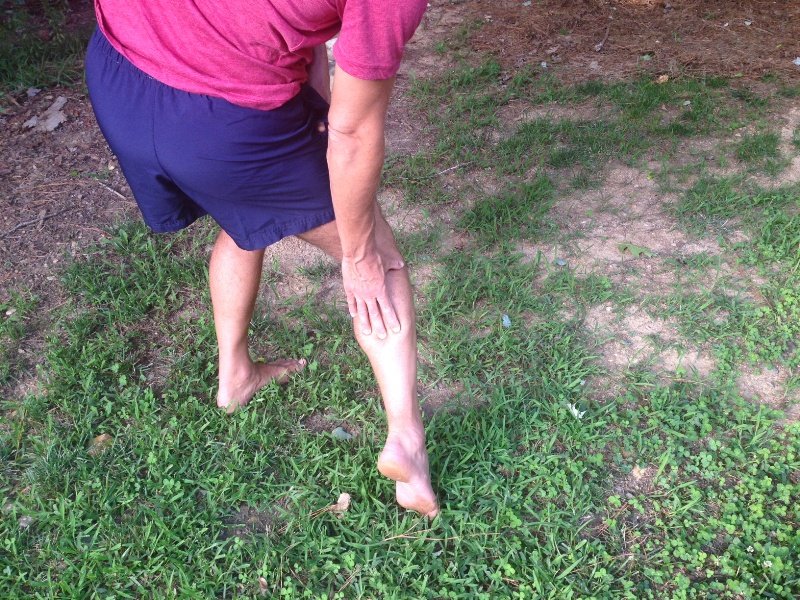
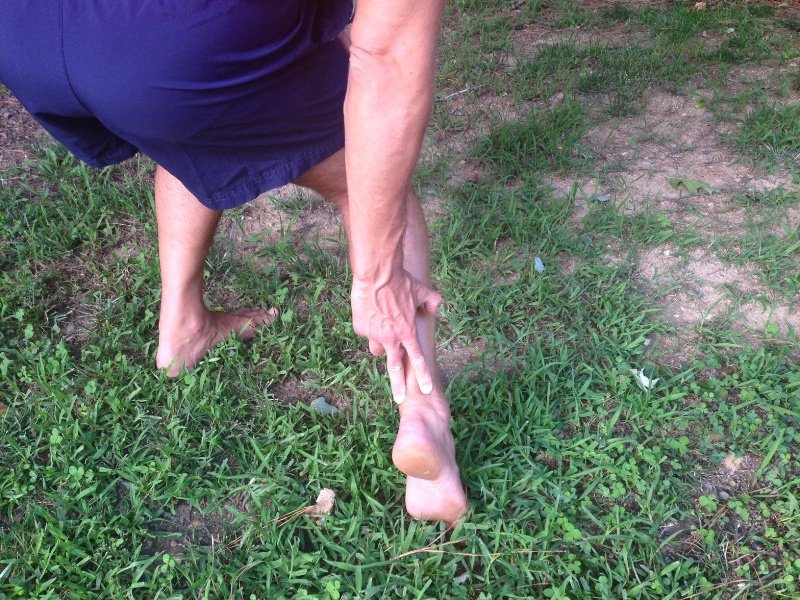
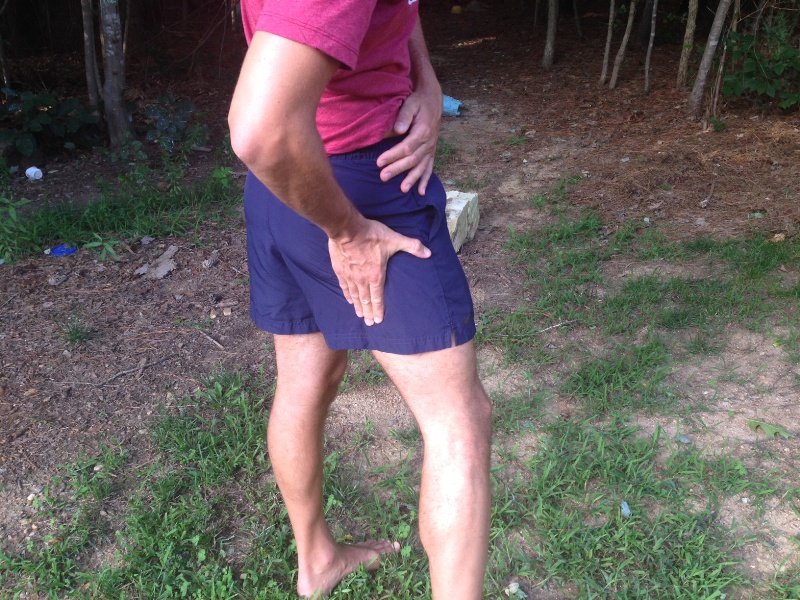
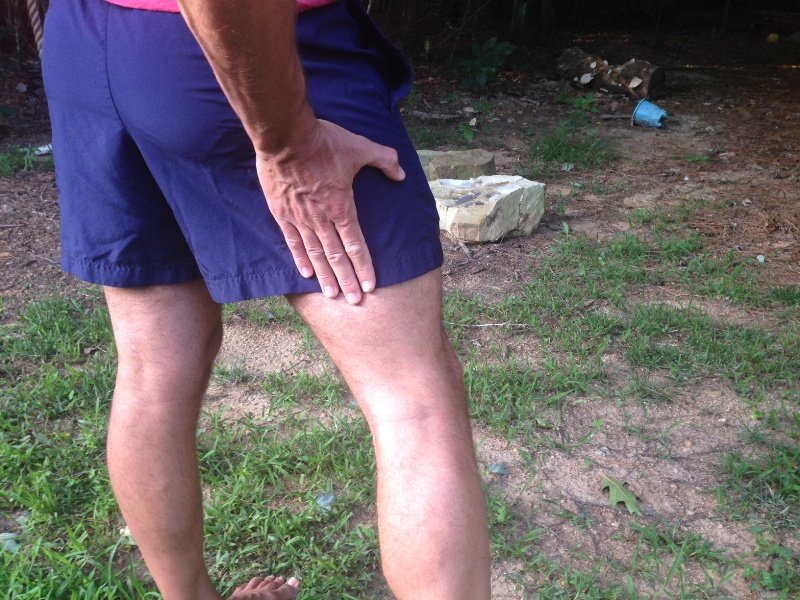
When the gastroc fatigues, which is very, very common in athletes especially due to its association with stress and adrenal gland function, the hamstrings have to work harder to take up the slack. This over-working of the hamstrings can cause a sudden tear or spasm resulting in pain and injury to the muscle. So although a hamstring may be injured, the gastroc must be treated aside from therapies to help diminish pain in the hamstring. Trigger point therapy around the origin of the gastroc as well as the lower belly of the gastroc right where it thins out and overlaps with the other calf muscle, the soleus, can be very beneficial. (* See photos #1 and #2 at bottom.) But again, as much as it may seem counterintuitive, you’re often better staying away from the pain in the hamstring.
Speaking of the soleus, athough this lower calf muscle primarily plantar flexes the foot, it actually has a huge impact on lower leg and knee stability. A failing (fatigued) soleus can result in a slew of problems, especially to the hamstrings. Trigger points are often found around the sides of the Achilles tendon as well as the just below the belly of the gastroc. (* See photos #2 and #3 at bottom.) Dig deep!
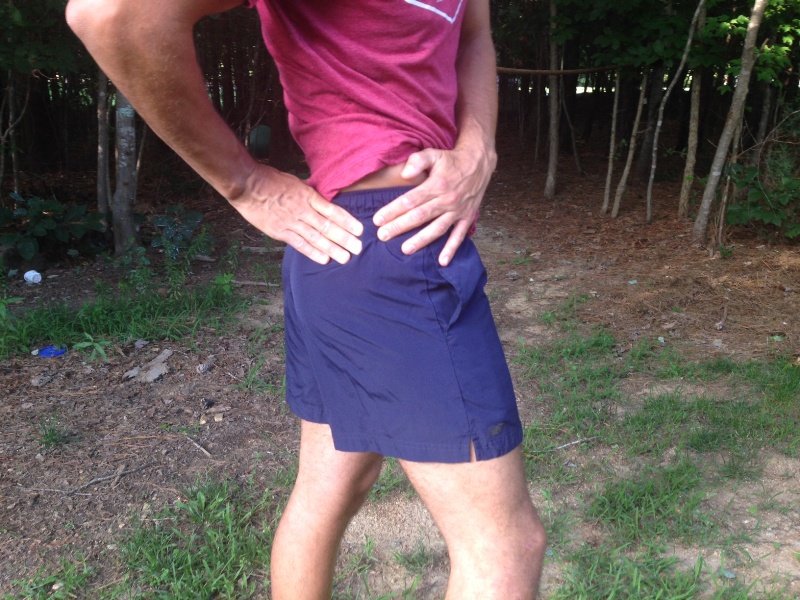
Let’s not forget to look above the hamstrings as that is where the meaty part of the glute max resides. The glute max, like the hamstrings, extends the hip. The fibers of the glute max extend deep into the femur and oftentimes this feels like a hamstring problem to many people. Like the calves, glute max problems are very common and usually what someone thinks is a hamstring pain because of the location is really their butt muscle. Again, trigger point therapy around the origin, (the upper pelvis as shown in photo #4 ), and the mid posterior thigh, (as I show in photos #5 and #6), can work wonders.
Pelvic Instability and the Psoas
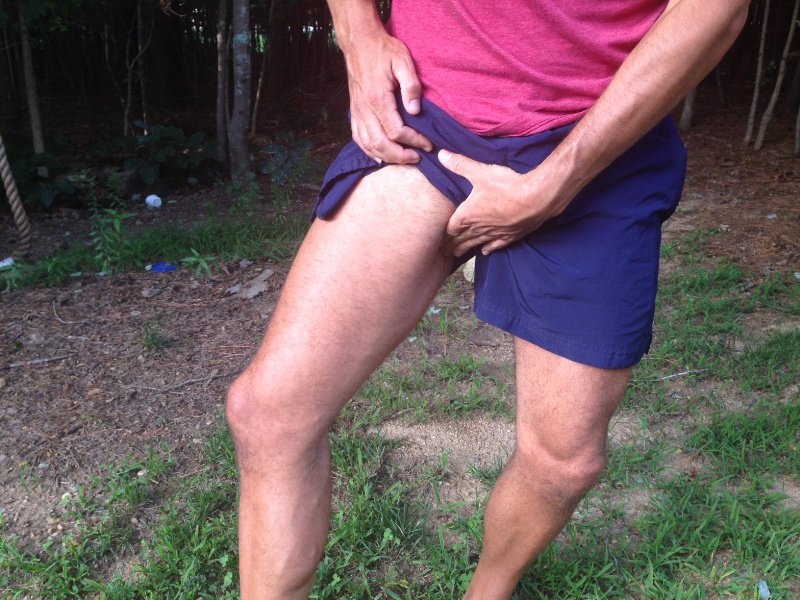
Pelvic instability can result in the hamstring muscles functioning improperly and eventually lead to pain or injury in the muscles themselves or other pelvic muscles. But, like the glute max and the gastrocs (and soleus) involvement with hamstring-assumed problems, there is another muscle that can feel like hamstring pain even when it isn’t. This muscle, the psoas, is a major flexor of the thigh and interestingly enough it attaches to a small little eminence called the lesser trochanter which just so happens to reside on the upper backside of the femur. Hey, the hamstrings go right over this insertion point! As I show in the photo, you have to sort of dig deep and hook your fingers up the back inside of your upper thigh to get to this area, and it’s often very sore. (* See photos #7 and #8 at bottom.) Probably not a great idea to do in public.
Since the hamstrings and glute max extend the thigh, an injured psoas, a thigh flexor, can cause more strain to the back of the leg as these muscles work unopposed. Psoas problems are very common as many athletes have poor pelvic stability, low back issues, and breathing and posture issues all which rely on a fully functioning psoas.
Gait and the Hammies
Gait plays a huge role in the function of the hamstrings. Many times I have had to correct a shoulder girdle related muscle on the opposite side of the painful thigh as the shoulder-hip balance is compromised. This gait association is very common and neglected in patient assessments. I see the shoulder girdle to be the most undervalued joint(s) of the body; they’re often injured without the athlete knowing because there can be little to no pain. Yet, the shoulder throws off the gait and the hip is affected, and soon the hamstring. Poke and prod, ice and heat, ultrasound and E-Stim the hammies all you want and you will go nowhere.
This is not to say the hamstrings are not important. Of course they are. They are just way too implicated when it comes to injuries. I’d estimate that of all the “hamstring pain” and “hamstring injury” that show up in my office 49% of them are not the hamstrings and 49% are effecting the hamstrings function but stemming from another source. That final 2%, (that’s being generous), is actually a hamstring problem and a hamstring solution, (meaning that therapy to a hamstring muscle is necessary).
Of course don’t be a dummy – people really do tear these muscles and in extreme cases they need to be surgically repaired. But for most, both the patient and doctor, evaluating and treating where the pain is felt in the hamstrings is an effort that will only delay healing and result in other imbalances the longer the problem goes uncorrected. So look above, look below, look behind, and look to the shoulder girdle – but don’t waste too much time on your hammies because chances are they’re not your problem.


Dr. Stephen Gangemi "Sock Doc"

I'm a board-certified chiropractic physician and clinical nutritionist with a passion for true natural health care. I implement dietary & nutritional therapies, exercise & movement practices, and lifestyle changes along with manual therapy techniques to help the body heal and prevent illness and injuries.
Bobbie Jo Hunter says
Thank you for your clear explanation. I appreciate your expertise as well as your generosity of spirit.
Nancy Ouding says
This is great. I wish you worked near by.
Geoffrey Greene says
How would you recommend to best condition these above/below to protect these biomechanical issue from arising in the first place?
Sock Doc says
Follow the Sock Doc Training Principles. Eat well. Recover well. And train naturally – run, jump, crawl, etc…
Louie says
Thank you for this great article. I have been having hamstring soreness for the last few days which was preceded by adductor pain. After reading your article I am guessing I have a psoas issue and / or pelvic instability. I know have a place to start to get back running. Thank you.
Joe B says
Mah man! You seriously know your stuff, it is a shame that there is not many professionals like you. If I have a sore hip from years ago from wrestling practice… Can this hip problem be naturally cured from building my aerobic base over time? Or does it need professional tweaking/cracking?
Sock Doc says
Hard to say. Depends on the injury. Typically you can’t build and aerobic base to heal an injury but you need to address the muscle imbalances via the trigger points and sometimes other therapies.
André Cruz says
Great explanation.
I have a pain on my knee, let´s see what the doctor will say.
Tks for sharing.
laura` says
What about sharp pain where the hamstring inserts on the sit bone. Could not run for a few weeks. Just back at it 3 miles or so with residual soreness in meat of hamstring
Sock Doc says
Common spot to have some hamstring tendonitis or bursitis but again, as I state in the article, the hamstring is stressed due to other imbalances. So focusing on your sit bone (the ischial tuberosity), will typically bring you short term relief at best.
Rob says
Great stuff as usual and always helpful—and very timely; thanks! also struggling with pain in the sit-bone area. i can run generally comfortable but hills/speed put a strain in that area. what other areas beyond the ischial tuberosity should i look at? psoas seems ok; maybe not??? adductor magnus? it doesn’t get worse and it doesn’t get better…only feels sore when riding in the car or sitting for long periods….help???
Sock Doc says
Piriformis typically the issue when you have pain there sitting prolonged. There is a SD video on this.
Rob says
fantastic; thanks and I’ll take a look. I wish you worked closer to where I live (RI)!
Rob says
brilliant; thanks!
George Hadjikolev says
Hello.I am 19 years old and im training athletics for 3 years.Four months ago i was doing exercises with weights for power of ankle.Suddenly the next day i felt a pain in the achilies tendon and i realised i have done something wrong so i gave myself 3 days off training.After 3 days when i went to the stadium and start training i felt better but there was a pain which i felt again in the achilies tendon.The next day the pain got bigger and after 2-3 days i couldnt run anymore cuz of this pain.So i decided to go to the doctor after a week of trainin with this pain.He told me i have inflammation of the achilies tendon and i should give myself at least 20 days break in order to recover.He told me to buy Perskindol Cool gel and to use it on the tendon for faster recover.In the first days when i was waking up in the morning i felt some kind of little pain in the tendon but only in the morning and after 2-3 hours the pain dissapeared.This continued 4-5 days and after a week of none training i really felt better and the pain dissapeared.When these 20 days past i went to my doctor again and he told me im recovered and ready to train again.I was verry happy.The first days at training i didnt felt anything.But after 3-4 weeks i started to feel pain before the warming up.After i started warming up the pain dissapeared and i was feeling great but after 4-5 hours after training i feel the pain on the achilies tendon.This thing countinued about 3 weeks when our competitions finished.When i started touching my achilies tendon i felt pain but when i was running and after the warming up i was feeling great but i realised that the inflamattion was not fully dissapeared.Now we are in 2 months break and i feel the pain too.When i started running faster or making sprints the next day i feel big pain in the tendon especially in monrnings when i woke up.Please give me some advices what to do with this problem and if you could explain me what i suffer is it inflammation and can this inflammation get to achilies tendon rapture becouse i really want to run without this pain.I hope you have answers for this and i will be very grateful if you could help me.
Sock Doc says
Check out the Video on Achilles Tendinitis as well as the First Aid Series where I discuss inflammation.
Kelly S says
Hi Sock Doc! I am truly enjoying your site. I was wondering, do you have any doctors you recommend in or around Houston, TX? My story is long and I will not bore you with details, but I need to see someone like you!!! I am a group fitness instructor and runner (well I have not run since Easter). I am continuing to instruct, but I am in pain…daily. Last spring I had a corneal abbrasion due to an accident, my entire body tightened up. During this time, I tried to gently stretch, etc. (which had I followed you sooner, I would not have done!) I strained my calf, landed in PT, etc. I continued to feel awful. I kept telling my docs I felt like I was hit by a bus. The word “overtraining” was tossed around. Now months later, my calf, ankle, knee,foot and hip are still a mess and due to feeling so bad and other symptoms, my doc ran a panel and I am hyporhyroid. It is like a switch was flipped and I went from a truly healthy athlete with little to no issues to a true mess. I have the diet part mastered, working on strengthening my feet, ankles, hips and glutes, but things are still not right. I have seen two orthos, a PT, my OB/GYN and now an an Endocronologist. Wish you were closer! I miss running desperately and love instructing, but it is a daily struggle. Any recommendations on who to see in Houston? Thanks!
Sock Doc says
Sorry I don’t know anyone down there in TX.
Kelly S says
Thanks for the quick reply. I might need to take a trip to NC some time!
Nathan Reid says
Did the photos at the bottom get taken down? I don’t see them and I’ve tried using a couple different browsers.
I just found this article (and your site!) and I’m very interested in seeing these photos as for ages I have had “hamstring” issues that I have been unable to resolve.
Thanks!
Sock Doc says
Thanks for letting me know that. It’s back up.
Gabe says
Hello. I have an recurring issue with my right leg when running. During harder efforts or later in my run I have what I would call muscle failure in my right hamstring just above my knee. Sometimes if I slow down it will go back to normal, but other times my right glute and hip flexor will tighten up from over compensating. I have had issues with over striding(more so on the right), and over rotation of my trunk due to poor arm movement. I’ve been working for at least six months to improve my form, and the issue doesn’t occur as frequently as it used to, but it still happens. I should also note that it usually only happens on road runs. Could there be something I’m missing, or do I just need to continue doing these things?
Sock Doc says
Something like this you should should have checked out by a qualified doc/therapist since it’s been reoccurring.
Josh says
Hi Doc! I am having symptoms of “Snapping Hamstring” on the medial side of my right knee. It seems to be caused by the semi-t and semi-m tendons getting pulled over the fibular head.
Any advice?
Sock Doc says
Check out the adrenal article series on this site.
Lexie says
Hello Gangemi,
About 4 weeks ago, I was performing a power clean, and I felt a pull in the right glute/lower back area. I tried playing basketball later that day, as I felt it loosened up. But then at one point my right side gave out. I rested for a few days, and then started with light activity. I would notice my leg was still very weak. And for about 3-4 days my quad was continuously muscle spasming. Now I have no pain but my leg is extremely weak and I feel there is quite a bit of atrophy. It seems as though I can not get the muscles in glute/ham area to fire or activate, thus causing my quad to be weak as well.
What do you feel would be a diagnosis and possible plan to recovery?
Thank you for your time>
Dr. Stephen Gangemi "Sock Doc" says
Probably best to have someone check that out for you since you see some atrophy. Most likely there is some body work needed to be done there. Sounds like you tore some tissue to some degree.
Sara says
My main pain is in the high hamstring, right where it connects to the bone. Sitting on hard surfaces for a long time is impossible. I do also have some pain in the lower hamstring and sometimes on my left hip. I am an avid hiker in the mountains of NY. My muscles are incredibly tight all the time, I am seeing a massage therapist, and she sees them getting better then worse, a back and forth. Any suggestions? My chiro wants me to get orthotics.
Dr. Stephen Gangemi "Sock Doc" says
My suggestions are to look elsewhere, as the article discusses. 🙂
Bob says
Hi! Great article! I get stiff in the area on the two last pictures (psoas 1 and 2) from time to time and I am wondering how to fix it so it never comes back? Mobility issue? Hope for an answer. Thanks so much for all the info on this site.
Dr. Stephen Gangemi "Sock Doc" says
Check out all the videos I have for injuries, specifically psoas.