 Consult with
 Sock Doc Workshops
Nobody wants to be injured and if you’re injured you obviously want the injury gone as soon as possible. Properly treating an injury involves more than just looking at the symptom, which is usually where the pain is felt. You have to understand why you’re injured to properly assess, treat, and prevent that injury and any other injury from occurring again and that can sometimes be hard to figure out on your own. We live in a symptom-based treatment world which relies on outdated, unproven, and often harmful therapies. Combine this “professional” help with the loads of advice out there, (yes, including Sock Doc advice), and you’re left with wondering what to do and who to trust.
One of the most common questions I receive is from an injured athlete asking me what they should do for a certain injury. So many people are injured though the majority of them can be avoided. Of course there are exceptions such as accidents – sudden trauma to your body maybe from tripping over a rock while running or some jackass taking your flag football game way too seriously.
Ideally what you should be doing for any injury you ever sustain are some specific therapies and lifestyle adjustments which are individualized for you and only you. That means your plantar fasciitis may need a trigger point addressed on the back of your upper leg and you may need to change your training by easing off the anaerobic workouts. Someone else with the exact same symptoms may have a trigger point by the arch of their foot and they need to change their running shoes. Another with the same injury may not even have a trigger point but their foot pain, though the same as yours, is a result of four cups of coffee a day and working twelve hours, six days a week.
But of course we all can’t have individualized treatment. So the information I provide here, which of course is typically the opposite of what many are told, is meant to cover the most common findings which are present when there is an injury as well as assessments and harmless treatment options you can try yourself. In my office, there’s a whole lot more I do when I see someone with an injury; but I also use the very same therapies and principles I discuss throughout the Sock Doc site.
So you want to take care of yourself, and use the advice of others as you see fit. Of course you don’t want to be foolish and end up trying to assess and treat your own injury only to realize weeks later you had a broken bone or something even worse the whole time. But it also doesn’t mean that if you turn an ankle you run over to your hospital to have an X-Ray, CT scan, and MRI lined up the next day.
The point here is to be smart about your injury and think about why you got injured and what is going to make the most sense to you and given your situation. I’m not here to convince you of anything; I’m sharing ideas, knowledge, beliefs, and experience gained over many years. You can take or leave anything on the Sock Doc site. But if you choose to learn this different approach and give it a go, you have to give just more than a “try”. This isn’t some program where if you don’t get better in a day or two then you head back to your old ways. Regardless of how you respond, I encourage you to consider and learn perhaps controversial and unorthodox methods for the prevention of injuries.
Conventional vs. Natural Methods: Risk vs. Rewards
The natural assessment, treatment, and prevention principles and therapies which I discuss come with zero downside risk, that is as long as you’re doing them correctly. In other words, if you’re working a trigger point on your Achilles tendon and it’s becoming more and more inflamed then that is a problem. But if you’re doing such a thing then you’re not only doing the therapy wrong, (as I often say stay off the injured area), but you’re also not listening to your body. You should either see improvement or at worst no further increase in symptoms when applying any therapy. Some next day discomfort, but not pain, is sometimes normal and expected.
Conventional therapies come with risks. The common “go-to” methods of stretching, bracing, icing, and drugs such as NSAIDs rarely, if ever help. But many (most) continue to use them despite the fact that they often cause more harm than benefit.
Some will tell me they feel better stretching but that’s often because it’s providing mechanical stimulation to the area of pain and temporarily damping that pain. It’s not correcting anything and actually will delay healing. Same goes with ice – it’s great for pain reduction but not if you want waste products removed and healing nutrients and blood circulated to the injured area. But we love to ice and stretch. Think you’re an exception to this rule? I don’t.
And of course many take the anti-inflammatory drugs every day or for every injury. These are still provided in many major races (often endurance type) despite the fact that we know of their impact to health. Not only will they tear up your gut perhaps to the point where you have fecal bacteria in your bloodstream but they slow down connective tissue repair. But if your diet is less than ideal and thus provoking inflammation then you’ll feel better when you take your NSAID, that’s a fact. If you choose to make some lifestyle/dietary changes and figure out the problem then lasting results will follow.
Minimalist Footwear? Conventional Footwear? Barefoot? Orthotics?
How about the minimalist footwear idea or going barefoot – is that for you? That depends on you. The sole reason I wrote “Healthy People = Barefoot People” is so athletes can understand the relationship between their feet, footwear (or lack of), and health.
Should you wear a more supportive shoe when you’re injured? It depends on your injury. Someone may need less of a shoe to help them recover from an injury while another may need a bit more. It’s not uncommon for a little bit more heel in a shoe to help relieve an Achilles tendonitis issue; many have created such a problem by going the minimalist route too quickly. But also know that if you’re feeling much better always wearing a shoe that provides more support that doesn’t mean you just wear it all the time and never work your way to more minimalist. You’re not correcting the problem if you’re in that situation.
How about orthotics or even some sort of heel lift or arch support – do you need them? I can’t personally tell you what you need or don’t need but I can tell you that they will never correct the problem. Sure there are cases of acute trauma to the foot and a temporary orthotic brace may help relieve the pain and start the healing process. Though think how often someone is put in such a device for only a few days or weeks. Very rarely. Some doctors believe in the necessity of orthotics with specific injuries and for their “aging population”. None of this changes the fact that while orthotics may provide some relief they aren’t healing the problem or figuring out why the person is unable to function without such support. Instead of relying on orthotics, figure out the source of the problem so you can move unassisted again, regardless of age. Find me a truly healthy person in orthotics and I’ll reevaluate my position.
Look at the Bigger Picture But Focus on the Problem
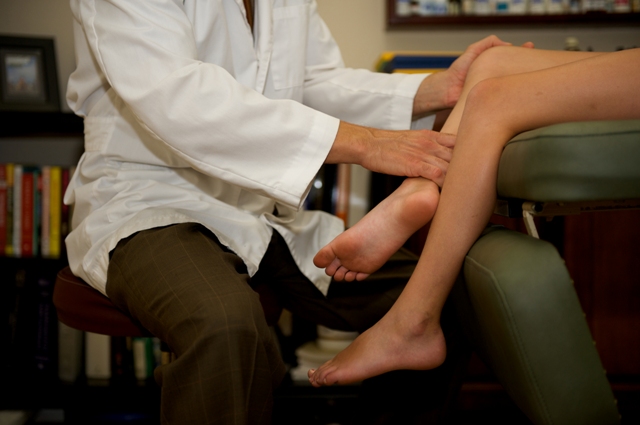 When you’re injured it is fine and helpful to treat it symptomatically to some degree to lower the pain quickly, but you need to go further and figure out why the injury has occurred and that’s a much bigger picture. Sometimes it’s an easily solution – say if you have been wearing the wrong footwear. But often it’s much more than that. Lifestyle stress, dietary inadequacies including poor food choices, and training problems are often either the reason you’re injured and/or not recovering. These are also much harder to figure out on your own and address and sometimes it takes more than just eating “Paleo”, more aerobic training, and lowering stress at work.
When there is an injury there are always muscle imbalances. Not sometimes – always. In my office I am constantly evaluating, testing, challenging, and treating these imbalances to figure out the best approach to an injury while correcting other problems along the way. So since you can’t provide such detailed service to yourself you have to try the general (though they can be very specific) applications of such therapies as I show in the videos and discuss throughout the site.
Sometimes I am told that someone isn’t improving with the “natural” approach because they’re also still doing other conventional therapies at the same time. This combined effort often doesn’t help. If you’re still wearing that night splint to stretch your plantar fascia and wondering why the trigger points or other non-invasive approaches aren’t helping, well improvement is probably not going to happen.
Seeking Professional Help: Choose the therapist, not the therapy
As most of you know, I answer each and every question on this site personally. There is only one “cut and paste response” I have written which I use. It is this: “As I often say to people – ‘Sometimes you just gotta be treated by a doc or therapist who looks at the entire body from a structural, nutritional, and emotional perspective and understands how everything is interrelated and attributing to a health issue or injury. Although there’s not a lot of “us” out there, that’s your best bet. A good doc will be able to get you back in a very short period of time and if not, at least explain why it may take longer.'”
So ask around and do your own research when it comes to your health. Look for an individual – a physician or therapist – who shares a similar philosophy and approach to health and fitness. If you’re focused on a title or a bunch of letters after a name, you probably will not have much luck; (though the guy at the gas station giving foot rubs is probably a bad idea). The best advice I can give you when seeking someone out is to see how much time that person spends with you and actually listens to you. If it’s only a few minutes and more of a question and answer session (they’re asking the questions) and not a conversation especially one that at least goes a bit beyond your chief complaint, then probably a good idea to look elsewhere.
Finally, and this is the part nobody likes to have to face – don’t go to a doc or use some therapy just because your insurance pays for it. Yeah I know it sucks that health insurance pays little if any for real “health care.” It’s like auto insurance – it doesn’t pay for your maintenance, wear and tear, or when you break down. Yeah you should have a doc available when you need to see him or her for an ailment but if you’re going to someone just because they take your insurance it’s often a bad idea. The same goes for therapies. Would you pay the $300-$400 out of pocket for those orthotics? Would you pay hundreds of dollars for a cortisone shot or PRP injection? How about a couple thousand bucks for that MRI? Don’t use it just because it’s “paid for”, it’s the wrong approach. Not to get into the whole insurance debacle out there, but you, I, and everyone else are paying for it somewhere down the line – premiums don’t jump every year for no reason. A good doc or therapist may cost you but a bad one will cost you more.
Educate yourself.
Take care of yourself.
Seek help when you need it.
Always listen to your body.
Dr. Stephen Gangemi "Sock Doc"

I'm a board-certified chiropractic physician and clinical nutritionist with a passion for true natural health care. I implement dietary & nutritional therapies, exercise & movement practices, and lifestyle changes along with manual therapy techniques to help the body heal and prevent illness and injuries.
Nitin says
Hi doc :),
This is way off topic I’m sorry for that.
I’m 24 male from India, I’ve went through almost all of your articles. I want to build my AEROBIC BASE but I can’t afford an HR monitor at this time seriously I can’t !!! got a lot of shit to take care.
As for my fitness background till the age of 16 i was very active kid I played for my schools field Hockey & Basketball team, I also used to play a lot of Football(Soccer) with my friends, basically i was playing or running around atleast 6-8 hours every day
After 16 I went onto play semi professional cricket for 3 year which involved a lot of anerobic work every day almost 4-5 hours it also involved a lot of aerobic work too.
Then from 19 to 22 came a very very stressfull period in my life it almost broke me down. But even in those days i was working out very hard 1-2 miles fast running lots of sprinting after that lots of pushups & 1 hour of weight lifting all in a day, every day of the week for full 3 years!!! Basically very anerobic life.
After that I got Typhoid infection got treated with very harsh antibiotic for a full month.
Since then I’ve not had a consistent workout routine sometimes doing absolutely nothing for 5-6 months.
I’ve started working out again & I’m basically running 1 mile every day & some sprints after it but i feel I’m inly working my anerobic system. Cause running with correct posture I end up running a bit too fast for my body 6-7 min a mile..
So please can you suggest a way to build my aerobic base effectively so that i don’t end overtraining my anerobic system(cause during those stress years i had low immunity) even now after a hard day i feel kind of feverish.
P.S. sorry for this long post :).
I am not looking to run marathon but want a good health & fitness. Please Helppp! !
Also is milk not good for our health as I’ve read somewhere it hinders absorbtion of calcium & slows digestion. I’m not allergic to it & have been drinking it a lot all my life.
OH GOD I’m a long writer register me for writing marathon 😉
Sock Doc says
Check out the Training Principles (https://sock-doc.com/2012/01/sock-doc-training-principles/) and basically w/o a HR monitor then you have to use something like the “talk test”. That means if you were/are running with someone then you should be able to talk to him/her comfortably for at least a sentence or two without having to stop and take a breath.
Ken Bradley says
Hi Doc
I am 67. Used to be a sub-3 hr marathoner up to my early 40’s. I still work out about 3-4 days per week – weights and elliptical. I can’t run any more. I developed peripheral neuropathy about 3 years ago that started at the bottom of my left foot (I thought it was a neuroma) and then spread to both feet and now up to my ankles. Shortly after it began, I lost the ability to dorsiflex my right big toe, although I have regained that function. Also numbness and pain beginning in my hands. No one can seem to determine the cause. Diagnosis – Ideopathic poly-neuropathy. I am not a diabetic nor am I an alcoholic. I have gone to several local neurologists and even to Mayo Clinic. I have constant burning, pain and numbness in my feet. I stopped taking the meds recommended about almost 2 years now and I just deal with it. I have tried all types of dress and running shoes. The minimalist shoes with 5 toes seem to help and protects my feet somewhat since I cannot feel sharp objects until they press further into the foot, such as a stone. Any ideas or suggestions? Thanks. Ken
Sock Doc says
Usually this is a metabolic issue of some type rather than a physical problem. Really hard to give suggestions on this one via a comment; need more history info. I’d be curious to know though if you had a Hemoglobin A1C done.
Ken Bradley says
No Clue what Hemoglobin A1C is. Is that something I can get done at a local lab?
Sock Doc says
Yes – that tells you the percentage of what is called glycosylation, in this case your red blood cells exposure to glucose. This, in my opinion though I’m sure many would agree, would be a priority to have run to see if your neuropathy is being influenced by high glucose levels. Actually it’s a marker of diabetes too.
Ken Bradley says
I had so many tests including a Glucose Tolerance Test, that I would hope this Hemoglobin A1C test was done, although I don’t know for sure, so I will go to a lab and get it done for sure. What are normal levels? I also had Nerve conduction tests and there were significant deficiencies there as well. I have been off pain meds for a few years now and I have learned to tolerate the burning and pain, but it is my constant companion 24/7/365. About a year ago, I started taking a high dose Neuropathy Formula B1 (Benfotiamine), B12 and Alpha Lipoic Acid (NeuropathyTreatmentGroup.com) My feet were very muscular prior to the neuropathy and since the neuropathy, the musclature has atrophied siginifcantly and I feel like I am walking on bones. Very frustrating for an athlete. Other than the neuropathy, physically no one could tell by looking at me. I am 5’8″ with a muscular build at 185 lbs with not much abdominal fat. At my peak of running at about age 40 I weighed about 160. Since I can no longer run, I spend more time with the weights and the elliptical machine and in the warm weather I swim laps as well. It sure would be great if I could figure out a way to get rid of this neuropathy. I am concerned that there is irreversible nerve damage at this point. What about HGH and/or stem cells?
Sock Doc says
GTT are old tests that are used for hypoglycemia. Really unnecessary and very impractical test.
Normal A1C levels are <5.7% though ideal is <5.4%.
Not sure on HGH for this or stem cells.
Ken Bradley says
Got Blood Work Results back. Hemoglobin A1C is 5.3. Fasting Glucose 97. Lipid Panel: LDL 186 (H). HDL 45. Triglycerides 87. The only other (H) was in the CBC: Absolute Eosinophils 1296 (H). (I have had allergies my whole life). Complete Urinalysis All tests normal.
I was on Lipitor for a number of years for the high Cholesterol , but stopped 2 years ago as the Neuropathy symptoms got worse. I only take Lisinopril/HCTZ 10-12.5 Mg Tabs 1X per day.
I have a very good diet. No Junk food. No soft drinks, no artificial sweetener, moderate alcohol – 1-2 glasses of red wine maybe 6X per month.
I am from a very large family and there does not seem to be any family history of neuropathy. 9 siblings, 2 children, 8 grandchildren and 4 great grandchildren. There is some type 2 diabeties and heart disease in later years, but hopefully my lifestyle will help me avoid that for many more years to come.
I guess I will get back to my former distance running weight of 160lbs (Now 185, muscular from weight lifting). Reduce weights and increase cardio: elliptical, bike and swimming. See if that works by reducing BMI. Maybe I can get off the BP Med by doing that so I will be taking no drugs except vitamins with some extra B and Alpha Lipoic.
I am very frustrated with this Neuropathy that majorily impacts my quality of life with constant pain, burning and numbness and limits my outdoor activities such as running, hiking, back packing, bike riding, etc. that I have enjoyed for many years. Most of my older relatives live into their 90’s, so it looks like I may have to endure this for another 25 years unless someone can figure it out.
It is especially frustrating since I have been doing everything right most of my life.
Of course there are many people who have much worse problems than I and I guess I should be thankful that I have been as healthy as I have been and enjoyed all the outdoor activities I have.
Any other thoughts or words of wisdom from the Maverick Soc Doc? Thanks. Ken
Sock Doc says
Need to figure out the eosinophil issue – most often an allergy.
http://www.neurology.org/content/38/1/144
And read this on cholesterol: http://www.drgangemi.com/2012/01/elevate-cholesterol-elevate-health/
Ken Bradley says
Thanks Doc. According to the Cholesterol article, the high Cholesterol does not appear to be a major concern. However, what I read on the Eosinophil Neuropathy link you sent and associated links is a little scary. My level looks pretty close to HyperEosinophilic Syndrome. Is this something they should have noticed at Mayo Clinic or the various Neurologists that I saw. The only diagnosis I have to date is Ideopathic Peripheral Neuropathy with recommended treatment with various drugs to reduce the pain, but with no treatment to reverse the cause. Where do you recommend I start looking for the underlying cause and treatment to reverse the nerve damage.
Sock Doc says
You’d have to look for a doc who understands that disorder or wants to help you investigate if that is perhaps what you’re dealing with, or if not, then the cause of the high eosinophils.
Neal says
Hey Dr Gangemi. Do you have any natural treatments for my plantar fibroma? If not, whats your best opinion on treating it?
Sock Doc says
Best advice I’d say you can do to check on yourself is to check in the entire plantar fascia area for trigger points, and particularly focus on the tibialis posterior muscle as I show in the Foot Pain and Plantar Fasciitis videos.
Sam Edwards says
My chiropractor firmly believes in the use of Rock Tape, and I’ve used it in several races and feel like it helped. What are your thoughts on the effectiveness of Rock Tape?
Sock Doc says
Not familiar with Rock Tape, so I can’t comment.
Neal says
So if there is a firm trigger point that is not visible is that plantar fibroma or plantar fibromatosis? And is it possible it can cause my second toe to be weak and painful?
Sock Doc says
No, that would not be the same thing. You probably won’t get much working out the fibroma area. But yes it could cause the 2nd toe pain.
Bengil says
Hey Dr. Gangemi. I need your help. Im having trouble curling my Second toe all the way. It seems too weak or as if somethings stopping it. It curls just about half way. All the other toes seem to curl fine What is it that you think I can do to?
Sock Doc says
Check out the Foot Pain Video and see if any of those points help with the toe. If not, you should have it checked out by a qualified doc.
Cindy says
Hi,
I am 54 yo female. Active athletically my whole life. For the last 15 months I have been experiencing pain in my lower back, hip, pelvic area….I think due to a strain in my inner thigh doing squats. I have pain when sitting too long or bending over deep in my pelvis on the same side. I’m wondering if I may have a hernia as bending over and holding in my abdominals and pushing down in that area relieves the pain.
Of course now it’s leading to problems with my hips and thigh and Achilles. You mentioned the pariformis might actually go through the sciatic nerve instead of under it. Could that be causing the pain in pelvis?
I have been able to run periodically, with pain afterward, but walking lessens the pain after about 10 minutes. When i stop walking, the pain returns. when i left my right keg to get into the car, i have to literally pick my leg up with my hand bc it is painful in the hip flexor area. It seems to come and go……..sports doctor maybe?
Thanks for any input.
Sock Doc says
Please read this; thanks!
https://sock-doc.com/sock-doc-questions-comments/
Samuel says
Hi Dr.Gangemi,
Im 19 years old and and I have been frustrated over my musculoskeletal problems that i have been dealing with for over a year. Do you have any fellow doctors who share the same stance and belief when it comes to overall body health you could refer me to? I live in the Bay Area, California. specifically the east bay.
Thanks for you Time
Sock Doc says
Sorry I don’t know anyone.
Neal says
Hey Doc. I have a slight labral tear in my hip. Do you think it can heal on its own or have any ways to treat it?
Sock Doc says
Depends on each circumstance and your health. I saw a guy today who had his (hip) labrum repaired in 2006 and he’s no better from it.
John says
hey Doctor G. I have a heel spur, any tips on natural treatment?
Sock Doc says
Watch the Achilles Tendonitis Video.
John says
Hey Doctor Gangemi. I have been using your philosophy on my injuries for a while now. I feel I have supination problems. Ive checked all the trigger points and they seem like there in good shape now with your help. I do have flat feet and a heel spur that does not cause heel pain along with a tight flexor digitorum brevis that I massage every day. My question is that is it possible that the heel spur can mess with the harmony of the biomechanics of my foot, and would that be an exception to wear Orthotics?
Sock Doc says
Please read this; thanks!
https://sock-doc.com/sock-doc-questions-comments/
Kathryn says
Hello, I have PF and my podiatrist suggested that Shock Wave Therapy may be a possible treatment. What are your thoughts about its effectiveness for long term healing? Thank you- I really appreciate and enjoy your website and mindset.
Sock Doc says
Please read this; thanks!
https://sock-doc.com/sock-doc-questions-comments/
Tim says
Hi,
I’ve been battling PF for 2 years and finally started to get some relief after I read some of your articles and watched some of the videos. I have started walking around the house in socks/barefoot, stopped using my orthotics, been doing lower leg strengthening exercies, and have been trying trigger point therapy on the inside of my tibia. In less than a week I already see a huge difference. I have a question about trigger point therapy. In general, is there a timeframe for when the trigger points begin to feel “normal” and there is no need to continue? I have been trying it for about a week and work on my tibia several times per day. I think the pain is slowly diminishing. I wondered if it ever typically goes away for good and how long it could take.
Thanks! I hope to be running again soon – working my way into Nike Frees…
Sock Doc says
Please read the Trigger Point Post. Thanks.
Yeh says
Hi Dr:
My right knee has some mild pain and it is not straight (about 15 cm off the straight line). I also was told that my left pelvic bone is a bit higher than the right, so my left leg is 1/2 inch shorter than the right leg and that probably had caused my right knee not to be straight. The right knee’s x-ray shows” mild tricompartmental knee DJD. Faint geometric calcifications in the intercondylar notch, suggestive of faintly calcified loose bodies”.
I found your website recently and stopped wearing orthotics for a few days now and I’ve been doing some toe and balance exercises according to your website for p.f and calf pain relieve on left leg. My question is: what should I do to straighten my right knee? I saw physical Therapist and she suggested I stretch my calf, hamstring, and lie down and prop my leg on a small roll of tower to force it straight – this seem to help straighten it for a short period but then the knee would go back to not being straight again. I am 52 yrs old.
Sock Doc says
Please read this; thanks!
https://sock-doc.com/sock-doc-questions-comments/
Conner M. says
Hello Sock Doc,
I was diagnosed (after a negative x-ray and tibial palpation) with a stress reaction about 3 weeks ago (medial portion of tibia, close to 1/2 way down. The reaction started as dull pain for about 2 weeks (while playing basketball) and then became more prominent (with throbs at night) and then more focal and I was able to point it out on my tibia. I am and have been able to walk fine with no pain at all (even 3 weeks ago). I have been cycling and continuing my regular upper body anaerobic exercises. I am occasionally wearing a walking boot if I know I will be on the feet for a while. I have done stationary body weight squats and body weight squats on both sides of the bosu ball, no pain. I have also been stretching out my calves. The doctor (a PT, sports specialists at a well-known rehab facility) recommended orthotics because he noticed i had flat feet, so i went and used a Dr. Scholls kiosk. I have been wearing the orthotics to work and to workout, switching them to different shoes. I am eager to get back to action and am just terrified of re-injury or worsening.
I am a very explosive basketball player and am right handed (land on my left foot alone often, after shooting) and make hard lateral movements (cutting, playing defense).
Are there certain exercises/ rehab I should be performing? What about a shin sleeve?
Every now and then I will notice a random throb on and around the area of my tibial reaction. Is this normal? Does this mean I should not try running hard yet? The throb is not painful, more annoying and worrisome.
Thanks for your advice!!
Sock Doc says
Check out the articles on this site about stress reactions/fractures as well as the shin splint article and video. And no, I wouldn’t call that “normal”, but common with the injury you are describing.
Conner M. says
Thanks for the reply!
Lax says
Hey. I suffering Achilles Tendon over one year long. Now I am pain free then how to start running safely please inform
Dr. Stephen Gangemi "Sock Doc" says
https://sock-doc.com/achilles-tendonitis-bump/