 Consult with
 Sock Doc Workshops
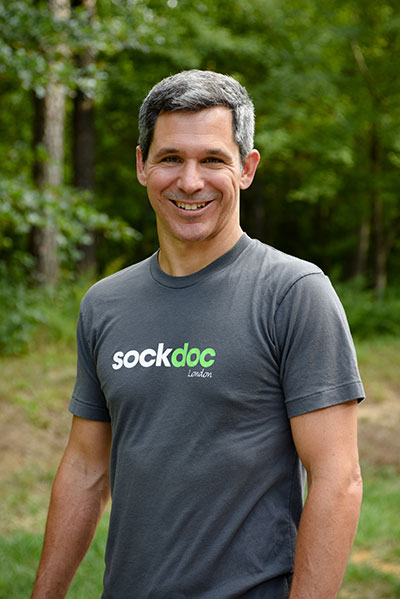 I launched this site in March 2011 to educate athletes about natural injury treatment and prevention. I also strive to assist athletes sort through various treatment therapies, fitness trends, claims, and products that they are bombarded with every day. The goal is to help every person live a longer, healthier and fitter life while becoming a faster, stronger and more efficient athlete.
The Sock Doc “Disclaimer”
Sock Doc is a thinking-person’s website. The views here are not your typical “the research says this” or “everybody does it this way” opinions that you will find on most sites. Although I find a lot of research interesting, my research lab is my treatment room. This is where, on a daily basis, I get to see how individuals are functioning or dysfunctioning, and determine how to correct and improve their health and fitness faster than most can comprehend. It’s 100% holistic. It’s mental and physical work. I’m not behind a desk recommending exercises or dietary changes based on simply what I have read in a research publication, and I sure as hell am not offering expensive, problematic orthotics, useless stretching, or conventional therapies that don’t work. My expertise is figuring out WHY a person has a health issue, how to correct it and then prevent it from happening again. If you’re looking for the same-old type of treatments or advice, you’ve come to the wrong place.
Why are you called the Sock Doc?
I am called the Sock Doc because I only wear socks or go completely barefoot in my office while treating patients. I don’t wear shoes as most all other doctors and people in general do all day long at work. Most warm days I’ll leave my house barefoot, drive to my office barefoot, and remain barefoot while treating patients.
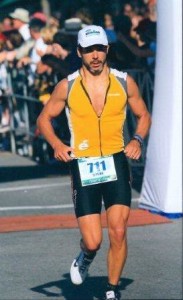
Sock Doc 2010 Ironman Coeur d’Alene
Are you really a doctor?
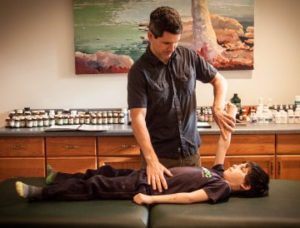
Yes, I don’t just play one on the internet. I am a chiropractic physician, but not the typical chiropractor you may have been to or heard of. I use various holistic methods to restore a person’s health and get them back on their road to fitness. I have been trained in the fields of functional neurology, biochemistry, acupressure meridian therapies, applied kinesiology, along with dietary and lifestyle-modification methods. I currently teach my health care protocol called Systems Health Care to students and doctors throughout the US and Europe. If you could sum up in a few words what I do, the most apt definition would perhaps be “complementary medicine,” or “holistic health care.” I don’t use the word “alternative” because for me, my family, and many of my patients, this type of health care is not alternative – it is the only one we follow. Merging functional neurology and nutritional biochemistry into mainstream natural health care is the essence of what I do. As a chiropractic physician, my interest is in the entire body – a body that is constantly changing from an infinite amount of external and internal stimuli it receives every day. Doctor means teacher. That is my job – to teach you how to live the healthiest life possible and sort through all the propaganda out there.
So you’re not a foot doctor, but what’s the big deal with the feet?
The Sock Doc is not just about the feet. It’s not even just about body structure or your muscles, bones, tendons, and ligaments. It’s about the health of the entire body and learning to listen to the signs and signals your feet, as well as the rest of your body, may be giving you to tell you how well you are or perhaps you are not doing. Healthy people have healthy feet. They don’t need a supportive, cushioned shoe. They can walk barefoot comfortably. They don’t need their feet rubbed at night, (although it is nice!). Health means different things to many people. Many people see their family general practitioner and are told during their annual physical that they’re healthy because no disease can be found. Yet they often can’t walk more than ten minutes without pain or having to stop to catch their breath. Many wake up every day with achy joints, need coffee to get going and then a drink or pill to get them to sleep at night. With the addition of other medications to keep their cholesterol or blood pressure “in check”,this is clearly not health. The World Health Organization states, “Health is a state of complete physical, mental and social well-being and not merely the absence of disease or infirmity.” Though I think it’s safe to say very few adhere to this definition; we’re a lot unhealthier than we think.
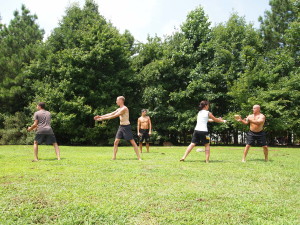
Sock Doc Workshop
Yes, I’m saying that if you’re taking any drug for any reason you’re really not healthy, despite what you’d like to believe. Sure, I realize that some people are on certain medications to keep them alive and others take them so they don’t kill themselves, or someone else. I am not against these types of drugs. The same goes for antibiotics and other similar medications that can get someone out of a crisis situation quickly in order for their health to be restored sooner rather than later. But don’t kid yourself – if you’re taking a pill to sleep at night, or one to help you get through the day, or one to alter your hormones or mood, or one to lose weight, or one to lower your cholesterol, or one to stop your heartburn, or one to relieve pain – you’re not healthy – despite what the man or woman in their high-clad shoes with the “Dr” in front of their name may be telling you.
Who are your typical patients?
The range of people who come to me for care include software engineers, professors, housewives (and their kids), professional hockey players, professional dancers, and athletes as well as coaches from both Duke and the University of North Carolina. I see endurance type athletes such as runners, cyclists, triathletes, and various other types of athletes that cross all ranges of abilities. Many of my patients travel from other states to see me in my office. Often I am the guy who they end up seeing after all the other conventional and usually over-priced treatments have failed. Read some coach and athlete testimonials.
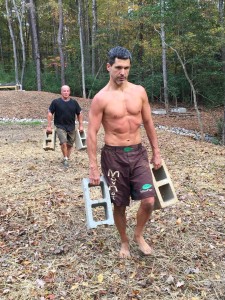 Why don’t you wear shoes?
The feet are the foundation upon which you rely on all day long. Each foot is home to thousands of nerve endings and the information they receive and then pass on to the rest of the body is anything less than extraordinary. When your foot feels the ground, (or whatever is below it, including any footwear), the thousands of touch receptors in the nerve endings feed back to the rest of the entire nervous system. Since your nervous system runs your entire body, any foot impairment, dysfunction, injury, pain, or improper footwear can not only hinder things such as your lower leg function and balance directly, but also your entire health. Yet so many choose to stand in shoes for eight to sixteen hours a day?
What is your philosophy and how are you different than other doctors?
I’m much more interested in the cause of the health problem or injury than just merely addressing its symptoms. I like to tell patients that what I am going to diagnose is their health process that has gone awry, and not just the symptoms they are experiencing as an illness or injury. For example, an aching knee might be due to something else taking place, distant to where the actual pain is felt in the knee. An imbalance in the muscles of the leg and foot could be the cause of knee pain in one person. For someone else, the knee hurts because of improper footwear. For another sufferer, the knee pain might be associated with too much stress from a poor diet and overtraining. Compared to conventional therapies which offer treatment of the symptoms via drugs, surgery, and physical therapy, the process of dealing with the cause provides a more effective, faster, and rewarding remedy. It is safe to also mention that approaching health in this manner is often much less expensive. You’d be surprised how quickly injuries and other health problems can be resolved when they’re dealt with on a cause-oriented, individual level. It’s a very patient-individualized practice!
 Why not just see a foot doctor such as a podiatrist?
If your foot hurts then a doctor as such is very skilled at looking at that foot and addressing only that foot. Typically remedies such as orthotics, anti-inflammatory medications, and certain therapies are prescribed, such as stretching. Despite the lack of evidence that any of these therapies adequately address the true problem (of the foot), this is still the way things are done in mainstream medical offices. Stretching may provide temporary relief to plantar fasciitis, an NSAID might reduce pain and inflammation, and an orthotic might lend support to any already dysfunctioning area, but none of these therapies will treat the root cause. When was the last time a podiatrist looked at your other (normal) foot? Or even perhaps more importantly, when was it that he or she examined the opposite upper body limb? Shall we talk about those 2” heel shoes you walked into their office wearing?
What is your own athletic background?
I have competed in 20 Ironman races and countless other triathlons, as well as road, trail, and bike races. I am a six-time qualifier and finisher of the Ironman Hawaii World Championship Triathlon. I’ve been an All-American Triathlete twice, in 1997 and 2004. Currently I’m focusing on trail running, natural movement and Original Strength training, and kettlebell training. With my experience in training and racing competitively for over 20 years, I have unique qualifications and insight as both a competitive athlete and a doctor. So yes, I talk the talk and I walk the walk.
How often do you get injured?
I’ve been injury-free since my Ironman career began in 1996. Not too many people have trained and competed in 20 Ironman races and can say they haven’t had one injury to speak of. I’ve completed 16 of those IM races – I dropped out of four during the run portion for reasons such as dehydration, conditioning, and just having a really bad day.
 Have you ever been injured?
Over 20 years ago when I started running competitively in high school, and then after I began racing triathlons in college, I followed the running shoe fads and wore whatever over-supported shoe promised to make me run faster. I was a heavy heel striker, quickly destroying the back of running shoes, moving onto a new pair every two to three months. I overpronated, or so I was told, so custom orthotics and shoes with motion-control devices soon filled my closet. Then along came the injuries, which I was often told was what all athletes get – “It’s normal and to be expected.” I had ITB frictional syndrome, shin splints, heel pain, heel spurs, knee pain, side stitches, and so on. Taking ibuprofen and using DMSO was a daily ritual, until I got tired of people not wanting to be near me due to the distinct sulfur smell of DMSO reeking from every pore of my body. Rotten milk and old lasagna don’t make a great deodorant.
But then around 15 years ago while I was still in college, I got interested in racing flats – really the only minimalist shoes back in the mid 1990s. I wore flats from Nike and Saucony because they were light, and the thinking was that lighter shoes made you faster because you were carrying less weight, not because I knew there was any injury connection. Soon I would realize there was more to running than just the shoe’s weight. Wearing them in 10K road races and the 10K part of the Olympic-distance triathlon was not all that uncommon, but when I started wearing them in the longer races, such as half-marathon distances, I was warned by coaches that I had better be careful.
Around the same time, I also began using a heart rate monitor, and not just wearing it to see how high my heart rate could get but actually using it to train and recover properly. I remember wearing it shirt-less during my days training under the hot Miami sun – the strange looks I received from others was common. The mold that grew on the transmitter back then if you didn’t clean them well was enough to make some people within a few feet consider a Hazmat suit.
Interestingly though, the injuries started to subside. Not only that, but new injuries didn’t appear. I was getting faster and able to train longer and harder, eventually moving my way up to racing several half-Ironman distances each season. I soon qualified and raced in the Hawaii Ironman in 1996.

I teach sans shoes at professional conferences
Should I go barefoot or just wear socks in the office like the Sock Doc?
Is there a sign at your office saying “Shoes Required”? Probably not. At least kick them off at the desk. It doesn’t matter if you’re a runner or not, because you were born to be on two [bare] feet, not in high heels or motion-control devices. I’ve promoted going barefoot for years. It’s one of the things I advise most patients to do whether their ailment is in the foot itself or elsewhere, such as in the knee, hip, lower back, or even neck or shoulder.
Who can benefit from going barefoot? Everybody. And not just multi-sport athletes and runners. Who can benefit from wearing built-up shoes with supportive devices and extra padding? Very few, and only perhaps to get them out of short-term crisis mode. Your nervous system runs your entire body, therefore going barefoot can not only improve lower leg function and balance, but your entire health.
How quickly do you get people healthy and back into their exercise or racing routine?
There’s no magic pill to your health program. It takes more than a few hours a week and you don’t get to eat anything you want all day one day a week because you need to be rewarded. It’s a lifestyle change, one that you will always reap the rewards from – that of good health. Yes it takes consistency and commitment, because nobody ever got very far and stayed there on minimal effort. But it doesn’t mean that it’s difficult. It’s not a wheat grass diet and walking barefoot to work in the snow type of exercise program. It’s a lifestyle change – a lifestyle adaptation. That being said, it’s not uncommon for someone who has been dealing with a health issue or injury for years to see dramatic (and permanent) changes after a very short time – often within the first or second appointment.
How can I set up an appointment or ask you questions about my health problem or injury?
Feel free to post your question as a comment under the appropriate post section. If you have a question about shin splints, simply ask it as a comment under that post. See here for office appointments and phone consultations with me.
Do you know of a doctor in my area who practices similarly as you do?
Over the past year or so I have begun teaching other doctors how to utilize my assessment and treatment protocols. Like myself, their background is in chiropractic. They follow my philosophy of truly holistic health, an organic and often Paleo-Type diet, and a minimalist/orthotic-free lifestyle. I am (slowly) updating the Systems Health Care doctor referral list as a train and certify these individuals.
Do you have a real name?
Yes. Sock Doc is not on my driver’s license. It’s Stephen (Steve) Gangemi and you can learn more about my practice as well as a lot more information about health and fitness that is not contained on this site by heading over to my other site, drgangemi.com. For healing-arts practitioners interested in learning Systems Health Care, check out the site!